The Architecture of Guanghua Temple: How to Read a Chinese Buddhist Temple
A Chinese Buddhist temple is more than a collection of halls, statues, and courtyards. Its architecture reflects centuries of religious thought, cultural traditions, craftsmanship, and the relationship between people and the natural landscape. A gate marks a transition, a courtyard creates a moment of pause, and a pagoda may preserve the memory of an important Buddhist teacher.
For first-time visitors, these details can easily become part of the background. Yet once you understand the principles behind traditional temple design, a visit becomes a much richer experience. You begin to recognize the meaning of a mountain gate, understand why certain buildings occupy particular positions, and notice how architecture guides the movement of worshippers and visitors.
Longmen Guanghua Temple (龙门广化寺), located on the western hillside of Longmen Village in Luoyang, Henan Province, offers a particularly interesting place to explore this architectural language. Unlike a large temple complex built on a broad, level site, Guanghua Temple is closely connected to its hillside setting. Its stone steps, historic pagoda, courtyards, and memorial buildings reveal how Buddhist architecture adapts to both religious purpose and local geography.
This guide introduces the main elements of traditional Chinese Buddhist temple architecture and explains what visitors can observe at Guanghua Temple. It is intended for travelers who want to understand the cultural meaning behind the buildings, rather than simply photograph them.
The Architectural Language of a Chinese Buddhist Temple
Traditional Chinese Buddhist temples often follow an organized spatial arrangement. In many large temple complexes, important buildings are positioned along a central axis, with courtyards and secondary structures arranged around it. This creates a sense of order and a gradual movement from the entrance toward the principal religious spaces.
The arrangement is not simply decorative. It reflects several ideas that have shaped Chinese religious architecture over many centuries.
Order and the Central Axis
A central axis gives many traditional temples a clear visual and spatial structure. Visitors enter through the gate and move through a sequence of courtyards and halls. Important buildings are often positioned along this route, while smaller structures may stand to either side.
This arrangement can express hierarchy, ceremonial order, and the gradual movement from everyday life into a religious environment. However, not every Chinese temple follows exactly the same plan. Local terrain, historical development, Buddhist traditions, and later rebuilding can all influence the final layout.
Architecture and the Natural Landscape
The relationship between buildings and their surroundings is another important feature of traditional Chinese architecture. Temples may be built on mountainsides, beside rivers, within valleys, or in urban neighborhoods. Rather than forcing every site into one standard arrangement, builders often adapted the position and orientation of structures to the available land.
This is particularly important when visiting Guanghua Temple. Its hillside setting means that the visitor's route is shaped by the slope, the stone stairway, and the placement of buildings across the terrain. The experience is therefore different from walking through a large, flat temple complex with a long north–south axis.
The Mountain Gate: Entering the Temple
The Mountain Gate (Shanmen, 山门) is one of the most recognizable features of a traditional Chinese Buddhist temple. The word "mountain" does not necessarily mean that the temple is located on a high mountain. It is a traditional expression for the entrance to a Buddhist monastery or temple.
The gate marks a transition between the outside environment and the temple grounds. For visitors, passing through it is the beginning of a different kind of experience: the pace becomes quieter, attention turns toward the surroundings, and the ordinary movement of the street gives way to the atmosphere of the temple.
In many Chinese temples, the Hall of Heavenly Kings stands near the entrance. It commonly contains an image of Maitreya Buddha and representations of the Four Heavenly Kings, who are associated with the protection of Buddhist teachings and the temple community. Other temples have different entrance arrangements, so visitors should avoid assuming that every mountain gate leads to an identical sequence of halls.
Guanghua Temple: A Temple Shaped by the Hillside
One of the first things to notice at Longmen Guanghua Temple is the way its architecture responds to the surrounding hillside. The temple is not experienced as a single flat courtyard entered from a broad avenue. Instead, the approach involves a sequence of steps and changes in elevation that gradually bring visitors into the temple environment.
The approach includes approximately 199 stone steps, rising around 31 metres. The climb is not merely a practical way to reach the buildings. It also changes the visitor's sense of movement. The view shifts as the steps rise, the sounds of the surrounding area become less prominent, and the entrance gradually reveals itself.
Guanghua Temple also differs from the common image of a temple arranged along a strict north–south axis. Its orientation and building positions are influenced by the local terrain. This is an important detail when studying the site: traditional Chinese temple architecture has recognizable conventions, but the actual arrangement of an individual temple must be understood through its own history and geography.
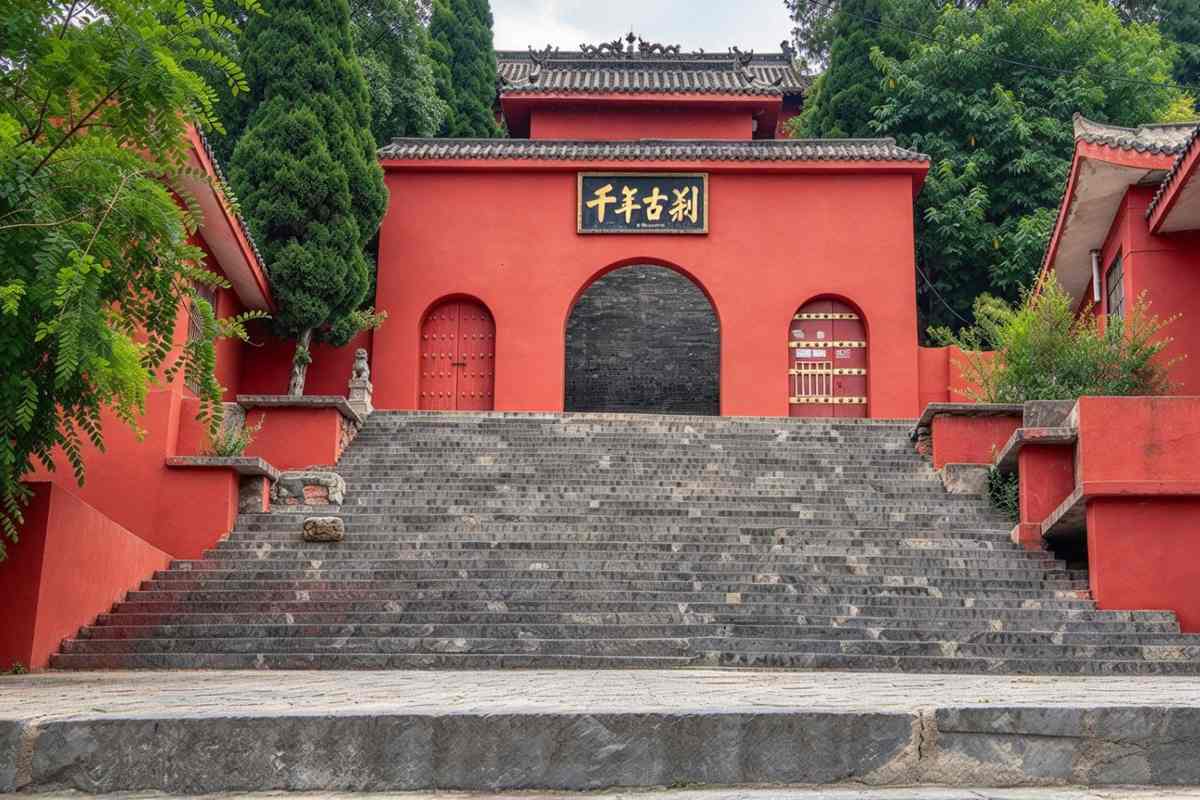
The stone steps create a gradual transition from the surrounding landscape into the temple grounds.
The Main Hall: The Spiritual Center of a Temple
In many Chinese Buddhist monasteries, the Mahavira Hall (Daxiong Baodian, 大雄宝殿) is the principal worship hall. The name refers to the Buddha's great spiritual strength and courage. It is commonly the most important ceremonial building in the complex.
Depending on the temple's tradition and history, the hall may contain an image of Shakyamuni Buddha, other Buddhas, or a group of Buddhist figures. The arrangement of statues is not identical everywhere. Their identities, positions, and accompanying figures reflect the temple's particular religious traditions.
Visitors may also notice an altar, offering tables, incense vessels, and decorative details around the interior. These elements are part of an active religious environment. The hall is not simply an exhibition space: it may be used for chanting, ceremonies, offerings, and other forms of Buddhist practice.
It is worth remembering that the names and functions of individual halls can differ between temples. When exploring Guanghua Temple, visitors should identify the buildings according to the site's actual signs and historical explanations rather than assuming that every structure corresponds to the standard layout found in a larger monastery.
Pagodas: Architecture That Preserves Buddhist Memory
The pagoda is one of the most distinctive forms in Chinese Buddhist architecture. Its origins are connected with the Buddhist stupa tradition, which developed around the veneration and preservation of sacred relics and the memory of eminent Buddhist teachers.
Over time, the pagoda developed into a variety of architectural forms in China. Some are tall and multi-storeyed, while others are compact structures with a strong commemorative or religious function. Their materials, proportions, decorative details, and locations can all provide clues to the history of a temple.
At Guanghua Temple, the Wuwei Pagoda (无畏塔) is an important historical landmark associated with Subhakarasimha, known in Chinese as Shan Wuwei (善无畏). Subhakarasimha was one of the major Buddhist masters who helped establish Esoteric Buddhism in Tang Dynasty China. His historical association gives the pagoda particular significance within the Buddhist heritage of Luoyang.
When observing a pagoda, look beyond its outline. Consider its position in relation to the surrounding buildings, the condition and style of its stonework, and any inscriptions or commemorative structures nearby. These details help connect architecture with the people and traditions remembered at the site.
The Three Kaiyuan Masters and the Heritage of Tang Esoteric Buddhism
Guanghua Temple's significance is closely connected with the history of Tang Dynasty Esoteric Buddhism. Three eminent masters are especially important in this tradition: Shan Wuwei (Subhakarasimha), Jingangzhi (Vajrabodhi), and Bukong (Amoghavajra). Together, they played a major role in the development and transmission of Esoteric Buddhist teachings during the Tang period.
Their work contributed to the translation and interpretation of Buddhist texts, the development of ritual traditions, and the formation of an influential Buddhist lineage in China. Their legacy also became important beyond China, particularly in the later transmission of Esoteric Buddhist teachings to Japan.
At Guanghua Temple, the Memorial Hall of the Three Kaiyuan Masters provides a place to learn about this historical tradition. The hall was opened in 2015 and uses architectural references associated with the Tang Dynasty. It helps visitors understand why the temple is more than a scenic religious site: it is also connected with a significant chapter in the history of Chinese Buddhism.
To understand the wider cultural background, visitors can explore the history of Longmen Guanghua Temple and its relationship with the development of Tang Esoteric Buddhism before or after their visit.
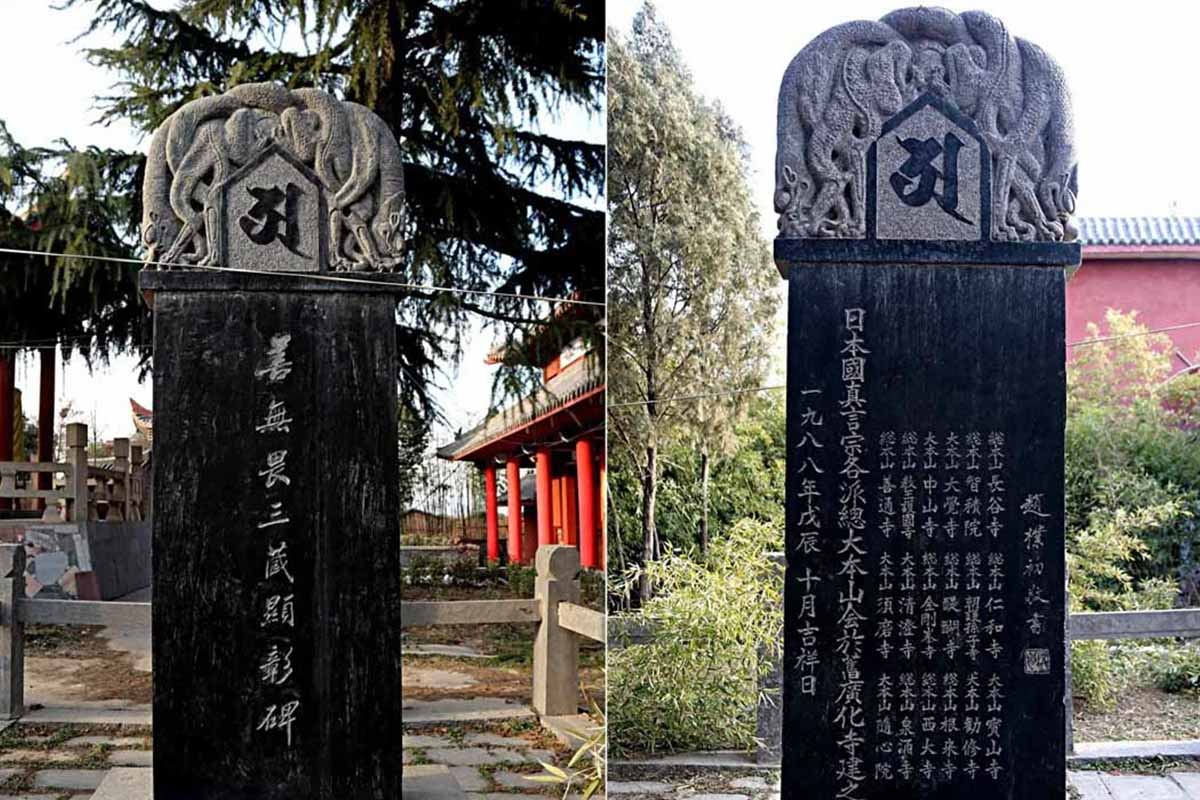
Wuwei Pagoda connects the temple landscape with the memory of Tang Dynasty Esoteric Buddhism.
Bell and Drum Towers: Giving Rhythm to Temple Life
Bell towers and drum towers are common features of traditional Chinese Buddhist temple complexes. They are often positioned on opposite sides of an important courtyard or architectural axis. Their paired arrangement contributes to the visual balance of the temple, but their function is also practical and religious.
Traditionally, the bell and drum helped mark the daily schedule of monastic life. The bell is associated with the evening, while the drum is associated with the morning. Their sounds helped organize the rhythm of practice, ceremonies, and community activities before modern clocks became part of everyday life.
Guanghua Temple has both a Bell Tower and a Drum Tower, with the Bell Tower to the north and the Drum Tower to the south. When viewing them, notice not only their architectural details but also their relationship to the surrounding buildings. Their position reflects the importance of sound and time in the daily life of a Buddhist temple.
Courtyards, Gardens, and the Meaning of Open Space
Courtyards are essential to the experience of many Chinese temples. They provide light and ventilation, connect different buildings, and create space for gatherings and religious activities. Just as importantly, they offer moments of visual and mental rest between enclosed halls.
In traditional Chinese architecture, open space is not simply the absence of buildings. It is part of the design. A courtyard can frame a tree, direct attention toward a doorway, reveal the shape of a roof, or create a quiet place between two important structures.
At a hillside temple such as Guanghua, the surrounding landscape also becomes part of the architectural experience. Stone paths, slopes, trees, and views of the surrounding area contribute to the atmosphere of the site. The relationship between built structures and nature is one of the most rewarding details to observe during a visit.
The Bodhisattva Pond, also known as the Longevity Pond, is another feature of Guanghua Temple's landscape. With its standing Guanyin image and Longevity Stele, the pond offers a place to reflect on the relationship between Buddhist imagery, traditional beliefs, and the design of temple surroundings.
Buddhist Statues: Understanding the Figures You See
Buddhist statues are not simply decorative objects. Their identities and positions communicate religious ideas, stories, and teachings. Learning to recognize a few common categories can make a temple visit much more meaningful.
Buddhas
A Buddha represents awakening and the realization of Buddhist truth. Shakyamuni Buddha, the historical Buddha, is one of the most commonly represented figures in Chinese Buddhist temples. Other Buddhas may appear depending on the temple's tradition and the arrangement of its devotional images.
Bodhisattvas
Bodhisattvas are associated with the aspiration to attain awakening for the benefit of all beings. Guanyin (Avalokiteshvara), widely associated with compassion, is among the most familiar figures in Chinese Buddhism. Manjushri represents wisdom, while Samantabhadra is associated with practice and vows.
Arhats and Buddhist Disciples
Arhats and disciples represent different aspects of Buddhist practice and spiritual attainment. Their images may appear in rows or groups, often with distinctive facial expressions, gestures, and clothing. These figures remind visitors that Buddhist teachings are also transmitted and practiced through generations of disciples.
One useful principle is to pay attention to the complete arrangement rather than judging a figure's importance by size alone. The central image, surrounding figures, inscriptions, and ritual function together provide a more reliable guide to the meaning of a Buddhist hall.
Roofs, Timber, Stone, and Decorative Details
Chinese temple architecture is also recognizable through its construction methods and decorative language. Traditional timber buildings often use columns, beams, brackets, and layered roof structures to distribute weight and create broad covered spaces.
The upturned eaves of many Chinese roofs are among their most recognizable features. Their shape is related to traditional roof construction and the visual proportions of the building. The roofline can also help distinguish a more important hall from a smaller supporting structure.
Look closely at the details when visiting a temple:
Roof ridges and eaves: Notice the curve of the roof, its decorative ridge ornaments, and how far the eaves extend beyond the walls.
Timber brackets: Traditional bracket systems support the roof and create distinctive patterns beneath the eaves.
Stone inscriptions: Inscriptions can preserve names, dates, religious dedications, and records of restoration.
Doors and thresholds: Their scale and position influence how visitors enter and move through the building.
Color and decoration: Painted beams, carved details, and traditional colors contribute to the character of the structure.
These details are particularly valuable at historic sites, where different periods of construction and restoration may exist side by side. A temple should be understood as a place that has developed over time, not as a building frozen in a single historical moment.
Incense and Ritual Spaces: Architecture in Daily Use
Incense burners, offering tables, prayer spaces, and ceremonial halls reveal how a Buddhist temple functions as a living religious community. These features connect the physical environment with the daily activities of monks and visitors.
In many Buddhist traditions, offering incense is a gesture of respect and devotion. Its fragrance may also serve as a reminder of mindfulness and the intention to cultivate a sincere attitude. The meaning of incense is therefore not limited to its scent or visual appearance.
Chinese incense culture has developed into a range of artistic and ceremonial practices, including the careful preparation of incense materials and the creation of incense seals. Visitors interested in this tradition can explore the Incense, Tea and Singing Bowl Culture Retreat to learn more about the cultural relationship between incense, tea, sound, and contemplative practice.
When entering a ritual space, remember that the temple is an active place of worship. Follow local guidance, avoid touching religious objects without permission, and allow people who are praying or participating in ceremonies to continue without interruption.
How to Read Guanghua Temple During Your Visit
You do not need to be an architecture specialist to understand a Chinese Buddhist temple. A few simple observations can help you notice details that might otherwise be overlooked.
Begin with the landscape. Before focusing on individual buildings, notice the slope, surrounding trees, paths, and the way the temple fits into its natural setting.
Observe the entrance. Look at the mountain gate and the route leading toward it. At Guanghua, the long stone stairway is an important part of the approach.
Identify the major structures. Notice the pagoda, memorial hall, bell tower, drum tower, and other buildings. Use on-site signs and historical explanations to understand their individual functions.
Look for inscriptions and commemorative details. Names, dates, and memorial texts can connect a building with a particular person or period in Buddhist history.
Notice how people use the space. Incense offerings, chanting, quiet walking, and other activities show that the temple is a place of ongoing practice, not simply an architectural attraction.
Take time to pause. Courtyards, shaded paths, and views across the hillside are part of the experience. Allow yourself time to observe rather than rushing from one photograph to another.
Experience the Temple Beyond Sightseeing
Understanding temple architecture is a valuable starting point, but the meaning of a Buddhist temple becomes clearer when visitors also learn about the activities that take place within it. The sound of a bell, the arrangement of an offering table, the quiet of a courtyard, and the rhythm of daily practice all give context to the buildings.
Located near the Longmen Grottoes, Guanghua Temple offers an opportunity to explore a different dimension of Luoyang's cultural heritage. The Longmen Grottoes are widely known for their Buddhist stone carvings, while Guanghua Temple provides a setting in which visitors can learn about temple life and the history of Tang Esoteric Buddhism.
For travelers who want to spend more time with these traditions, a temple stay or cultural retreat can provide a deeper perspective than a short sightseeing visit. Rather than treating the temple as a place to pass through, visitors have more time to understand its atmosphere, cultural practices, and daily rhythm.
Funzendo introduces visitors to Chinese Buddhist culture through experiences that may include meditation, tea culture, incense traditions, and sound-based cultural activities. You can learn more about its meditation experiences or explore the Incense, Tea and Singing Bowl Culture Retreat for a closer introduction to traditional Chinese contemplative culture.
Frequently Asked Questions About Chinese Buddhist Temple Architecture
Do all Chinese Buddhist temples follow the same layout?
No. Many traditional temples use a central-axis arrangement, but their layouts vary according to geography, Buddhist tradition, historical period, available land, and later reconstruction. Mountain temples, in particular, may adapt their buildings to the natural slope.
Why is Guanghua Temple different from a typical flat temple complex?
Guanghua Temple is built on a hillside. Its approach includes a long stone stairway, and its buildings respond to the local terrain. Its orientation and spatial arrangement should therefore be understood through its own site conditions rather than assumed to follow a standard north–south plan.
What is the purpose of a pagoda in a Buddhist temple?
Pagodas developed from the Buddhist stupa tradition and may be associated with sacred relics, eminent Buddhist teachers, or commemorative functions. Their specific meaning depends on the history and purpose of the individual structure.
Why do Buddhist temples have bell and drum towers?
Bell and drum towers traditionally helped mark the daily rhythm of monastic life. The bell is commonly associated with evening, while the drum is associated with morning. Their paired arrangement is also an important feature of temple architecture.
What should visitors pay attention to inside a Buddhist temple?
Visitors can observe the arrangement of statues, the function of different halls, inscriptions, roof details, courtyards, and ritual objects. It is equally important to notice how monks and worshippers use the space and to respect any local rules.
Can visitors learn about Tang Esoteric Buddhism at Guanghua Temple?
Guanghua Temple is associated with the history of Tang Esoteric Buddhism and the legacy of the Three Kaiyuan Masters. Its Wuwei Pagoda and Memorial Hall of the Three Kaiyuan Masters provide important points of reference for understanding this heritage.
Read the Temple, Not Just the Buildings
Chinese Buddhist temple architecture is a language shaped by religious ideas, local geography, craftsmanship, and centuries of cultural development. A mountain gate marks an entrance, a pagoda carries historical memory, a bell tower gives rhythm to daily life, and a courtyard creates space for reflection.
At Longmen Guanghua Temple, these architectural elements are closely connected with the hillside landscape and the history of Tang Esoteric Buddhism. The stone steps, Wuwei Pagoda, memorial hall, bell and drum towers, and surrounding courtyards each offer a different way to understand the temple.
The next time you visit a Chinese Buddhist temple, take a moment to look beyond its most recognizable buildings. Notice how the spaces connect, how the architecture responds to the landscape, and how religious practice continues within the historic setting. You may find that the temple has far more to tell than its photographs can show.
Explore Funzendo at Longmen Guanghua Temple to discover more about Chinese Buddhist culture, temple life, meditation, and traditional cultural experiences in Luoyang.