Dunhuang Mogao Caves: Buddhist Art and the Silk Road Heritage of China
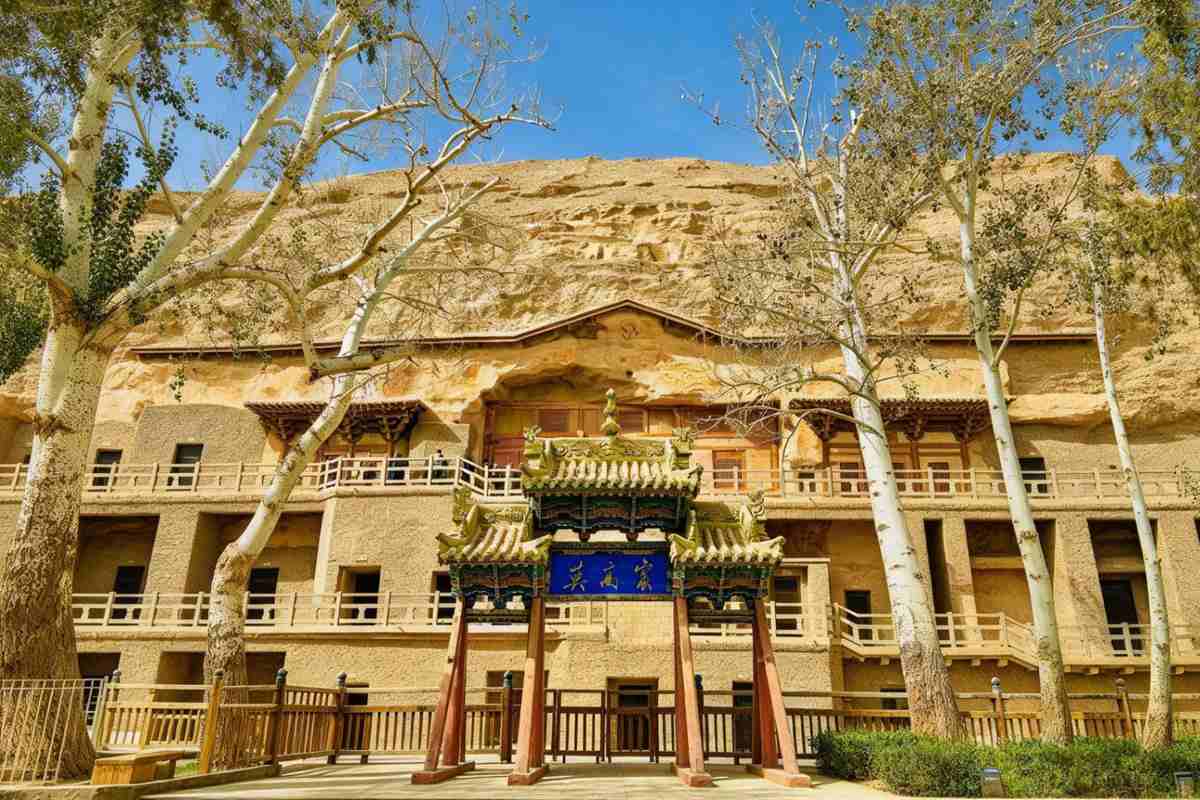
At the edge of the Gobi Desert in northwestern China, the city of Dunhuang preserves one of the most remarkable records of Buddhist art and cultural exchange in Asia. The Mogao Caves, carved into cliffs southeast of the historic oasis, contain centuries of murals, painted sculptures, and architectural remains. Their significance extends far beyond their artistic beauty. Together, these caves reveal how religious teachings, artistic techniques, commercial networks, and different communities interacted along the ancient Silk Road.
For travelers interested in Chinese Buddhist culture, Dunhuang offers a different perspective from the temples and monuments of central China. At Longmen, near Luoyang, Buddhist history is expressed prominently through monumental stone sculpture and inscriptions. At Mogao, the interior walls of cave sanctuaries preserve elaborate painted worlds filled with Buddhist figures, narrative scenes, symbolic imagery, and details of historical life.
The two destinations illuminate different chapters of a much larger story. Buddhism did not develop in China through a single route or remain unchanged as it traveled. It moved through networks of people, texts, languages, artistic traditions, and religious institutions. Dunhuang became one of the places where these influences met, leaving behind a cultural record that continues to inform the study of Buddhism and the history of Eurasian exchange.
Dunhuang: An Oasis at the Crossroads of the Silk Road
Dunhuang occupies a distinctive position in the geography of northwestern China. Historically, the oasis stood near the point where northern and southern routes around the Taklamakan Desert diverged. Travelers moving between the Chinese interior, Central Asia, and regions farther west could use the surrounding network of routes to cross some of the most challenging landscapes in Eurasia.
The term Silk Road describes a network rather than a single road. Merchants, diplomatic missions, monks, translators, artisans, and other travelers moved along different routes according to political conditions, geography, season, and the goods or knowledge they carried. Silk was one important commodity, but textiles, horses, precious materials, religious texts, artistic ideas, and technical knowledge also circulated through these connections.
Dunhuang's historical importance came partly from its role as a place where travelers could pass through, exchange goods, encounter different communities, and continue their journeys. Its position helped connect the Chinese interior with the wider cultural world of Central Asia. Religious ideas traveled within this same environment, carried by people who crossed borders for trade, diplomacy, study, or spiritual purposes.
Buddhism was especially suited to long-distance transmission through networks of teachers, monasteries, and written texts. Monks traveled to study, teach, translate, and obtain scriptures. Local communities supported religious institutions, while patrons commissioned images and buildings. As Buddhist teachings moved into new environments, they were interpreted through local languages, artistic conventions, and social customs.
Dunhuang therefore should not be understood simply as a remote outpost at the edge of China. It was a meeting point within a broad network of exchange. The Mogao Caves preserve evidence of this connected world, allowing researchers and visitors to explore how religion and art developed through contact among different societies.
The Origins and Development of the Mogao Caves
According to the traditional account associated with the site, construction of the Mogao Caves began in 366 CE. Over the following centuries, additional caves were excavated and decorated, creating a large complex of Buddhist sanctuaries within the cliff face. The site developed across successive historical periods rather than being completed according to a single architectural plan.
The caves are remarkable because they preserve more than one thousand years of artistic development. The World Heritage Centre describes 492 preserved caves containing approximately 45,000 square meters of murals and more than 2,000 painted sculptures. These figures help explain the extraordinary scale of the site, but the importance of Mogao lies equally in the historical variety of the works and the relationships between them.
Different caves were created under different circumstances. Their decoration depended on the period, the religious purpose of the space, the resources available, and the individuals or communities who supported the work. A cave might include a central sculptural image, painted walls and ceilings, narrative scenes, decorative patterns, and representations of donors associated with the commission.
The complex consequently provides evidence of changing artistic styles and religious priorities. Earlier and later works do not all present Buddhist subjects in the same manner. Changes in figure proportions, composition, clothing, ornament, color, and spatial organization can help researchers trace broader developments in Chinese art and the movement of visual ideas across Asia.
It is also important to distinguish between the age of a site and the age of every object within it. The Mogao complex developed over centuries, and its individual caves, paintings, sculptures, and architectural features belong to different historical contexts. Understanding the site requires attention to these differences rather than treating the entire complex as one unchanging monument.
Reading Buddhist Murals as More Than Decoration
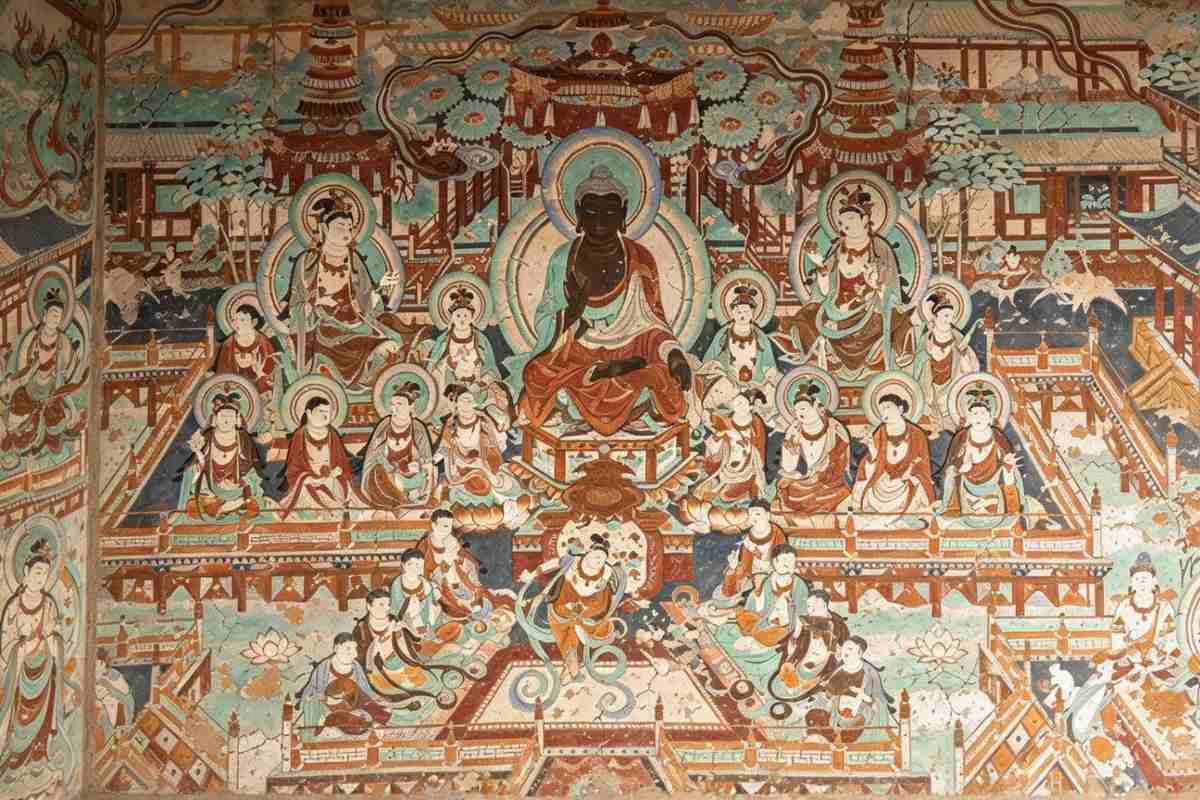
The murals of Mogao are among the site's most recognizable features. Their surfaces contain representations of Buddhas and bodhisattvas, celestial figures, religious narratives, decorative motifs, and scenes that connect Buddhist teachings with the visual culture of their time. Their complexity invites viewers to look beyond the immediate impression of color and beauty.
In Buddhist art, images often serve several purposes at once. They may support devotional attention, communicate religious narratives, illustrate concepts found in scriptures, or establish a visual environment appropriate to worship. The arrangement of figures and scenes can reflect the intended function of a cave and the traditions understood by its patrons and artists.
Some murals depict episodes connected with the life and teachings of the Buddha. Others represent celestial assemblies, symbolic landscapes, or stories associated with the wider Buddhist literary tradition. The meaning of a scene can depend on the identities of its figures, the gestures they make, the objects they hold, and the way the composition relates to surrounding images.
For modern visitors, learning to observe these details can transform a visit. Instead of seeing a wall as a single image, viewers can consider how a composition guides the eye, how individual figures relate to one another, and how color and gesture help communicate meaning. Even a brief introduction to Buddhist iconography can make the paintings more intelligible.
At the same time, a mural should not be interpreted through modern assumptions alone. Images were created within particular religious and historical contexts, and their meanings may not be immediately obvious to a visitor unfamiliar with Buddhist traditions. Reliable interpretation depends on scholarship, documentation, and comparison with relevant historical sources.
The murals are also historical records of the people who made and encountered them. Clothing, musical instruments, architecture, objects, and representations of daily activity can provide evidence for the study of past societies. Religious art thus becomes a source for understanding both spiritual ideas and the wider world in which those ideas were expressed.
Painted Sculptures and the Experience of Sacred Space
The artistic heritage of Mogao is not limited to two-dimensional painting. Painted sculptures form an essential part of many cave interiors, creating three-dimensional focal points within the surrounding visual environment. Their scale, position, and relationship with the murals influence how a visitor experiences the space.
In a cave sanctuary, sculpture and painting can work together rather than functioning as separate works of art. A central figure may be surrounded by painted attendants, celestial beings, or narrative scenes. The architecture of the cave establishes the setting, while the arrangement of images creates a visual hierarchy that guides attention toward particular religious subjects.
These works also demonstrate the skills of artisans who worked with different materials and techniques. Sculpture required knowledge of form, structure, surface preparation, and finishing, while painting required control of pigments, lines, color relationships, and composition. Coordinating these elements within a cave demanded both technical expertise and an understanding of the intended religious environment.
The resulting spaces differ from a modern gallery in which objects are generally separated from their original architectural settings. At Mogao, the relationship between the cave, the sculptures, and the murals is part of the heritage itself. Removing an image from its surroundings, even conceptually, can make it harder to understand the original visual experience.
This is one reason the preservation of the caves involves more than protecting individual paintings or statues. The rock surface, cave environment, painted layers, sculptural materials, and surrounding landscape all contribute to the site's historical integrity. A change in one part of the environment may affect the condition or interpretation of another.
The Silk Road Influences Visible in Dunhuang Art
One of the most important features of Dunhuang art is the evidence it preserves of cultural exchange. Buddhist art developed across a vast geographical area, and the forms that reached China had already passed through different artistic and intellectual environments. As these traditions traveled, artists and patrons adapted them to local contexts.
The Mogao Caves contain evidence of interactions among Chinese artistic traditions and influences associated with Central Asia and the Indian subcontinent. These influences should not be understood as a simple one-way transfer. Artists worked within local communities, selecting and transforming visual elements rather than merely copying foreign models.
Differences in clothing, ornamental details, figure types, decorative patterns, and narrative composition can help researchers study these exchanges. The evidence is often complex: a single work may combine several influences, and the presence of a visual resemblance does not automatically establish a direct route of transmission.
Trade networks made such encounters possible, but merchants were not the only people responsible for cultural exchange. Buddhist monks, translators, pilgrims, local rulers, craftspeople, and religious patrons all played roles. The movement of ideas depended on people who carried knowledge, adapted it, supported its production, and introduced it to new audiences.
Dunhuang also demonstrates that the Silk Road was not exclusively a commercial system. Religious teachings, artistic practices, technologies, languages, and forms of knowledge moved through the same interconnected routes as material goods. A sacred image could reflect the history of contact between communities as clearly as an imported object could.
For visitors, this perspective changes the way the caves can be understood. Rather than viewing Mogao as an isolated collection of Chinese masterpieces, it becomes possible to see the site as part of a wider history of Eurasian culture. Its artistic achievements are rooted in local creativity and in the exchanges that connected different societies.
Cave 302 and the Representation of Everyday Life
The value of Mogao lies not only in images directly concerned with Buddhist doctrine. Some paintings also preserve scenes that help researchers understand the material and social world of earlier periods. The World Heritage Centre identifies a Sui dynasty scene in Cave 302 showing a camel pulling a cart, an image associated with trade and movement along the Silk Road.
Such details remind viewers that the people who supported Buddhist institutions lived within wider economic and social networks. Caves were created in a world of travelers, merchants, craftspeople, local communities, and political authorities. The religious life represented in the paintings did not exist separately from the everyday realities of transport, work, clothing, and exchange.
Images of this kind must still be interpreted carefully. A painted scene is not necessarily a literal record of one identifiable historical event. Its meaning may depend on the surrounding narrative, the purpose of the decoration, and the visual conventions used by the artist. Nevertheless, when considered alongside other evidence, such scenes can provide valuable insight into historical life.
The broader lesson is that religious heritage often preserves information beyond its primary devotional purpose. A temple mural may communicate a Buddhist story while also documenting artistic techniques, clothing styles, objects, or social relationships. These layers of meaning help explain why the study of Buddhist art involves historians, archaeologists, conservators, and scholars from several disciplines.
The Library Cave and the Discovery of Manuscripts
Among the most significant chapters in the modern study of Dunhuang is the discovery of the Library Cave, commonly identified as Cave 17. The chamber contained a large collection of manuscripts and other materials, offering an extraordinary record of the intellectual and religious life of the region.
The collection is important because it extends far beyond one type of Buddhist scripture. Manuscripts from Dunhuang include materials associated with different languages, religious traditions, administrative activities, and aspects of everyday life. Together, they provide evidence of the diverse communities and forms of knowledge that existed along the Silk Road.
The discovery also transformed scholarly understanding of the region. Written records can reveal information that is not always visible in paintings or architecture: the circulation of texts, the use of different scripts, the activities of religious communities, and the ways documents were copied, preserved, or stored.
Yet the history of the collection also raises difficult questions about the movement of cultural objects. Materials from Dunhuang entered collections in different countries during a period when modern ideas about heritage ownership, archaeological responsibility, and international cooperation were developing. Their present locations and histories form part of the broader discussion about the preservation and study of cultural heritage.
For researchers, the manuscripts remain an important source for understanding medieval China and Central Asia. For visitors, the Library Cave demonstrates that a sacred site can preserve more than visible architecture and imagery. Documents, fragments, and written records can open a different window onto the lives and intellectual activities of people who lived centuries ago.
From Northern Wei to Tang and Later Dynasties
The Mogao Caves developed across numerous dynastic periods, and their art reflects the changing circumstances of the communities that created them. The Northern Wei period, the Sui and Tang dynasties, and later periods each contributed to the site's artistic and historical character. Rather than presenting one fixed style, the caves preserve a sequence of developments.
During the Tang dynasty, Dunhuang participated in a period of extensive artistic and cultural activity. Buddhist art flourished in different parts of China, while the wider Silk Road connected the region with other societies. The murals and sculptures associated with this period reflect the richness of Buddhist visual culture and the ability of local artists to work within sophisticated artistic traditions.
Later works also matter. They show that the site did not cease to be culturally significant after the Tang dynasty. The continued creation and maintenance of caves over many centuries reveal changing religious needs, patterns of patronage, artistic choices, and local circumstances.
Studying the sequence of caves can therefore help explain how artistic traditions are maintained and transformed. An older visual form may continue in a later period, while other features change in response to new influences or expectations. Such continuity and variation are central to the history of art.
This long chronology also makes it important to avoid attributing every cave or image to the same date. Accurate interpretation depends on distinguishing periods and understanding that the present appearance of the complex reflects centuries of creation, use, and preservation.
Why Conservation Is Essential to the Future of Mogao
The fragile condition of the Mogao Caves makes conservation a central part of their modern significance. Murals and painted sculptures are sensitive to changes in their environment, including moisture, temperature, dust, and physical contact. The materials used by historic artists can deteriorate over time, and the effects may be difficult or impossible to reverse once substantial damage has occurred.
Preservation therefore involves more than repairing visible damage. Specialists study the rock surfaces, pigments, plaster, environmental conditions, and structural stability of the caves. Monitoring and research help conservators understand risks and develop methods suited to the materials and conditions of the site.
Visitor management is another important part of conservation. The presence of people changes the environment inside a cave, and large numbers of visitors can increase the pressure on sensitive spaces. Access arrangements and visitor guidance help balance public understanding of the heritage with the need to protect it for the future.
Digital documentation can also contribute to research and interpretation. Photographs, detailed imaging, records of conservation work, and other forms of documentation can help researchers study the paintings and monitor changes over time. Digital access may support learning, but it does not remove the need to preserve the original site and its physical context.
Conservation is not an attempt to freeze history at one arbitrary moment. Historic sites have often changed through use, repair, and rebuilding. The challenge is to understand those changes, preserve significant evidence, and avoid interventions that compromise the authenticity or integrity of the heritage.
For visitors, respect for conservation measures is part of responsible cultural travel. Following instructions, avoiding contact with painted surfaces, and observing photography rules help protect the caves. These requirements are not obstacles to appreciation; they are essential conditions for ensuring that the site remains available for future generations.
Visiting Mogao with Historical Understanding
A visit to the Mogao Caves is most rewarding when it begins with an understanding of what the site represents. It is not simply a place to see beautiful paintings. It is a complex historical landscape where architecture, Buddhist imagery, written records, and evidence of cultural exchange have survived together.
Before visiting, travelers can familiarize themselves with the basic history of Dunhuang and the role of the Silk Road. Learning a little about Buddhist iconography can also help visitors recognize the difference between Buddhas, bodhisattvas, attendants, donors, and narrative figures. Even a modest amount of preparation can make the experience more engaging.
Visitors should check the official site's current access arrangements and reservation requirements before traveling. Access to individual caves may be managed according to conservation needs, and the available viewing arrangements can vary. It is better to plan around confirmed information than to assume that every cave or artwork will be accessible on a particular day.
Inside the caves, a respectful pace is important. The spaces may be dim, and many details require time to observe. Rather than attempting to photograph or remember everything, visitors can focus on a few features: the relationship between a central sculpture and its surrounding murals, the use of color, a narrative scene, or a detail that reveals contact between different artistic traditions.
Photography and other visitor activities must follow the rules in force at the site. Restrictions protect fragile materials and support the work of conservation staff. Visitors should also recognize that the Mogao Caves are an irreplaceable cultural resource rather than a backdrop for unrestricted photography.
From Longmen to Dunhuang: Understanding a Wider Buddhist Journey
Exploring Dunhuang alongside Longmen can deepen an understanding of the geographical and artistic diversity of Chinese Buddhism. The Longmen Grottoes, near Luoyang in Henan Province, are renowned for their carved Buddhist images and inscriptions. Mogao, farther northwest, preserves extensive painted cave sanctuaries and a rich documentary record connected with the Silk Road.
The contrast between the two sites is particularly valuable. Stone sculpture at Longmen demonstrates how Buddhist imagery was carved into cliffs and shaped by local artistic and historical circumstances. The murals and sculptures at Mogao show how sacred spaces could be developed through painted surfaces, three-dimensional figures, and compositions that reflect a broad network of cultural influences.
Neither site tells the whole story of Buddhism in China. Each reveals particular aspects of a much larger history involving translation, artistic exchange, religious patronage, local communities, and the movement of people across Asia. Visiting more than one destination can help travelers recognize both the shared elements and the distinctive characteristics of different regional traditions.
For travelers interested in exploring this connection through a structured cultural itinerary, Funzendo lists the Silk Road Zen Pilgrimage: From Longmen to Dunhuang among its pilgrimage and cultural programs. The program page provides a starting point for reviewing the available journey and its details.
A route linking Longmen and Dunhuang can be understood as more than a sequence of destinations. It offers a way to examine how Buddhist culture took different forms across China's varied landscapes. From carved stone images to painted cave interiors, each place reflects the communities, materials, artistic traditions, and historical circumstances that shaped its heritage.
Cultural Pilgrimage Beyond Sightseeing
In a cultural context, pilgrimage can involve more than reaching a sacred destination. It may include learning about religious history, observing local customs, visiting significant monuments, and considering how places acquire meaning over generations. Different travelers bring different intentions, and a responsible itinerary should allow room for both learning and reflection.
For some visitors, the primary interest may be Buddhist art and architecture. Others may be interested in the history of the Silk Road, the transmission of religious texts, or the relationships between Chinese culture and other Asian societies. These interests can complement one another without requiring every visitor to share the same religious beliefs.
It is important, however, to distinguish historical learning from claims about personal transformation. A pilgrimage can be meaningful, but its effect depends on the individual, the purpose of the journey, and the way the experience is approached. No destination can guarantee a particular emotional or spiritual outcome.
Responsible cultural travel begins with preparation and respect. Travelers should learn about the historical context of the places they visit, follow local guidance, protect fragile heritage, and remain open to interpretations that may differ from their initial expectations.
For Funzendo, connecting cultural destinations with pilgrimage routes offers an opportunity to introduce international visitors to the diversity of China's Buddhist heritage. The aim is not to treat every site as interchangeable, but to help travelers discover the particular history and cultural significance of each place along the route.
Dunhuang as a Record of Cultural Exchange
The Mogao Caves preserve an exceptional record of Buddhist art and the wider cultural world of the Silk Road. Their murals, painted sculptures, cave architecture, and manuscript history reveal how religious teachings were expressed, adapted, and preserved over many centuries.
Dunhuang's significance comes from the relationship between local creativity and international exchange. Artists worked within Chinese traditions while drawing on a visual world shaped by contact with Central Asia and India. Monks, patrons, merchants, translators, and local communities contributed to the environment in which these works were created and maintained.
The caves also demonstrate why cultural heritage requires careful interpretation and active conservation. Their value lies not only in the beauty of individual images, but in the historical evidence preserved across the entire complex. Protecting that evidence allows future generations to continue studying the artistic, religious, and social history of the region.
For those exploring Chinese Buddhist heritage, Dunhuang offers a perspective that complements the monumental sculpture of Longmen and the temple traditions found elsewhere in China. A journey from Longmen to Dunhuang brings these different forms of heritage into conversation and reveals the scale of the historical networks through which Buddhism developed.
To understand Mogao is to look beyond the walls of a cave and into the world that made it possible: a world of journeys, translations, artistic skill, religious devotion, and encounters among different cultures. That wider history is what makes Dunhuang an essential destination for anyone seeking a deeper understanding of China's Buddhist past and the enduring legacy of the Silk Road.