How Buddhist Monasteries Helped Preserve Knowledge in Ancient China
Long before books could be produced with modern printing machines, the preservation and circulation of knowledge depended on the patient work of scribes, scholars, craftspeople, and institutions willing to protect written records across generations. In China, Buddhist monasteries became important participants in this history. They preserved manuscripts, supported translation projects, commissioned printed texts, and helped transmit religious and intellectual traditions across East Asia.
The story is more complex than the history of a single invention. Buddhist communities did not create every technology they used, nor were monasteries the only institutions responsible for preserving Chinese knowledge. Yet the scale of Buddhist textual activity created significant demand for reliable copies of scriptures and commentaries. That demand intersected with the development of Chinese paper production, calligraphy, woodblock printing, bookmaking, and long-distance cultural exchange.
Today, surviving Buddhist books, manuscripts, printing blocks, inscriptions, and temple collections provide evidence of how knowledge was produced and transmitted in premodern Asia. They also reveal a less familiar side of religious history: the monastery as a place where texts were edited, copied, organized, taught, and carried across cultural boundaries.
Before Printing: The Challenge of Preserving a Growing Body of Texts
In the centuries before printing became widespread, written texts were labor-intensive objects. A manuscript had to be copied by hand, and producing a lengthy work required considerable time, materials, and specialized skill. A damaged or lost manuscript could represent the disappearance of a particular textual version, while errors introduced during copying might be repeated in later copies.
These challenges were especially significant for Buddhist literature. Buddhist traditions contained discourses attributed to the Buddha, rules for monastic communities, philosophical commentaries, ritual texts, biographies, histories, and practical instructions. As Buddhism spread through China, the body of Chinese-language Buddhist literature grew through translation and interpretation.
Texts arriving from India and Central Asia were translated into Chinese over successive generations. Translators had to negotiate differences in language, terminology, and philosophical assumptions. A translated scripture was therefore not merely a word-for-word reproduction. It was also the outcome of intellectual work involving interpretation, discussion, and decisions about how unfamiliar concepts should be expressed.
Once translated, texts needed to be copied, circulated, studied, and preserved. Monasteries could provide settings for these activities because they brought together religious specialists, donors, students, and communities interested in Buddhist teachings. Their libraries and collections varied greatly in size, and not every monastery performed all these functions, but the wider institutional network helped Buddhist literature travel beyond its original places of translation.
The preservation of a text also involved more than keeping a physical copy safe. Readers needed to identify its contents, compare different versions, understand its place within a larger body of literature, and pass it on to future generations. These tasks made the history of Buddhist books inseparable from the history of education, scholarship, and institutional organization.
Translation and the Making of a Chinese Buddhist Library
Buddhism entered a Chinese intellectual world already shaped by classical learning, Confucian traditions, Daoist thought, historical writing, and established systems of education. As Buddhist literature expanded, translators and scholars had to develop a vocabulary capable of expressing ideas that did not always have direct equivalents in Chinese.
Translation projects often involved collaboration. A person familiar with an Indic language might explain a text, while Chinese-speaking assistants helped render the explanation into written Chinese. Editors and later scholars could review the resulting text, compare terminology, and produce revised versions. The precise arrangements differed across periods and individuals, but the broader process depended on cooperation rather than isolated acts of translation.
Over time, Chinese Buddhist literature became an extensive intellectual tradition in its own right. Readers encountered not only translated scriptures but also Chinese commentaries, doctrinal classifications, biographies of eminent monks, records of pilgrimage, and writings associated with different Buddhist schools.
This growing collection raised a practical question: how could readers understand the relationships among thousands of texts? The answer involved cataloguing, classification, comparison, and the compilation of larger collections of scriptures. Such work helped scholars identify texts, recognize differences among versions, and organize materials for study.
The idea of a Buddhist canon—the body of scriptures recognized and organized within a tradition—was therefore not simply a matter of collecting every available book. It required sustained intellectual decisions about authenticity, classification, interpretation, and the relationship between different works.
These activities connected the physical history of books with the development of Buddhist scholarship. A text had to survive materially, but it also needed to remain intelligible within a changing community of readers.
How Woodblock Printing Changed the Circulation of Buddhist Texts
Woodblock printing transformed the possibilities of reproducing written material in China. Instead of copying every character by hand for each new edition, a craftsman could carve a page of text into a wooden block, apply ink to its surface, and transfer the image to paper. The same block could produce multiple impressions, provided that it was properly maintained.
Preparing a block was itself a demanding process. The text had to be arranged in reverse on the printing surface, characters needed to be cut clearly, and the block had to remain stable enough for repeated use. Errors in the carved text could be reproduced many times, so careful preparation and proofreading were essential.
Buddhist texts and images formed part of the early history of printing in East Asia. Printing made it possible to produce multiple copies of religious materials and contributed to the wider circulation of Buddhist literature. It also supported the reproduction of devotional images, short texts, and other materials used in religious contexts.
The significance of printing was not limited to speed. Repeated impressions from the same block could help maintain consistency between copies. At the same time, printing did not eliminate textual variation. Different editions could be prepared from different source manuscripts, revised by editors, or carved with mistakes. Printed books still required scholarship, comparison, and careful preservation.
Printing also depended on resources. Wood, paper, ink, labor, storage, and financial support all affected whether a project could proceed. Large-scale editions required substantial planning, and their production could extend over years. The technology made reproduction possible on a new scale, but it did not remove the human and institutional effort required to create a reliable text.
For these reasons, the relationship between Buddhism and printing should be understood as a long historical partnership between religious demand, skilled craftsmanship, textual scholarship, and the material conditions of book production.
The Diamond Sutra and a Landmark in Printing History
One of the best-known surviving examples of early Chinese printing is the Diamond Sutra scroll dated to 868 CE. The work was discovered at Dunhuang and is now widely recognized as the earliest surviving complete printed book bearing a clear date. Its historical importance lies in the evidence it provides for the technical and cultural development of printing during the Tang dynasty.
The scroll combines printed text with a frontispiece depicting the Buddha and figures gathered around him. Its production demonstrates that printing was already capable of reproducing both written and visual material in a coordinated format. The result is not merely a technological specimen but a religious object whose text, image, and dedication belonged to a larger devotional culture.
The date of the Diamond Sutra also helps historians understand that printing had developed well before the European printing press associated with Johannes Gutenberg. The history of printing did not follow a single route or begin at one moment in every region. East Asia developed its own techniques and traditions, shaped by local writing systems, materials, social institutions, and intellectual needs.
The Diamond Sutra is especially valuable because it survives as a complete dated example rather than as an isolated fragment. It allows researchers to examine the relationship between text layout, image making, religious patronage, and book production in the ninth century.
Its survival also raises an important question about historical evidence. A surviving object is not necessarily the first example of a technology. It is simply one of the earliest examples that has endured and can be studied today. The actual history of printing is likely to have involved experiments, workshops, and earlier materials that have not survived.
Dunhuang: Where Texts Reveal a Network of Cultural Exchange
Dunhuang occupied a strategic position along routes connecting China with Central Asia and regions farther west. Merchants, religious travelers, translators, and other visitors passed through the oasis, bringing goods, languages, artistic styles, and ideas. Its historical significance is therefore not limited to the famous cave paintings for which it is widely known.
The manuscripts and printed materials associated with Dunhuang provide evidence of an unusually diverse textual environment. Buddhist scriptures appear alongside other kinds of written records, illustrating the many purposes for which writing was used. The surviving materials help researchers investigate religious practice, language, education, administration, and the circulation of ideas across regions.
They also demonstrate that cultural exchange was not a one-way process. Texts moved between regions, but they were also interpreted, copied, translated, and used in new circumstances. A scripture produced in one cultural setting could become part of the intellectual life of another community, acquiring new associations as it traveled.
The Dunhuang collections are particularly valuable because they preserve evidence of everyday textual activity as well as major religious works. Differences in handwriting, format, language, and content help researchers reconstruct how written materials were produced and used.
For modern readers, this evidence challenges the idea that ancient cultural centers existed in isolation. Dunhuang was part of a connected world in which religious ideas, artistic techniques, and written knowledge moved across considerable distances.
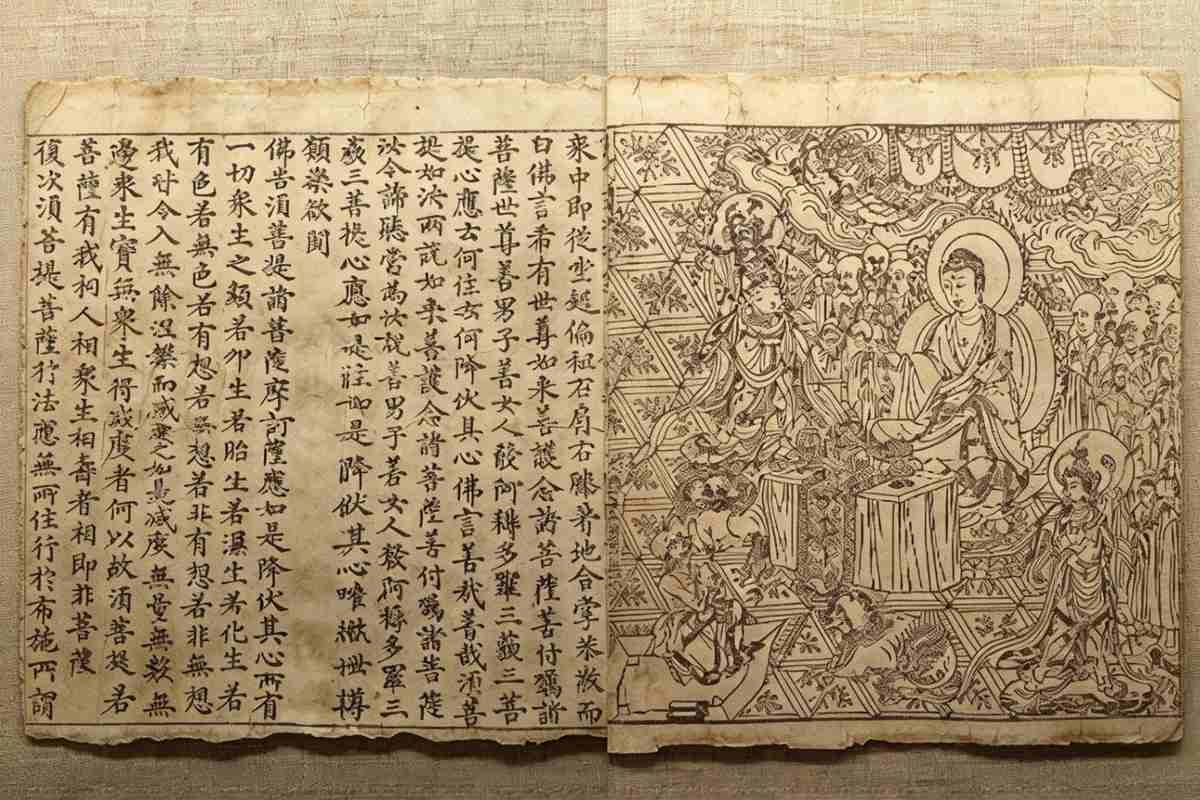
Manuscripts and early printed texts offer material evidence of how Buddhist knowledge circulated across Asia.
The Buddhist Canon: A Monumental Editorial Achievement
As Buddhist literature expanded, the task of organizing and reproducing large collections of scriptures became increasingly ambitious. A complete Buddhist canon could contain thousands of texts and required a sustained effort to gather source materials, compare readings, establish an arrangement, and prepare the collection for reproduction.
During the early Song dynasty, work began on a major woodblock edition of the Chinese Buddhist canon in Chengdu in 971. Known as the Kaibao Canon, the project took approximately a decade to complete. It is an important example of how printing technology, religious scholarship, and institutional support could come together in a large editorial undertaking.
Producing a canon required much more than carving individual characters. Editors needed to decide which texts to include and how to arrange them. Scribes and proofreaders had to prepare accurate copy. Craftspeople carved the blocks, printers produced impressions, and institutions organized the resulting volumes for storage and use.
The work did not end when the first edition was completed. Printed blocks could be stored and used again, allowing further copies to be produced when needed. Yet blocks required protection from moisture, insects, war, and physical wear. The survival of a collection depended on ongoing care, not simply the success of its original production.
Later editions of the Chinese Buddhist canon continued this tradition. Their differences are important to scholars because they preserve evidence of textual revision, changing editorial decisions, and the historical circumstances in which particular collections were produced.
These projects show that a canon is both a body of literature and a record of human organization. Its creation requires decisions about knowledge, authority, resources, and the responsibilities of preserving texts for future readers.
Monasteries as Centers of Learning and Craftsmanship
It is easy to imagine a monastery primarily as a place of worship, but historical Buddhist institutions could also support a wide range of intellectual and practical activities. Depending on their size, resources, and historical setting, some monasteries maintained libraries, trained students, hosted visiting scholars, copied texts, or commissioned printed works.
These activities required specialized skills. A person copying a manuscript needed training in writing and familiarity with the text. A proofreader needed to compare versions and recognize discrepancies. A woodblock carver required technical skill and close attention to the original layout. Book production therefore brought religious knowledge into contact with forms of labor that were artistic, technical, and administrative.
Patronage was equally important. Printing projects could be supported by rulers, officials, monks, wealthy donors, and wider communities. Their motivations varied. Some sought to support religious learning, some hoped to create merit through the reproduction of sacred texts, and others helped preserve institutions that mattered to their local communities.
The relationship between religious practice and practical work should not be overlooked. Copying, checking, carving, and storing texts could all form part of a larger commitment to transmitting a tradition. The physical production of a book was one way in which an intellectual and religious inheritance became available to people who had not participated in its original creation.
At the same time, monasteries differed considerably. Some had access to significant resources, while others had limited collections and depended on borrowed texts or local support. Their contributions should therefore be understood within a varied historical landscape rather than as a single, uniform system.
From China to Korea and Japan: The Movement of Texts Across East Asia
Chinese-language Buddhist literature became an important foundation for Buddhist scholarship across East Asia. As Buddhism developed in Korea and Japan, texts, commentaries, ritual materials, and scholarly traditions circulated between regions. Chinese writing served as a major medium of intellectual exchange, even as each society developed its own religious institutions and cultural practices.
The movement of texts involved more than transporting books. Scholars needed to read and interpret them, institutions needed to preserve them, and students needed ways to learn from them. Copies could be produced locally, new commentaries written, and particular teachings emphasized according to local circumstances.
The Tripitaka Koreana, a monumental collection of Buddhist scriptures carved onto wooden printing blocks in Korea during the thirteenth century, illustrates the scale of this tradition. Preserved at Haeinsa Monastery, the collection consists of more than 80,000 woodblocks. Its production reflects a remarkable commitment to textual preservation and the continued use of woodblock printing for scholarly and religious purposes.
The Korean example should not be mistaken for a Chinese project: it belongs to Korea's own political and religious history. Its relationship to the broader East Asian Buddhist world, however, shows how textual traditions crossed borders while being preserved and developed by different societies.
Such connections remind us that cultural heritage rarely belongs to a single isolated place. A text may originate in one language, be translated into another, be printed in a third region, and become part of the educational tradition of several communities. Each stage contributes to the text's historical life.
Why Preservation Is More Than Keeping an Old Book
Preserving historical texts requires attention to both the physical object and the knowledge it contains. Paper can become brittle, ink can fade, wooden blocks can warp, and bindings can deteriorate. Environmental conditions, handling, insects, conflict, and changes in institutional ownership can all threaten collections.
Conservation therefore involves careful storage, environmental monitoring, documentation, and, where appropriate, professional restoration. Digital imaging can provide additional ways to study fragile materials without repeatedly handling the originals. Cataloguing and accurate descriptions also help researchers locate and compare objects across collections.
Yet preservation is not only a technical task. Historical texts need interpretation. Readers must understand the language, context, and conventions in which they were created. A scripture may have several versions; a manuscript may contain corrections; a printed edition may preserve the choices of earlier editors. These details can be as important as the words themselves.
Responsible heritage interpretation also means acknowledging gaps in the record. Many books and manuscripts have disappeared, and surviving examples do not represent every community or every period equally. Historical conclusions should be based on available evidence while remaining open to revision as new materials are discovered or studied.
When conservation and scholarship work together, an old book becomes more than a relic. It becomes evidence that can help explain how people read, learned, debated, worshipped, and communicated across generations.
What Ancient Buddhist Books Can Teach Modern Readers
In the digital age, information can be copied and distributed almost instantly. This convenience can make the work behind historical knowledge less visible. Ancient Buddhist books remind us that the circulation of ideas has always depended on systems of production, organization, interpretation, and preservation.
A printed text is never simply information detached from human effort. Someone selected the source, prepared the copy, produced the printing surface, checked the result, and ensured that the finished material could reach readers. The same principle applies to modern digital archives, research libraries, and cultural databases, even though their technologies are very different.
The history of Buddhist printing also demonstrates that technological change does not automatically guarantee accuracy. Printing made it easier to reproduce a text, but it could also reproduce mistakes. Greater access to information still depends on careful editing, reliable sources, and the ability to evaluate competing interpretations.
Finally, these collections reveal the value of long-term stewardship. A manuscript or printing block may survive because generations of people chose to preserve it, sometimes without knowing which future questions it would help answer. Cultural heritage is therefore not simply inherited. It is maintained through continuing decisions about what to protect, study, and pass on.
Discover the Wider Buddhist Heritage of Luoyang
Luoyang offers an important setting for exploring the historical development of Buddhism in China. Its religious heritage includes temple traditions, monumental sculpture, inscriptions, and sites associated with different periods of Chinese history. These places reveal complementary aspects of a cultural tradition that developed through translation, scholarship, artistic production, and exchange.
The Longmen Grottoes, for example, preserve a vast body of Buddhist sculpture and inscriptions that records changing artistic styles and patterns of religious patronage. Longmen Guanghua Temple adds another dimension to the city's Buddhist landscape through its own historical setting and cultural traditions.
For visitors who want to connect individual sites with broader historical themes, a cultural itinerary can provide useful context. Funzendo's Buddhist heritage and pilgrimage journeys introduce routes associated with Longmen, Dunhuang, Chang'an, and Mount Wutai. Exploring the available programs can help travelers identify an itinerary suited to their interests in Chinese Buddhist history and cultural heritage.
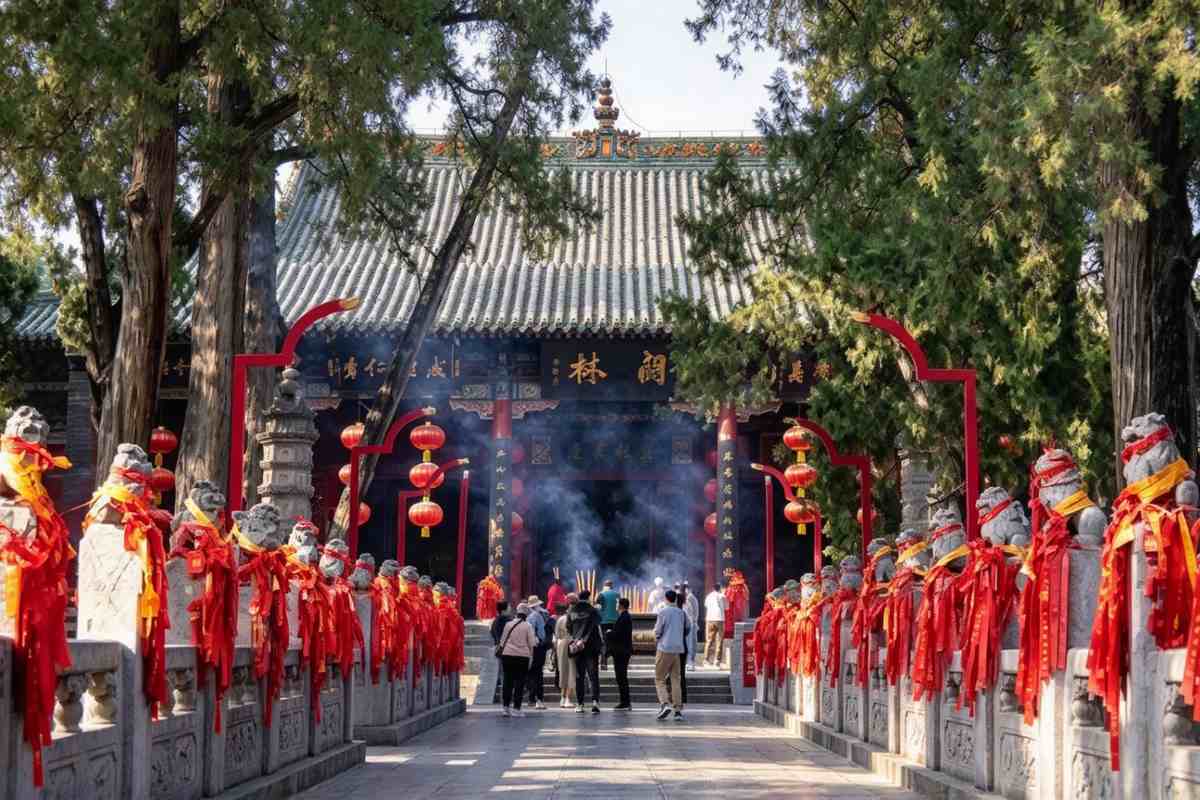
Luoyang's historic temples and Buddhist monuments provide a wider context for understanding China's religious and cultural history.
Keeping the Record of Human Knowledge Alive
The history of Buddhist books in China is a story of religious devotion, intellectual labor, technical innovation, and cultural exchange. From handwritten manuscripts to woodblock editions, generations of translators, scholars, monks, patrons, and craftspeople helped ensure that texts could move beyond the lifetimes and locations of the people who first produced them.
The Diamond Sutra of 868 demonstrates the sophistication of early printing. The Kaibao Canon illustrates the organizational scale of a major editorial project. The manuscripts associated with Dunhuang reveal the diversity of texts circulating along routes connecting different parts of Asia. Later collections, including the Tripitaka Koreana, show how the preservation and reproduction of Buddhist literature became a shared but locally distinctive undertaking across East Asia.
These examples also caution against reducing history to a list of inventions or famous objects. Printing technology mattered because people used it within social and intellectual systems. Texts survived because communities organized resources and continued to care for them. Knowledge traveled because readers, translators, and institutions made it possible to understand and transmit ideas across boundaries.
When we encounter an ancient book today, we are seeing the result of that accumulated effort. Its survival connects the present with people whose languages, beliefs, and circumstances may be very different from our own. Protecting such objects and studying their histories helps preserve not only the written words but also the human stories behind their creation.
For anyone interested in China's Buddhist heritage, this history offers a valuable perspective: temples were not only places where traditions were practiced. In many settings, they were also part of the wider network through which knowledge was created, organized, and passed on. Their legacy continues in the surviving texts, cultural monuments, and historical questions that invite new generations to learn.