How Feng Shui Reads a Space: Chinese Principles of Landscape, Direction and Living
Why do traditional Chinese buildings often appear to be carefully positioned in relation to mountains, water, pathways, and surrounding structures? Why might two houses with similar layouts be interpreted differently in traditional Chinese spatial thinking?
For centuries, Chinese Feng Shui has offered a distinctive way of observing the relationship between people and their surroundings. Often translated as the art of wind and water, Feng Shui is not simply a set of decorative rules or a method of arranging furniture. It is a traditional system of environmental interpretation that considers landscape, orientation, spatial relationships, and the character of a place.
For international visitors interested in Chinese culture, Feng Shui provides an opportunity to explore how traditional philosophy influenced architecture, settlement patterns, and ideas about living environments. Understanding its principles also requires looking beyond popular claims about lucky colors, wealth corners, or symbolic objects.
At Funzendo, located at Longmen Guanghua Temple in Luoyang, China, the Feng Shui & Chinese Destiny Analysis Workshop introduces participants to traditional Chinese metaphysics through theory, observation, and practical learning. This article explores the cultural ideas behind Feng Shui and explains how beginners can start understanding the way it reads a space.
1. What Does Feng Shui Actually Mean?
The words Feng Shui (风水) literally mean wind and water. These two natural elements represent more than weather or geography. In traditional Chinese thought, they are part of a broader understanding of how the environment influences the conditions of human life.
Historically, choosing a place to live or build was a practical matter. People needed access to water, protection from harsh weather, suitable terrain, and routes for transportation. Over time, these observations developed alongside Chinese cosmology, philosophical ideas, and traditional methods of interpreting the landscape.
Feng Shui brought these concerns into a more systematic framework. Practitioners examined the shape of the land, the direction of buildings, the surrounding environment, and the relationship between different features of a site.
It is useful to distinguish this historical and cultural system from modern scientific environmental assessment. Some traditional observations overlap with practical concerns such as sunlight, wind exposure, drainage, and access. Other interpretations belong to traditional metaphysical beliefs and should not be presented as scientifically proven effects.
2. The Landscape Comes Before the Building
One of the most important ideas in traditional Feng Shui is that a place should not be understood by looking at a building alone. Its surrounding landscape matters.
Before examining a doorway, room, or piece of furniture, traditional practitioners may first consider the larger setting: the terrain, nearby hills, water features, open spaces, roads, and the way the site relates to its surroundings.
Mountain Forms and Protection
In traditional landscape interpretation, mountains are often discussed in terms of their shape, position, and relationship to a site. A mountain may be considered a protective backdrop, a visual boundary, or an important feature within the overall configuration of the land.
From a practical architectural perspective, surrounding terrain can also influence wind exposure, sunlight, drainage, and the available building area. These are observable environmental factors, even though traditional Feng Shui may interpret them through additional symbolic concepts.
Water and the Shape of a Site
Water has an important place in traditional Chinese landscape thinking. Rivers, streams, ponds, and other water features can influence the development of settlements and the use of land.
Traditional Feng Shui considers the position and shape of water in relation to the surrounding terrain. In practical terms, water also affects access, irrigation, drainage, and the everyday use of a property.
For this reason, studying Feng Shui can introduce learners to a broader way of looking at the relationship between architecture and landscape. The aim is not to assume that every water feature brings good fortune, but to understand why its position has traditionally received so much attention.
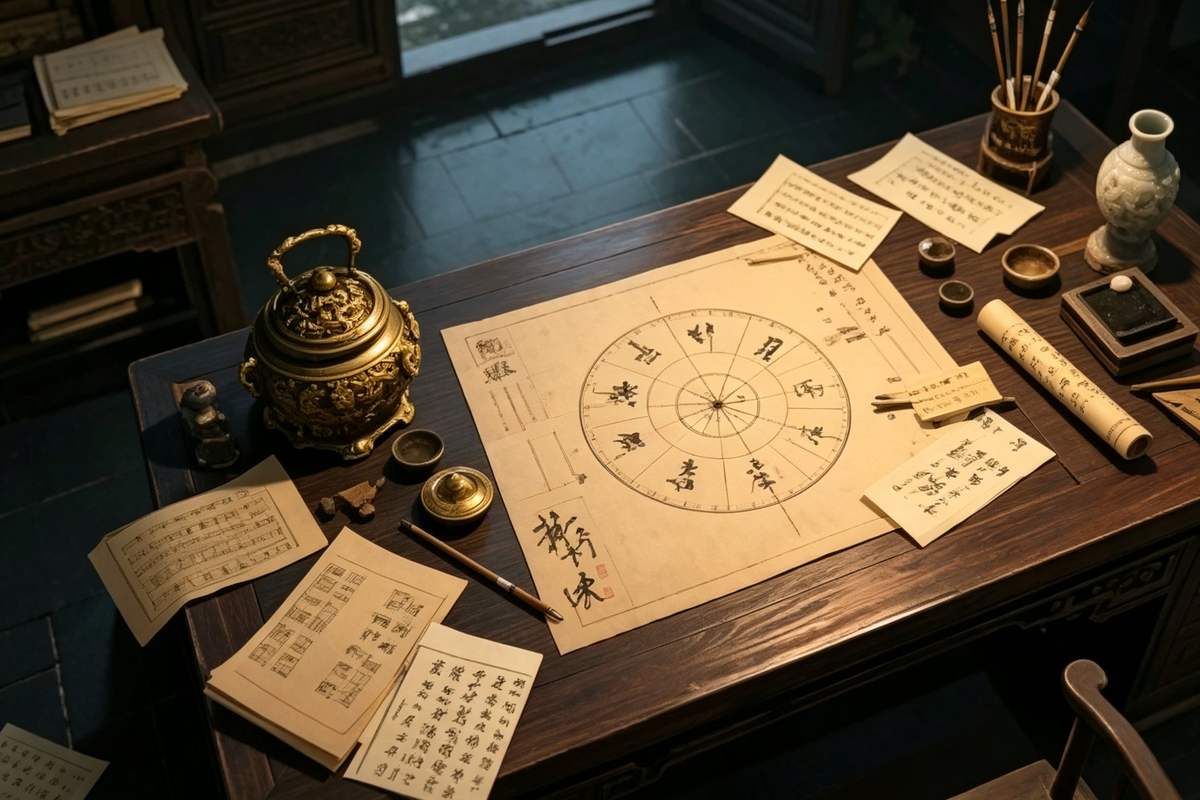
3. Form School Feng Shui: Understanding What You Can See
One major approach within traditional Feng Shui is commonly known as Form School, or Xing Shi Pai (形势派). Its emphasis is on the visible characteristics of the environment.
Rather than beginning with complicated calculations, learners are encouraged to observe the actual shape and arrangement of a site. This includes the surrounding landforms, the position of buildings, the presence of water, and the way different elements relate to one another.
When studying a traditional courtyard, for example, a Form School perspective might consider:
Surrounding terrain: Whether the building is positioned in relation to hills, slopes, or open land.
Approach and access: How pathways and entrances connect the building with its surroundings.
Spatial enclosure: How walls, courtyards, and neighboring structures define the space.
Environmental conditions: How sunlight, wind, shade, and drainage affect the site.
Overall configuration: How the different features form a coherent spatial arrangement.
This way of looking at a place is especially interesting when visiting traditional Chinese architecture. A building is not always treated as an isolated object. Its relationship with the surrounding environment can be just as important as its own design.
4. Compass School Feng Shui: Why Direction Matters
Another important area of traditional Feng Shui is compass-based analysis. It uses directional information and traditional systems of classification to interpret a location.
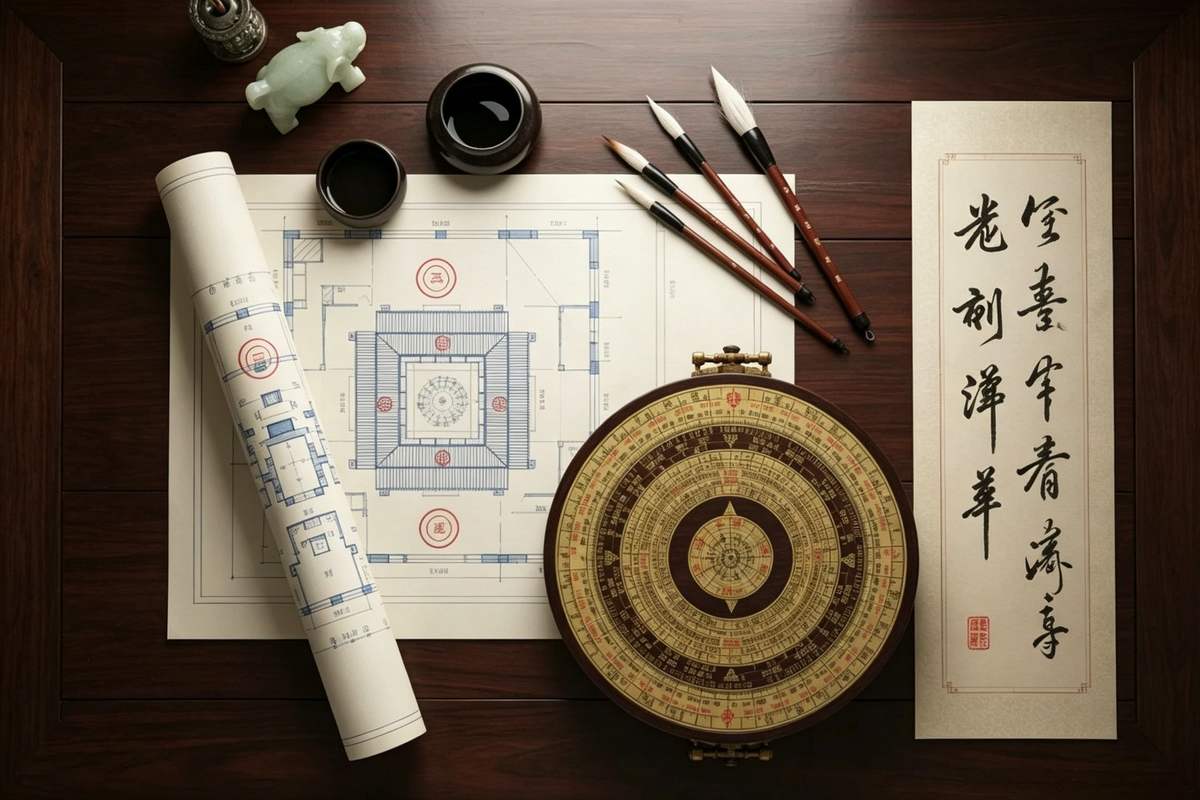
A traditional Feng Shui compass is known as a Luopan (罗盘). Unlike an ordinary navigation compass, a Luopan contains multiple concentric rings marked with traditional symbols, directional divisions, and other information used in different methods of analysis.
For beginners, the most important first step is understanding what the instrument is designed to do. It is a specialized tool within a traditional system, not simply a decorative compass or a device that automatically determines whether a property is fortunate.
Direction and Orientation
Traditional Feng Shui analysis may consider the orientation of a building, its entrance, and the relationship between different directions. These observations are interpreted through specific schools and methods.
In practical architectural terms, orientation also affects the amount of daylight a building receives, its exposure to prevailing winds, and the way its rooms relate to the outdoor environment.
Learning to Use a Luopan
Learning to use a Luopan involves more than reading a compass needle. Students need to understand the instrument's structure, the meaning of its different rings, and the traditional method being applied.
Different schools may use different layers of information and interpret them in different ways. Beginners should therefore learn the basic vocabulary and measurement principles before attempting a detailed reading.
5. Yin-Yang and the Five Elements in Spatial Thinking
Feng Shui is closely connected with traditional Chinese philosophical concepts, particularly Yin-Yang and the Five Elements. These ideas provide a symbolic language for describing relationships, changes, and patterns.
Yin and Yang
Yin and Yang describe complementary aspects of existence. They are often discussed through contrasts such as light and shade, movement and stillness, warmth and coolness, or openness and enclosure.
In spatial interpretation, these ideas can be used to discuss the character of different environments. A bright, open courtyard and a shaded, enclosed interior may be described through contrasting qualities rather than treated as identical spaces.
The objective is not to label every room as exclusively Yin or Yang. It is to understand how different qualities interact within a larger arrangement.
The Five Elements
The Five Elements—Wood, Fire, Earth, Metal, and Water—form another central part of traditional Chinese cosmology. They represent patterns of interaction and transformation rather than simply five physical materials.
In traditional Feng Shui and related systems, the Five Elements may be used to classify directions, forms, colors, and other symbolic relationships. Their interpretation depends on the specific method being studied.
For international learners, it is helpful to approach these concepts as part of a historical philosophical system. They are not equivalent to the chemical elements of modern science.
6. Feng Shui and Traditional Chinese Architecture
Traditional Chinese architecture offers many opportunities to observe the relationship between buildings and their surroundings. Courtyards, gates, walls, rooflines, pathways, and the placement of halls all contribute to the experience of a site.
Feng Shui is one of several traditional frameworks through which people have interpreted these spatial relationships. It should not be used as the only explanation for every architectural decision. Climate, available materials, construction methods, social customs, religious requirements, and historical circumstances also influenced the development of Chinese buildings.
Consider a traditional courtyard house. Its enclosed central space may provide daylight, ventilation, and a protected area for family activities. The entrance and internal pathways help organize movement, while the surrounding rooms define the courtyard's boundaries.
A Feng Shui interpretation may also consider orientation, spatial balance, and the relationship between the building and its surroundings. These perspectives can coexist, offering different ways to understand the same architectural environment.
Visitors interested in this subject can also explore Funzendo's article on the hidden wisdom of Chinese temple architecture, which examines how traditional buildings relate to landscape, courtyards, and cultural meaning.
7. Three Beginner Exercises for Observing a Space
You do not need a Luopan or advanced knowledge of traditional metaphysics to begin observing the environment. These simple exercises can help you develop a more careful way of looking at a place.
Exercise One: Observe the Approach
Stand at a comfortable distance from a building and look at how people approach it. Notice the entrance, pathways, nearby structures, and surrounding landscape.
Ask yourself:
Is the entrance easy to identify?
Does the pathway lead directly to the building or change direction?
Are there natural or built features that frame the entrance?
How does the building relate to the surrounding space?
These observations are useful for understanding spatial organization before introducing traditional interpretations.
Exercise Two: Notice Light and Air
Spend a few minutes observing how natural light enters the space. Notice shaded areas, sunny areas, and how the air moves through the environment.
Compare the conditions in the morning and afternoon if possible. The experience of a room can change considerably depending on the time of day, season, and weather.
Exercise Three: Sketch the Layout
Make a simple sketch of a courtyard, room, or small outdoor area. Mark the entrance, main pathways, walls, windows, and major surrounding features.
Do not worry about artistic quality. The purpose is to record spatial relationships. Once the layout is clear, you can begin learning how traditional Feng Shui methods interpret direction and environmental form.
8. What Is the Difference Between Feng Shui and Bazi?
Feng Shui and Bazi are sometimes introduced together because both belong to the broader field of traditional Chinese metaphysics. However, they focus on different kinds of information.
Feng Shui: The Relationship Between People and Their Environment
Traditional Feng Shui examines the characteristics of a place. It may consider landforms, building orientation, spatial arrangements, and compass-based analysis.
Bazi: The Traditional Interpretation of Birth Information
Bazi (八字), also known as the Four Pillars of Destiny, is a traditional system based on a person's birth year, month, day, and hour. These details are represented through the traditional system of Heavenly Stems and Earthly Branches.
In Bazi analysis, the Five Elements are used as part of a symbolic framework for interpreting relationships within a birth chart. The system belongs to Chinese metaphysical tradition and should not be presented as a scientifically validated method for predicting a person's future.
In simple terms, Feng Shui focuses on interpreting the environment, while Bazi focuses on interpreting traditional birth-chart patterns. Studying both provides a broader introduction to Chinese metaphysical thought.
9. Learning Feng Shui Through Practical Study in Luoyang
Traditional Feng Shui can be difficult to understand through isolated definitions. Terms such as Form School, Luopan, Yin-Yang, and Five Elements become more meaningful when learners see how they relate to actual examples.
Funzendo offers a Five-Day Feng Shui & Chinese Destiny Analysis Workshop at Longmen Guanghua Temple in Luoyang, China. The course introduces traditional Chinese metaphysics through classroom learning, observation, and practical exercises.
The Five-Day Learning Structure
Day 1 – Introduction to Chinese Metaphysics: An overview of Feng Shui and Bazi, including basic concepts of Yin-Yang, the Five Elements, and traditional destiny analysis.
Day 2 – Bazi and Destiny Analysis: Introduction to the Four Pillars, birth-chart reading, and practical analysis exercises.
Day 3 – Feng Shui Theory: Study of Form School Feng Shui, traditional concepts of Qi and the environment, and basic compass knowledge.
Day 4 – Plum Blossom Numerology: Introduction to traditional methods, symbolic patterns, and practical case analysis.
Day 5 – Field Practice and Integration: On-site Feng Shui observation, practical assessment, and review of the subjects covered.
The workshop is designed for beginners as well as people interested in Chinese culture, traditional metaphysics, and environmental interpretation. Previous experience is not required according to the official course description.
The course page lists the location as Longmen Guanghua Temple, Luoyang, China, and the published price as $859 per person for five days. Accommodation, three meals a day, and other listed facilities are included in the course information. Please check the official page for current availability, dates, and booking conditions before making arrangements.
For the complete course description and booking information, visit the Feng Shui & Chinese Destiny Analysis Workshop.
10. How to Approach Feng Shui as a Cultural Learner
For international students, the most rewarding way to approach Feng Shui is to begin with curiosity rather than expectations of guaranteed results.
Instead of asking whether a particular object will bring wealth or whether a certain direction will change your destiny, consider asking more useful questions:
What traditional ideas explain the relationship between a building and its landscape?
Why are direction and orientation important in different Feng Shui methods?
How do Yin-Yang and the Five Elements shape traditional interpretations?
What can be observed directly, and what belongs to metaphysical belief?
How have these ideas influenced Chinese architecture and cultural practices?
This approach makes it easier to distinguish cultural knowledge from commercial superstition. It also allows learners to appreciate the complexity of a tradition that developed through philosophy, architecture, observation, and historical practice.
Conclusion: Learning to See the Relationship Between Space and Life
Feng Shui offers a distinctive perspective on the relationship between people and their surroundings. Through the study of landscape, orientation, the Luopan compass, Yin-Yang, and the Five Elements, learners can explore how traditional Chinese thought interpreted the spaces in which people live.
Its value as a cultural subject lies not in promises of instant fortune, but in understanding a historical system of environmental observation and symbolic interpretation. When approached thoughtfully, Feng Shui also opens a window into Chinese architecture, philosophy, and traditional ways of understanding the natural world.
For those who want to move beyond reading and explore these ideas through guided study, Funzendo's five-day workshop in Luoyang provides an introduction to Feng Shui, Bazi, Plum Blossom Numerology, and practical environmental observation.
Sometimes, understanding a place begins with a simple change in perspective: instead of looking only at the building, look at the landscape around it.