How to Start Sutra Copying: A Beginner's Guide to Meditative Handwriting
You do not need beautiful handwriting, previous calligraphy experience, or an in-depth knowledge of Buddhism to begin copying a sutra. What matters is having a suitable text, a little time, and a willingness to approach the process with patience and attention. Sutra copying, known in Chinese as Chao Jing (抄经), is a traditional Buddhist practice that combines the physical act of writing with the study and contemplation of Buddhist teachings, allowing practitioners to engage with a text through a slower and more deliberate process than ordinary reading.
In Chinese Buddhist culture, copying scriptures has long been valued as both a method of preserving religious teachings and a form of spiritual cultivation. Before printing became widespread, handwritten manuscripts played an essential role in transmitting Buddhist knowledge between monasteries and communities, while the repeated movement of writing gradually developed its own significance as a devotional and contemplative activity. Rather than simply reproducing words on a page, practitioners learn to pay attention to the structure of each character, the movement of the writing hand, the rhythm of their breathing, and the thoughts that arise throughout the process.
For beginners, sutra copying provides an accessible introduction to Buddhist culture and contemplative practice, particularly for those who are interested in meditation but may find it difficult to begin with extended periods of seated practice. Whether you are exploring Chinese Buddhist traditions for cultural interest, looking for a quieter activity away from digital distractions, or hoping to deepen your understanding of Buddhist teachings, this guide will introduce the historical background, essential materials, practical techniques, and everyday applications of sutra copying, including opportunities to experience traditional Buddhist culture during a temple stay in China.
1. What Is Sutra Copying?
Sutra copying, known in Chinese as Chao Jing (抄经), refers to the practice of manually transcribing Buddhist scriptures, a tradition that has played an important role in preserving and transmitting Buddhist teachings throughout Chinese history. Before the development of modern printing technology, handwritten manuscripts were among the primary ways of reproducing religious texts, and monks as well as devoted lay practitioners spent considerable time copying scriptures so that Buddhist teachings could be preserved and shared with future generations.
As Buddhism developed throughout China, sutra copying gradually became more than a practical method of reproducing religious literature. It developed into a devotional and contemplative activity through which practitioners could approach Buddhist teachings with respect, patience, and sustained attention. The process encourages people to engage with a scripture not only through reading its words but also through the deliberate physical act of writing, creating an opportunity to become more familiar with its content while developing a more attentive relationship with the present moment.
In traditional Chinese Buddhist practice, several qualities are commonly associated with copying scriptures, including respect for the teachings, concentration on each character, reflection on the meaning of the passage, and patience throughout the writing process. These qualities are not separate techniques that must be mastered before beginning; rather, they are gradually cultivated through the experience of returning to the text, maintaining a steady rhythm, and completing each passage without allowing the desire for speed or perfection to become the main objective.
Different Buddhist traditions and individual practitioners may approach sutra copying in different ways, with some emphasizing devotional intention and others placing greater attention on studying Buddhist philosophy or cultivating concentration. Beginners therefore do not need to understand every aspect of the tradition before starting, although learning something about the scripture being copied can make the experience more meaningful and provide a useful foundation for further exploration of Chinese Buddhist culture.
2. Why Copy a Sutra by Hand Instead of Simply Reading It?
Reading a Buddhist scripture and copying it by hand offer two distinct ways of engaging with the same teachings, because reading primarily involves visual attention and mental interpretation, whereas handwriting adds physical movement, coordination, and a more deliberate awareness of each individual word or character. When you copy a passage, your eyes follow the original text while your hand reproduces it, creating a continuous process in which visual observation, physical activity, and mental attention work together.
This additional involvement can make it easier to recognize when your attention begins to wander, particularly because writing a passage character by character requires you to remain with the task rather than quickly moving through the page. Instead of simply finishing a chapter, you have an opportunity to consider individual phrases, notice the structure of the writing, and become more familiar with teachings that might otherwise be overlooked during ordinary reading.
Developing sustained attention through deliberate writing
Copying a Buddhist scripture requires a level of patience that is different from reading a text at your usual speed, since each character must be observed and reproduced before moving to the next. Whenever your attention shifts toward unrelated thoughts, you have an opportunity to recognize the distraction and return to the writing process, making sutra copying a practical way to exercise concentration without needing complicated meditation techniques or special equipment.
Creating more opportunities for reflection
When you encounter the same Buddhist passage repeatedly, you may gradually notice details that were less obvious during your first reading, particularly when you take time to consider the meaning of unfamiliar concepts and their relationship to everyday experiences. This slower approach does not automatically provide a complete understanding of Buddhist philosophy, but it creates space for questions, reflection, and a more thoughtful engagement with the teachings.
Connecting physical movement with mental awareness
Unlike an activity that takes place entirely in the mind, handwriting involves posture, hand movement, visual observation, and coordination, allowing the physical process to become part of a broader experience of attention. The repeated movement of writing can also establish a comfortable rhythm, particularly when you work with a short passage and allow yourself enough time to complete it without unnecessary pressure.
Taking a meaningful break from digital distractions
Many people spend a significant part of their day moving between computer screens, mobile phones, messages, and online information, which can make it difficult to devote sustained attention to a single activity. Sutra copying provides a simple alternative by encouraging you to put electronic devices aside and spend a period of time engaging with a traditional written text, although the purpose is not to force the mind into complete silence but to notice distractions and gently return your attention to the character in front of you.
3. Which Buddhist Sutra Should Beginners Start With?
Choosing an appropriate scripture is one of the first decisions to make when beginning sutra copying, and a relatively short passage is generally more manageable than attempting to transcribe an entire Buddhist text during your first session. For international beginners who are unfamiliar with Chinese Buddhist literature, it is also helpful to choose a scripture with an established English translation so that the writing process can be accompanied by a basic understanding of the teachings.
The Heart Sutra (Prajnaparamita Hridaya Sutra)
The Heart Sutra, known in Chinese as the Xin Jing (心经), is among the best-known scriptures in Mahayana Buddhism and is widely studied, recited, and copied in Chinese Buddhist communities. Although it is relatively short compared with many other Buddhist texts, its teachings explore profound philosophical ideas concerning emptiness, perception, and the nature of reality, making it an interesting starting point for beginners who want to combine the physical practice of writing with an introduction to Buddhist thought.
Because some of its concepts can be challenging for readers without a background in Buddhist philosophy, beginners may find it useful to start with a few selected lines and gradually become familiar with the text rather than expecting to understand every teaching immediately. A bilingual edition containing the original Chinese characters alongside an English translation can make the process more accessible to international visitors.
The Diamond Sutra
The Diamond Sutra, known in Chinese as Jingang Jing (金刚经), is another influential Mahayana Buddhist scripture, particularly associated with the teachings of non-attachment, perception, and the nature of wisdom. It has a significant place in Chinese Buddhist history and has inspired generations of practitioners, scholars, and calligraphers to study and reproduce its text through traditional handwriting practices.
Compared with the Heart Sutra, the Diamond Sutra is considerably longer and contains more extensive philosophical discussions, which may make it a better choice for people who already have some familiarity with Buddhist scriptures or who wish to develop a longer-term copying practice. Beginners can still select a short section rather than attempting to complete the entire scripture at once.
Short Buddhist Verses and Selected Passages
There is no requirement to begin with a complete scripture, since a short Buddhist verse or a few selected lines can provide an equally useful introduction to the process of copying. This approach is particularly suitable for people who are unfamiliar with Chinese characters, as it allows them to concentrate on the structure of the writing while gradually learning about the background and meaning of the selected passage.
Regardless of which scripture you choose, it is important to work from a reliable edition and preserve the original wording rather than changing the text to make the exercise easier. If you are using a translation or transliteration as a learning aid, keep it separate from the original scripture so that you can distinguish between the traditional Buddhist text and the additional explanations provided for beginners.
4. What Do You Need to Begin Sutra Copying?
One of the advantages of sutra copying is that it does not require expensive equipment or a specially designed meditation room, since a suitable writing space, a reliable text, and a few basic materials are enough to begin. As your experience develops, you may decide to explore traditional Chinese brushwork and calligraphy materials, but there is no need to introduce additional techniques before becoming comfortable with the basic process.
1. A Buddhist text
Choose a short passage from a reliable edition of a Buddhist scripture, preferably one that includes clearly displayed characters and an accompanying translation if you are unfamiliar with Chinese. Beginners may find printed copybooks or practice sheets particularly helpful because they provide a visual reference for each character, while bilingual editions allow you to become familiar with the original text and its general meaning at the same time.
2. A pen or traditional brush
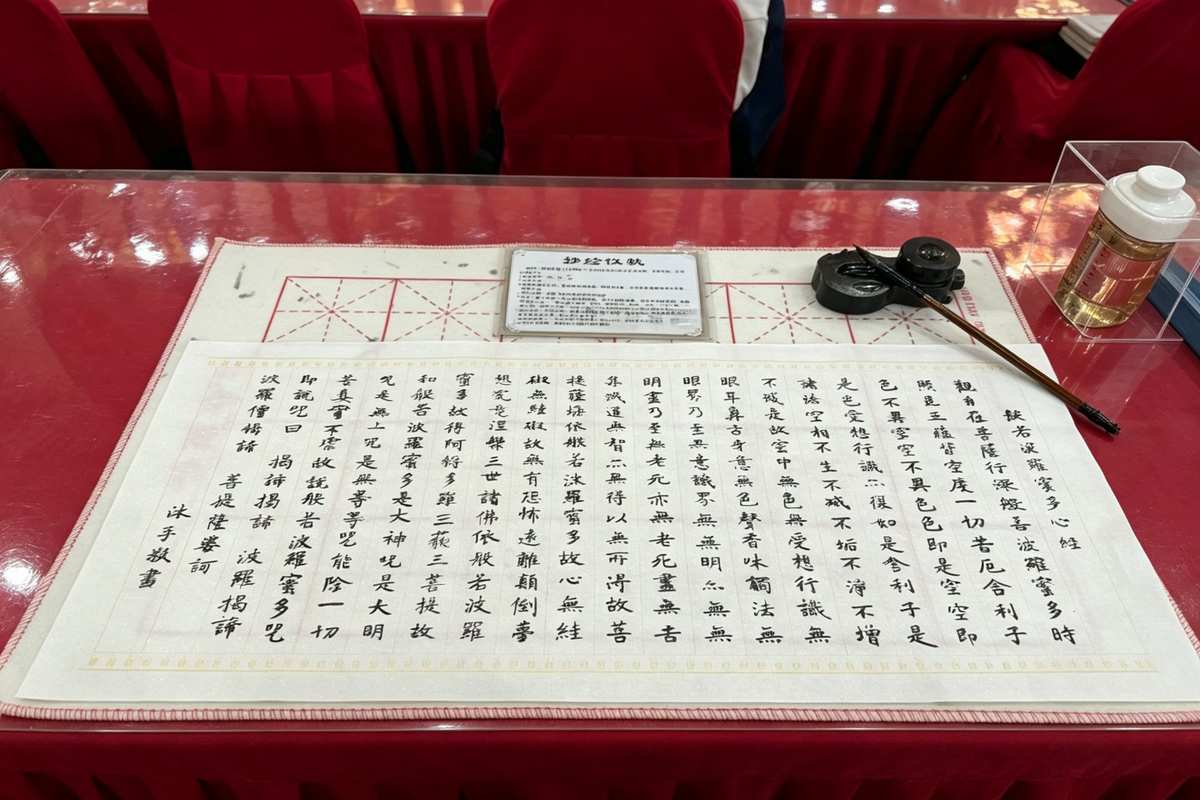
A smooth-writing pen is perfectly suitable for your first experience, allowing you to concentrate on the scripture and the movement of your hand without needing to learn another technical skill simultaneously. Traditional Chinese sutra copying may also involve a brush and ink, which introduce additional considerations such as brush pressure, stroke direction, character structure, and the relationship between individual movements, making this a natural extension for anyone interested in Chinese calligraphy.
3. Suitable paper
Good-quality writing paper is sufficient for ordinary pen-based practice, while those interested in traditional Chinese brushwork may eventually prefer calligraphy paper designed to absorb ink and support different brush techniques. Some sutra copying sheets also include printed reference characters or designated writing spaces, which can help beginners maintain consistent spacing and follow the original scripture more easily.
4. A quiet and comfortable writing space
Choose a stable table with enough room for your scripture, writing paper, and other materials, making sure that the lighting is comfortable enough to read smaller Chinese characters without straining your eyes. Although some people prefer to create a traditional atmosphere with a clean desk and carefully arranged writing materials, a simple and uncluttered workspace is entirely sufficient, provided that you can spend a short period of time without unnecessary interruptions.
5. A realistic amount of time
For your first session, ten to fifteen minutes is a reasonable starting point because it provides enough time to become familiar with the rhythm of writing without turning the experience into a demanding commitment. Once you feel comfortable with the process, you can gradually extend the duration or work with longer passages according to your interests and available time.
5. How to Copy a Sutra: A Step-by-Step Beginner's Guide
After preparing your materials and selecting a suitable passage, you can begin your first sutra copying session by following a simple approach that combines preparation, careful observation, deliberate writing, and a short period of reflection. The purpose of these steps is not to establish a rigid religious routine but to help beginners understand how to approach the activity with respect and attention, allowing the experience to develop naturally over time.
Step 1: Prepare Your Writing Space
Before beginning, organize your writing materials so that the original scripture is clearly visible and your paper is positioned comfortably in front of you, with enough space to move your writing arm without unnecessary tension. If possible, put your mobile phone aside, close unrelated applications, and create a short transition between your everyday activities and the more attentive process of copying the text, which can help you settle into the experience without requiring a complicated preparation ritual.
Step 2: Read the Passage Before Writing
Rather than immediately copying unfamiliar characters, take a little time to read the selected passage once or twice and become familiar with its structure and general meaning. If you are working with a Chinese Buddhist scripture, an accompanying English translation can help you understand the context of the passage, while identifying your starting and ending points in advance will make the writing process easier to follow.
Step 3: Sit Comfortably and Begin Slowly
Choose a posture that allows you to write naturally without creating unnecessary tension in your shoulders, back, or wrist, keeping your body comfortably upright while allowing your writing arm to move freely. There is no need to imitate a formal seated meditation posture while copying a sutra, because a stable and comfortable position is more important than maintaining a rigid posture throughout the session; once you are ready, begin with the first character and reproduce its shape as carefully as possible.
Step 4: Pay Attention to Each Character
As you continue writing, try to concentrate on the character directly in front of you rather than thinking about how many lines remain or how quickly you can complete the passage. Observe the direction of individual strokes, the spaces between them, and the overall balance of each character, allowing your hand to follow the original text at a steady pace; if you are using a traditional brush, you can also notice how pressure and movement influence the appearance of each stroke.
The objective is not to produce perfect calligraphy or create a visually impressive page, but to develop a more attentive relationship with the process of writing. Whenever you notice yourself rushing, take a moment to slow down and return to the character you are copying, allowing the quality of your attention to become more important than the number of words completed.
Step 5: Let Your Breathing Remain Natural
Your breathing can provide a useful reference for maintaining a comfortable rhythm, although there is no requirement to coordinate every character with a specific inhalation or exhalation. Allow your breathing to remain natural throughout the session, and whenever you notice that your hand is moving too quickly or your attention has shifted toward unrelated thoughts, pause briefly, relax your writing hand, and return to the text when you feel ready.
Step 6: Accept Imperfection
As a beginner, you may find that some characters look uneven, your handwriting changes as your hand becomes tired, or you occasionally lose your place while following the original scripture, but these experiences are a normal part of learning and do not need to become reasons for frustration. Sutra copying is not a calligraphy competition in which the value of a page depends on the visual perfection of every character, so it is more useful to follow the guidance of your chosen copybook, correct mistakes appropriately, and continue with patience rather than abandoning the session whenever something does not go according to plan.
Step 7: Finish with a Moment of Reflection
When you reach the end of your selected passage, put down your pen or brush and take a little time to look at what you have written, reflecting on the words themselves as well as the experience of maintaining your attention throughout the session. Some Buddhist practitioners conclude sutra copying with a dedication of merit, although the specific wording and methods vary between traditions; beginners who are unfamiliar with these practices can simply spend a quiet moment appreciating the opportunity to engage with the teachings in a careful and respectful manner.
6. Common Mistakes Beginners Should Avoid
Like other contemplative and cultural activities, sutra copying becomes more approachable when you understand its purpose and avoid placing unnecessary expectations on yourself. Many beginners initially focus too heavily on the appearance of their handwriting or the amount of text they can complete, but a more sustainable approach is to develop familiarity with the scripture, maintain a comfortable pace, and allow the experience to become more natural through regular practice.
Trying to copy too much at once
Beginning with an entire Buddhist scripture can make the activity feel unnecessarily demanding, particularly if you are unfamiliar with Chinese characters or have never tried copying a long passage by hand. Instead, choose a manageable section and gradually increase the amount of writing as your confidence develops, allowing yourself enough time to become comfortable with the materials and the process.
Focusing only on beautiful handwriting
Traditional Chinese calligraphy is an art form that requires dedicated study of brush technique, character structure, composition, and artistic expression, whereas sutra copying places greater emphasis on reproducing a Buddhist text with attention and respect. Although the two activities can complement one another, you do not need advanced calligraphy skills to participate meaningfully in sutra copying, and ordinary handwriting is perfectly acceptable when you are first learning the practice.
Rushing to finish the page
Completing a large number of characters is not the main objective, because the value of the activity lies in the opportunity to engage carefully with the text rather than simply reaching the end of a page. If you notice that you are rushing, consider reducing the amount of material you copy and giving yourself more time to observe the characters, allowing the process to become more comfortable and consistent.
Expecting your mind to become completely empty
Thoughts will naturally arise during repetitive activities, especially when you are beginning to develop the habit of sustained attention, so there is no reason to regard every distraction as a failure. Rather than trying to suppress your thoughts, recognize when your attention has moved elsewhere and gently return to the writing process, which is a more realistic and useful way to approach the contemplative aspect of sutra copying.
Ignoring the meaning of the scripture
Although beginners do not need advanced knowledge of Buddhist philosophy, taking time to learn something about the passage you are copying can make the experience more meaningful and help you understand why the text holds an important place in Buddhist culture. Reading an introduction, consulting a reliable translation, or learning about the historical background of a scripture can provide useful context without interrupting the simplicity of the writing practice.
Turning the practice into another obligation
It is easy to become overly concerned with maintaining a strict daily schedule, particularly when you begin to treat sutra copying as another task that must be completed alongside work and personal responsibilities. However, missing a day does not mean that you need to compensate by writing twice as much the following day, and a flexible routine that you can maintain comfortably is generally more useful than a demanding schedule that creates unnecessary pressure.
7. How Often Should You Practice Sutra Copying?
There is no universal schedule that every practitioner must follow, because the appropriate frequency depends on your available time, personal interests, familiarity with Buddhist scriptures, and the type of experience you hope to develop. For beginners, shorter and more consistent sessions are often easier to maintain than occasional attempts to complete large sections of a scripture, particularly when you are still learning to recognize Chinese characters and understand the structure of the text.
If you are looking for a practical starting point, the following four-week approach can help you gradually establish a comfortable routine without making the activity feel like a demanding commitment:
First week: Spend approximately ten minutes copying a short passage three or four times during the week, concentrating on becoming familiar with the text, writing materials, and basic movement of your hand.
Second week: If you feel comfortable with the process, gradually extend your sessions to around fifteen minutes while continuing to work with a manageable passage.
Third week: Begin exploring the meaning and historical background of the scripture you have selected, using a reliable translation or introductory reading to develop a better understanding of the teachings.
Fourth week: Establish a regular time that fits naturally into your daily routine and consider whether you would prefer to continue with the same text or explore another Buddhist scripture.
This is simply a suggested starting point rather than a formal Buddhist training schedule, and there is no need to follow it rigidly if your circumstances or interests change. Some people prefer to copy a few characters every morning before beginning work, while others enjoy a longer session during the weekend, so the most important consideration is finding a rhythm that allows you to continue without unnecessary pressure.
8. Sutra Copying and Chinese Calligraphy: What Is the Difference?
For international visitors interested in Chinese culture, sutra copying can provide an introduction to the structure and visual beauty of Chinese characters, particularly when traditional brushwork is used to reproduce Buddhist scriptures. However, although sutra copying and Chinese calligraphy share certain materials and techniques, their primary purposes are not necessarily the same, and understanding this distinction can help beginners approach both activities with more realistic expectations.
Chinese calligraphy is a traditional visual art that explores the expressive qualities of written characters through brush technique, stroke structure, rhythm, composition, and artistic style. Developing calligraphic skill requires sustained practice and a detailed understanding of how different brush movements influence the appearance and character of written forms, with experienced calligraphers often spending years refining their technique and developing their own artistic expression.
Sutra copying, by contrast, places greater emphasis on reproducing Buddhist teachings through careful and respectful handwriting, with attention directed toward the scripture and the process of writing rather than necessarily toward artistic achievement. Traditional brush calligraphy may certainly be incorporated into the practice, but the central purpose is to engage with the Buddhist text, making it possible for someone with ordinary handwriting skills to participate without first becoming an experienced calligrapher.
The two activities can nevertheless complement one another in meaningful ways, because learning basic brush techniques can help you appreciate the structure and movement of Chinese characters, while copying Buddhist scriptures provides a cultural and religious context for exploring traditional writing. For anyone interested in both Chinese calligraphy and Buddhist culture, combining these interests can create a particularly rewarding opportunity to learn about traditional Chinese artistic expression and contemplative practice.
9. Experience Sutra Copying in a Traditional Chinese Temple Setting
Practicing at home is a convenient way to begin sutra copying, but experiencing traditional Chinese Buddhist culture in a temple environment can offer a different perspective on the historical and cultural significance of the practice. Within a Buddhist temple, activities such as reading scriptures, studying Buddhist teachings, observing traditional architecture, and participating in contemplative practices exist within a broader cultural setting shaped by religious history and established traditions, allowing visitors to understand how individual practices relate to the wider life of a Buddhist community.
At Longmen Guanghua Temple in Luoyang, Henan Province, visitors can explore the historical background of Chinese Buddhism while becoming familiar with the quieter rhythm of traditional temple life. Located near the famous Longmen Grottoes, the temple is associated with the history of Tang Dynasty Esoteric Buddhism, also known as Tangmi, and its mountain setting and historical connections provide an interesting environment for international visitors who want to learn more about China's Buddhist heritage.
For international visitors, exploring Buddhist culture in a temple environment creates an opportunity to connect historical learning with direct cultural experience, rather than approaching traditional practices exclusively through books, museums, or online information. By learning about the background of Buddhist scriptures and observing the atmosphere of a historic temple, visitors can develop a broader appreciation of the relationship between religious teachings, traditional Chinese culture, and everyday contemplative activities.
Through Funzendo, visitors can explore traditional cultural activities, contemplative experiences, and temple accommodation in Luoyang, with opportunities to learn more about the region's Buddhist heritage and its relationship with traditional Chinese practices. For those interested in exploring cultural learning alongside a visit to Longmen Guanghua Temple, the surrounding historical environment provides an additional context for understanding the development of Buddhism in China.

If you are interested in exploring traditional Chinese cultural practices and structured learning experiences, visit our Training Programs page to learn more about the available opportunities. You can also discover our Temple Stay Experience, which allows visitors to spend time in the atmosphere of a traditional Buddhist temple, or explore our Meditation & Healing Programs for further opportunities to experience Chinese contemplative traditions.
10. Bringing the Practice into Everyday Life
One of the most appealing aspects of sutra copying is that it does not need to remain an activity reserved for temples, religious ceremonies, or special occasions, because the basic practice can be incorporated into ordinary daily life once you become familiar with the materials and writing process. A quiet corner at home, a short passage from a reliable Buddhist text, and a few uninterrupted minutes can provide everything you need to continue exploring the practice outside a traditional temple environment.
For example, you might begin your morning by copying a few lines before checking messages or starting work, creating an opportunity to engage with something other than the usual flow of digital information. Alternatively, you could set aside a short period in the evening to write instead of spending additional time in front of a screen, or combine sutra copying with a few minutes of seated meditation if you already have an interest in contemplative activities.
The practice can also become a starting point for exploring Chinese language and culture, since learning the structure of Chinese characters, discovering the historical background of Buddhist scriptures, and understanding the ideas behind particular passages can gradually turn an ordinary writing activity into a broader journey of cultural learning. As your familiarity develops, you may become interested in traditional Chinese calligraphy, Buddhist philosophy, temple architecture, or other aspects of Chinese Buddhist heritage that provide additional context for the texts you are copying.
There is no need to make your routine complicated or impose strict expectations on yourself, because the purpose is to develop a sustainable way of engaging with the text rather than completing a particular number of pages. Whether you choose to copy a few characters each day or spend a longer period writing during the weekend, consistency, patience, and an interest in the teachings are more important than the amount of material you finish.
Start with One Character
Sutra copying offers a reminder that meaningful practice does not always require complicated methods, extraordinary achievements, or previous experience with meditation and traditional arts. The process begins with one character followed by another, and although your attention may sometimes remain steady and at other times wander toward unrelated thoughts, these changing experiences are simply part of learning to work with patience and awareness.
As you become more familiar with the scripture and the movement of writing, the repeated activity can help you develop a closer relationship with Buddhist texts, traditional Chinese writing, and the cultural values associated with approaching an ordinary task with care. You do not need to be an experienced meditator or a skilled calligrapher to begin exploring this tradition, because a suitable text, a comfortable writing space, and a willingness to learn are enough to take the first step.
If you would like to explore sutra copying, Chinese Buddhist culture, or a traditional temple experience in greater depth, discover the programs offered by Funzendo in Luoyang, China. You can explore our Training Programs, learn more about our Temple Stay Experience, or contact our team to discuss your interests and plan a cultural or contemplative experience in Luoyang.
Frequently Asked Questions
What is sutra copying?
Sutra copying is the practice of reproducing Buddhist scriptures by hand, a tradition that has played an important role in preserving and transmitting Buddhist teachings throughout Chinese history. In addition to its historical function, it is also practiced as a devotional and contemplative activity that encourages patience, concentration, and reflection on the meaning of Buddhist texts.
Do I need good handwriting to copy a sutra?
No previous calligraphy experience or particularly beautiful handwriting is required, because beginners can use an ordinary pen and concentrate on reproducing each character carefully rather than trying to create an artistic result. Traditional Chinese brush calligraphy can be explored later if you become interested in developing your writing technique.
Which Buddhist sutra should a beginner copy?
The Heart Sutra is a popular starting point because it is relatively short and widely known within Mahayana Buddhism, although beginners can also choose a few lines from another reliable Buddhist scripture. A bilingual edition containing the original Chinese text and an English translation can make the experience more accessible to international learners.
Can I copy Buddhist sutras if I cannot read Chinese?
Yes, you can use a bilingual edition that presents Chinese characters alongside an English translation, allowing you to reproduce the original text while gradually learning about its general meaning and historical background. A printed practice sheet can also help you follow the structure of unfamiliar characters without needing to understand every word immediately.
Do I need a traditional Chinese calligraphy brush?
No, a regular pen is sufficient for your first sutra copying session, particularly if your main interest is becoming familiar with the scripture and developing a comfortable writing rhythm. A traditional brush and ink can be introduced later if you would like to explore Chinese calligraphy and learn more about traditional brush techniques.
How long should a sutra copying session last?
Ten to fifteen minutes is a reasonable starting point for beginners, as it provides enough time to experience the process without making the activity feel unnecessarily demanding. As you become more comfortable with the practice, you can gradually extend your sessions according to your interests and available time.
Is sutra copying a form of meditation?
Sutra copying can be approached as a contemplative activity because it involves sustained attention, deliberate physical movement, and reflection on Buddhist teachings, although it is distinct from formal seated meditation and may carry different devotional or cultural meanings depending on the Buddhist tradition. For beginners, it can provide an accessible way to explore attentive practice while becoming more familiar with Chinese Buddhist culture.
Can I experience sutra copying during a temple stay in China?
Some Buddhist cultural programs and temple-related learning experiences may include sutra copying or traditional calligraphy activities, although the specific arrangements and availability vary between organizers and programs. If you are interested in including this activity during a temple stay in China, it is advisable to contact the organizer in advance to confirm whether sutra copying is available as part of the experience.
Discover Chinese Buddhist culture with Funzendo. Learn more about our Training Programs and Temple Stay Experiences, or contact us for further information about exploring traditional Chinese Buddhist culture in Luoyang.