Karma and Reincarnation: What Buddhism Actually Teaches (and What Pop Culture Gets Wrong)
"Karma will get them." "She has good karma." "Maybe this is just my fate."
These expressions appear everywhere in modern English. Karma has become a familiar word in films, social media, conversations about relationships, and discussions about success or failure. It is often presented as a kind of cosmic scoreboard: do something good and good things will happen to you; do something bad and the universe will eventually punish you.
It is an appealing idea, but it is not an accurate explanation of what Buddhism teaches.
In Buddhist philosophy, karma and rebirth are connected with much deeper questions: How do our intentions shape our actions? Why do habits influence the way we experience the world? What continues when there is no permanent, unchanging self? And how can a person change the direction of their life?
These ideas are central to understanding Buddhist ethics and spiritual practice. They are also practical subjects for anyone interested in Chinese Buddhist culture, meditation, or a temple experience in China.
This guide explains the meaning of karma, the Buddhist understanding of rebirth, and several common misunderstandings in straightforward English, without reducing these teachings to superstition or a simple system of rewards and punishments.
1. What Does Karma Actually Mean in Buddhism?
The word karma comes from Sanskrit and is commonly translated as "action" or "deed." In Buddhist teaching, however, karma has a more specific meaning: it refers primarily to intentional action.
The intention behind what we do, say, and think matters. An action motivated by generosity is different from one motivated by greed. Speaking honestly is different from deliberately deceiving someone. Even when two actions appear similar from the outside, the intention behind them can give them different ethical significance.
This is why karma should not be understood simply as a record of everything that happens to a person. It concerns the ethical and psychological significance of intentional actions and the consequences that may arise from them.
Karma Is About Intention, Not Just the Outcome
Imagine two people who accidentally cause the same damage. One acted without knowing that harm would occur. The other deliberately intended to cause it.
The external result may look similar, but the intentions are different. Buddhist teachings place considerable importance on this distinction because intention helps determine the karmic significance of an action.
This does not mean that consequences are unimportant. An accidental action can still cause real suffering and may require an apology or practical effort to repair the harm. Rather, it means that Buddhist karma cannot be understood by looking only at what happened. We must also consider the intention behind the action.
How Karma Shapes Habits and Future Experience
One useful way to understand karma is to consider how repeated actions influence character.
When someone repeatedly responds to difficulty with anger, anger can become a familiar habit. When someone regularly practices patience, generosity, and honesty, those qualities can become more natural over time.
This is a practical dimension of karma that people can observe in everyday life. Our choices do not simply disappear after the moment has passed. They can influence our relationships, habits, attitudes, and the conditions we help create around us.
Traditional Buddhist teachings also understand karma in relation to the wider process of rebirth and the results of actions beyond a single lifetime. These teachings involve more than ordinary psychological cause and effect, and different Buddhist traditions explain their details in different ways.
The important point is that karma is not a supernatural judge deciding who deserves happiness or suffering. It is part of a broader Buddhist understanding of intentional action, causation, and the conditions that shape experience.
2. Karma Is Not a Cosmic Reward-and-Punishment System
One of the most common misunderstandings about karma is the belief that every good action must produce an immediate reward and every harmful action must lead to immediate punishment.
That is not how Buddhist teachings describe the relationship between actions and results.
Karmic results depend on causes and conditions. They are not always immediate, predictable, or visible. A generous person may still experience illness, financial difficulty, or personal loss. Someone who behaves selfishly may appear successful for a long time.
These observations do not prove that karma is a system of instant justice. They show why the popular idea of a simple moral scoreboard is inadequate.
Why Do Good People Sometimes Suffer?
This is one of the most difficult questions people ask when learning about karma.
Buddhist philosophy does not suggest that every painful experience is the direct result of one particular past action. Human life is influenced by many conditions, including physical health, family circumstances, social relationships, environmental factors, and the actions of other people.
It is therefore misleading and potentially harmful to tell someone who is suffering that they must have done something wrong in a previous life. Such a claim is not a responsible way to apply Buddhist teaching.
Understanding karma should encourage greater awareness and compassion, not judgment toward people experiencing hardship.
Does Karma Mean Everything Is Predetermined?
No. Karma is not the same as fate.
If every moment were completely fixed by past actions, there would be little meaning in ethical conduct, learning, or spiritual practice. Yet Buddhist traditions place great importance on present choices.
People can develop new habits, change harmful patterns, cultivate wisdom, and respond to difficult circumstances in different ways. The past influences the present, but it does not mean that every future event is already determined.
A useful image is to think of past actions as conditions that influence the direction of a journey. They matter, but they are not the only conditions at work. What you choose to do now also matters.
3. The Buddhist Teaching of No-Self: What Is Anatta?
To understand Buddhist ideas about rebirth, it is necessary to explore another important teaching: anatta in Pali, or anatman in Sanskrit, commonly translated as "no-self" or "non-self."
This teaching is one of the most distinctive features of Buddhist philosophy.
Many people naturally assume that there is a permanent inner self: an unchanging identity that remains exactly the same throughout life. We often describe this inner identity as a soul, a true self, or the essential person behind our changing thoughts and experiences.
In contrast, Buddhism teaches that what we normally regard as the self cannot be found as a permanent, independent, unchanging entity.
What Does No-Self Actually Mean?
No-self does not mean that people do not exist, that personal identity is meaningless, or that actions have no consequences.
In everyday life, we clearly have names, relationships, memories, responsibilities, and individual experiences. Buddhist teaching does not require us to deny these conventional realities.
Instead, it invites us to examine what makes up our experience and whether any part of it can truly be regarded as permanent and independent.
Classical Buddhist teaching often analyzes experience through the five aggregates:
Form: the physical body and material aspects of experience.
Feeling: pleasant, unpleasant, or neutral sensations and responses.
Perception: the recognition and identification of things.
Mental formations: intentions, habits, emotions, and other mental activities.
Consciousness: awareness associated with the different senses and mental experience.
These processes are constantly changing and depend on conditions. None provides evidence of a permanent, independent self that remains untouched by change.
For beginners, the practical significance is worth considering. We often become deeply attached to our opinions, social roles, achievements, and personal stories. The teaching of no-self encourages us to examine that attachment and recognize how much of what we call "me" is changing and dependent on other conditions.
4. If There Is No Permanent Self, What Is Reborn?
This is perhaps the most challenging question in Buddhist discussions of karma and rebirth.
If Buddhism teaches that there is no permanent soul, how can there be continuity from one life to another? If nothing remains exactly the same, what connects a person's actions with future experience?
Buddhist traditions approach this question through the principle of dependent origination: phenomena arise through causes and conditions rather than existing independently.
Rebirth is understood within this framework. There is continuity, but not the transfer of an eternal, unchanging soul from one body to another.
Why "Rebirth" Is Often Preferred to "Reincarnation"
In English, the words rebirth and reincarnation are sometimes used as if they mean exactly the same thing. In discussions of Buddhism, however, writers often prefer the word "rebirth."
The reason is that "reincarnation" can suggest that a permanent soul leaves one body and enters another. That interpretation conflicts with the Buddhist teaching of no-self.
"Rebirth" is often used to emphasize continuity through causes and conditions without assuming that an unchanging personal essence travels between bodies.
Different Buddhist schools offer different philosophical explanations of this continuity. Some discuss consciousness and karmic tendencies; others develop more detailed accounts of how actions and their results continue through the process of rebirth.
These explanations should not be reduced to the idea that an ordinary stream of consciousness simply moves from one physical body to another. Buddhist teachings about consciousness, identity, and rebirth are more subtle than that.
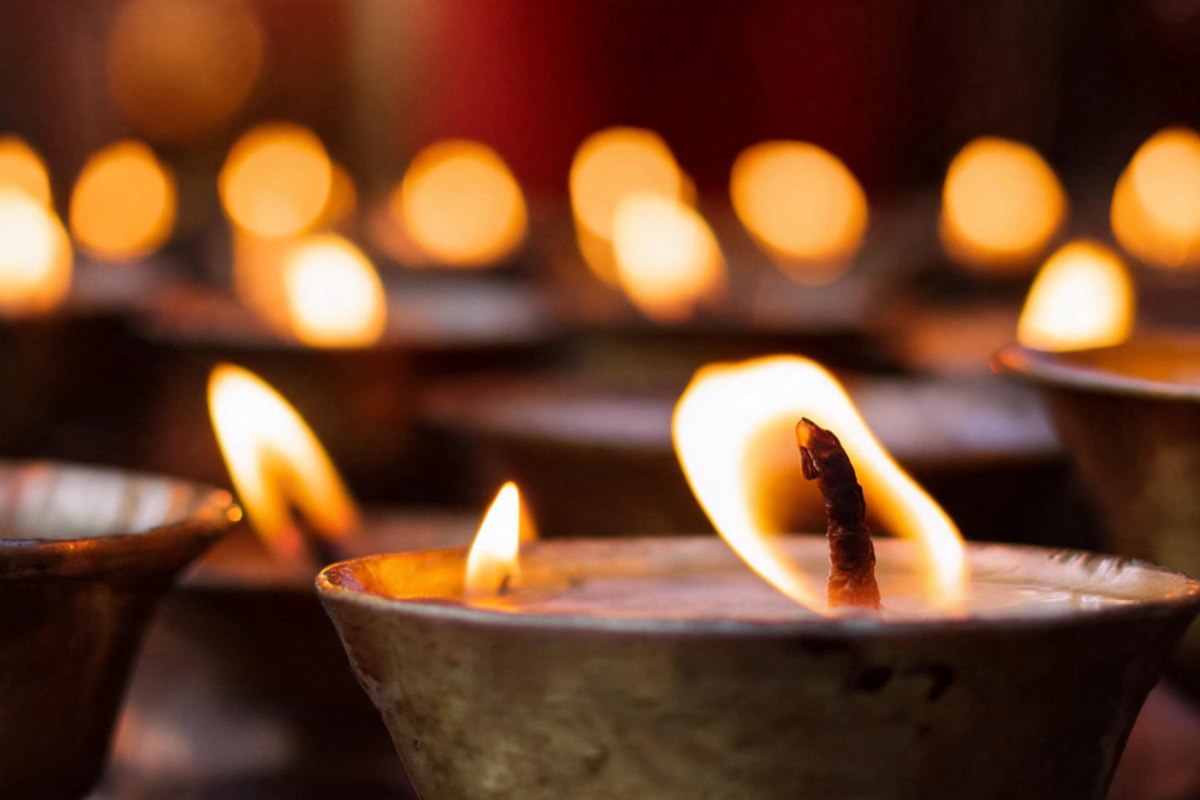
A Simple Analogy: One Flame Lighting Another
A traditional analogy used in Buddhist discussions is the relationship between two flames.
Imagine using one candle to light another. The second flame depends on the first, but it is not simply the same physical flame transferred from one candle to another. There is a relationship of continuity and causation without complete identity.
This analogy can help introduce the idea that continuity does not necessarily require an unchanging substance. However, it is only an illustration. It should not be treated as a complete explanation of the Buddhist doctrine of rebirth.
5. Karma, Rebirth, and the Cycle of Samsara
Karma and rebirth are closely connected with the Buddhist concept of samsara (轮回, lúnhuí): the continuing cycle of birth, death, and rebirth.
In Buddhist teachings, samsara is not generally presented as a perfect or permanent state of happiness. It is associated with suffering, dissatisfaction, impermanence, and the repeated patterns that arise through ignorance, craving, and attachment.
Karma contributes to the conditions through which this cycle continues. Intentional actions have consequences, and those consequences are understood as part of the wider process of conditioned existence.
What Keeps the Cycle Going?
Buddhist teachings frequently identify ignorance, craving, and attachment as important causes of continued suffering.
Ignorance: misunderstanding the changing and dependent nature of experience.
Craving: constantly seeking pleasure, security, recognition, or experiences that we believe will make us permanently satisfied.
Attachment: holding tightly to people, possessions, identities, and expectations as though they could never change.
These patterns influence how people think and act. They can create repeated cycles of dissatisfaction, conflict, and harmful behavior.
The Buddhist path therefore does not focus only on accumulating good karma. It also aims to develop wisdom and freedom from the underlying causes of suffering.
What Is Nirvana?
Nirvana (涅槃, nièpán) is a central goal in Buddhist teaching. It is associated with the ending of greed, hatred, and ignorance, and with liberation from the suffering connected with samsara.
It should not be understood simply as a pleasant heaven, a reward for good behavior, or another place to be reborn. In Buddhist traditions, nirvana refers to liberation from the causes that sustain suffering and the cycle of rebirth.
This is why Buddhist practice involves more than trying to collect positive experiences. Ethical conduct, meditation, and wisdom are traditionally understood as interconnected parts of the path toward liberation.
6. What Karma Means in Everyday Life
You do not need to resolve every philosophical question about rebirth before considering the practical implications of karma.
Even in ordinary daily life, the relationship between intention, action, habit, and consequence is easy to observe. The way we speak to others can influence our relationships. Repeated reactions can shape our character. The decisions we make today can create conditions that affect tomorrow.
Here are four ways to reflect on the Buddhist understanding of karma in everyday situations.
1. Pay Attention to Your Intentions
Before taking action, ask yourself why you are doing it. Are you acting out of generosity, patience, and understanding, or are you reacting from jealousy, anger, or the desire to control someone else?
Learning to recognize intention does not mean judging every thought harshly. It means becoming more aware of the motivations that influence behavior.
2. Notice the Habits You Repeat
A single reaction may seem insignificant, but repeated reactions can become deeply established patterns.
For example, responding to disagreement with hostility can gradually damage relationships. Practicing patience and listening carefully can create a different pattern. This is one practical way to understand how intentional actions influence future experience.
3. Take Responsibility Without Blaming Yourself for Everything
Buddhist karma encourages responsibility for intentional conduct, but it should not become a reason to blame yourself for every difficulty.
Many circumstances arise through causes beyond individual control. Illness, accidents, natural events, and social conditions cannot simply be explained by claiming that someone deserves what happened.
A balanced understanding of karma combines personal responsibility with compassion for the complexity of life.
4. Remember That Change Is Possible
One of the most encouraging aspects of Buddhist teaching is that harmful habits are not necessarily permanent. Through awareness, ethical conduct, and sustained practice, people can learn to respond differently.
A difficult past does not mean that a person is incapable of change. The choices made in the present remain important.
7. How Meditation Relates to Karma and Buddhist Practice
In Buddhism, meditation is not simply a technique for relaxation. It is part of a broader path that includes ethical conduct and the development of wisdom.
By observing thoughts, emotions, and reactions, practitioners can begin to recognize patterns that might otherwise remain unnoticed. They may become more aware of anger as it arises, notice how craving influences decisions, or recognize the difference between an immediate emotional response and a considered action.
This kind of awareness can support more thoughtful behavior. Rather than reacting automatically, a person may gradually develop the ability to pause, observe, and choose a more constructive response.
In this way, meditation can support the practical cultivation of wholesome intentions and actions. It does not mean that a single meditation session erases past karma or guarantees a particular future result. Buddhist practice is a gradual process involving repeated effort and understanding.
8. Karma and Rebirth in Chinese Buddhist Culture
Karma, rebirth, and liberation are important themes throughout Chinese Buddhist history. As Buddhism developed in China, these teachings became part of a wider cultural conversation involving ethics, family relationships, filial devotion, ritual practice, and the meaning of human life.
In Chinese Buddhist communities, the concept of cause and effect is often expressed through the phrase yinguo (因果). It is used to describe the relationship between causes and consequences and is an important idea in Buddhist ethical teaching.
The dedication of merit is another significant practice. After making offerings, chanting sutras, or performing other wholesome actions, practitioners may dedicate the merit of their practice to family members, deceased relatives, or all sentient beings.
This practice reflects the Buddhist emphasis on compassion and the wish that others may benefit from wholesome actions. It is also one reason Buddhist ceremonies are closely connected with family remembrance in many Chinese communities.
For international visitors, learning about these customs can provide a richer understanding of Chinese Buddhist culture. They show that Buddhist ideas are not limited to abstract philosophical discussions. They also influence how people express gratitude, remember loved ones, and approach their responsibilities toward others.
9. Experiencing Buddhist Practice in a Traditional Temple Setting
Reading about karma and rebirth provides an intellectual introduction to Buddhist philosophy. Experiencing the rhythm of a traditional temple offers a different perspective.
In a temple environment, the day may follow a structured rhythm of morning activities, chanting, meditation, meals, and periods of quiet. These routines can help visitors observe how Buddhist principles are connected with conduct and daily life.
At Longmen Guanghua Temple in Luoyang, Henan Province, visitors can explore a setting associated with the history of Tangmi, or Chinese Esoteric Buddhism. Tangmi and Chan Buddhism are distinct traditions, but both form important parts of China's wider Buddhist heritage.
For those who want to spend more time in a traditional Buddhist environment, the Temple Stay experience at Funzendo offers an opportunity to learn about temple customs and experience aspects of daily temple life.
Visitors interested in contemplative practice can also explore the Meditation & Healing programs. These experiences provide an introduction to meditation and traditional Chinese contemplative culture, while allowing participants to step away from the pace of ordinary routines.
A temple stay or meditation program should not be viewed as a shortcut to understanding karma, achieving enlightenment, or changing one's destiny. Rather, it can provide a setting in which to learn, observe, and reflect on the relationship between Buddhist teachings and everyday conduct.
10. Common Misunderstandings About Karma and Rebirth
Because karma and reincarnation have become popular subjects in films, books, and online discussions, several misunderstandings are especially common.
"Karma means people always get what they deserve." Buddhist karma is not a simple system of instant punishment and reward. Results depend on many causes and conditions.
"Karma is the same as fate." Past actions influence conditions, but present intentions and actions also matter. Buddhism does not teach that every future event is fixed.
"Buddhists believe in an eternal soul that moves between bodies." The teaching of no-self rejects the idea of a permanent, independent self. Buddhist explanations of rebirth focus on continuity through causes and conditions.
"Every misfortune is punishment for something done in a past life." This is an oversimplification. Suffering arises through many conditions, and blaming people for hardship is not a compassionate application of Buddhist teaching.
"Good karma is the only goal of Buddhist practice." Wholesome actions are important, but Buddhist practice also aims to develop wisdom and freedom from the causes of suffering.
Understanding these distinctions makes it easier to appreciate Buddhism as a philosophical and practical tradition rather than a collection of supernatural promises.
Frequently Asked Questions About Karma and Rebirth
Is karma a form of punishment in Buddhism?
No. Karma refers primarily to intentional action and its consequences. It is not a cosmic judge or a system designed to punish people. The results of actions arise through causes and conditions and are not always immediate or predictable.
Do Buddhists believe in a soul?
Classical Buddhist teaching includes the doctrine of no-self, known as anatta or anatman. It teaches that there is no permanent, independent, unchanging self. This does not deny conventional personal identity, but it challenges the idea of an eternal essence behind experience.
What is the difference between reincarnation and rebirth?
In English-language discussions, reincarnation often suggests that a permanent soul moves from one body to another. Rebirth is commonly preferred when discussing Buddhism because it emphasizes continuity through causes and conditions without assuming an eternal, unchanging self.
Can people change their karma?
People can change the direction of their lives through present intentions and actions. Ethical conduct, awareness, and Buddhist practice can help cultivate wholesome habits and reduce harmful patterns. This does not mean that every past action can simply be erased or that future results can be predicted with certainty.
Does karma explain everything that happens in life?
No. Buddhist teachings recognize that events arise through multiple causes and conditions. It is inaccurate to explain every illness, accident, or personal difficulty as the direct result of an individual's past karma.
What is samsara in Buddhism?
Samsara refers to the continuing cycle of birth, death, and rebirth. It is associated with suffering and the conditions that sustain conditioned existence. Buddhist practice aims to understand and ultimately become free from the causes of this cycle.
What is nirvana?
Nirvana is the liberation associated with the ending of greed, hatred, and ignorance. It is not simply a heavenly destination or a reward for good behavior. It represents freedom from the causes of suffering and continued rebirth.
Can meditation help me understand karma?
Meditation can help practitioners observe their intentions, thoughts, and habitual reactions more clearly. This awareness can support more thoughtful actions and a deeper understanding of Buddhist ethical practice. However, meditation is one part of a broader path that also includes ethical conduct and wisdom.
Conclusion: Karma Is About How We Live, Not Just What Happens to Us
Karma and rebirth are among the most important and frequently misunderstood teachings in Buddhism. They are not simply ideas about luck, punishment, or a mysterious force controlling the future.
Karma draws attention to intentional action and the conditions created by our choices. The teaching of no-self challenges the assumption that we possess a permanent and independent identity. Rebirth describes continuity through causes and conditions rather than the journey of an eternal soul. Together, these teachings form part of a wider Buddhist understanding of suffering, responsibility, and liberation.
For anyone beginning to explore Buddhism, a useful starting point is not to worry about predicting the results of every action. Instead, pay attention to intention, cultivate compassion, and notice how repeated choices shape the way you live.
These principles are not only subjects for philosophical discussion. They are also part of the everyday ethical and contemplative life that has developed within Buddhist communities for centuries.
If you would like to explore Chinese Buddhist culture beyond books and online explanations, discover the Funzendo Temple Stay and its opportunities to experience a traditional temple environment in Luoyang.
Understanding begins with learning. Practice begins with the choices we make today.