Singing Bowl Sound Healing: What to Expect in a Temple Session
Singing bowls produce a sound that is difficult to describe until you have experienced it in person. A single strike can create a clear, resonant tone that gradually softens into a long, delicate vibration. As the sound fades, another tone may emerge from across the room, creating an atmosphere that feels spacious, quiet, and unhurried.
Today, singing bowl sound healing can be found in wellness studios, yoga spaces, retreat centres, and private homes. Yet experiencing the sound in a traditional Chinese temple offers a different context. The surroundings invite a slower pace, while the practice creates an opportunity to step away from everyday noise and pay attention to the experience of listening.
For first-time participants, the questions are often practical. Do you need meditation experience? Will the bowls be played directly on your body? What happens if you cannot relax? And what should you expect to feel when the session ends?
This guide explores the experience step by step, explains what is known about sound and relaxation, and introduces the cultural atmosphere in which singing bowl sessions can become part of a broader temple experience at Funzendo in Luoyang, China.
What Is Singing Bowl Sound Healing?
Singing bowl sound healing is a relaxation and contemplative practice that uses the sustained tones of singing bowls to create an environment for listening, rest, and focused attention. Depending on the session, a practitioner may also use gentle chimes or other sound instruments.
Unlike a conventional meditation class, a sound bath usually requires very little active participation. Rather than following a long sequence of instructions or trying to maintain concentration on the breath, participants are invited to settle into a comfortable position and listen as the sounds develop and fade.
The term sound bath describes the immersive quality of the experience: sound seems to surround the listener, shifting in intensity, pitch, and distance. It does not mean that participants are physically immersed in water, nor does it imply a medical treatment.
At Funzendo, singing bowl experiences can be understood within a wider setting of meditation, traditional culture, and contemplative practice. Those who want to explore the broader context can learn more about meditation at Funzendo and how quiet practice can be incorporated into a temple visit.
How Singing Bowls Shape the Experience
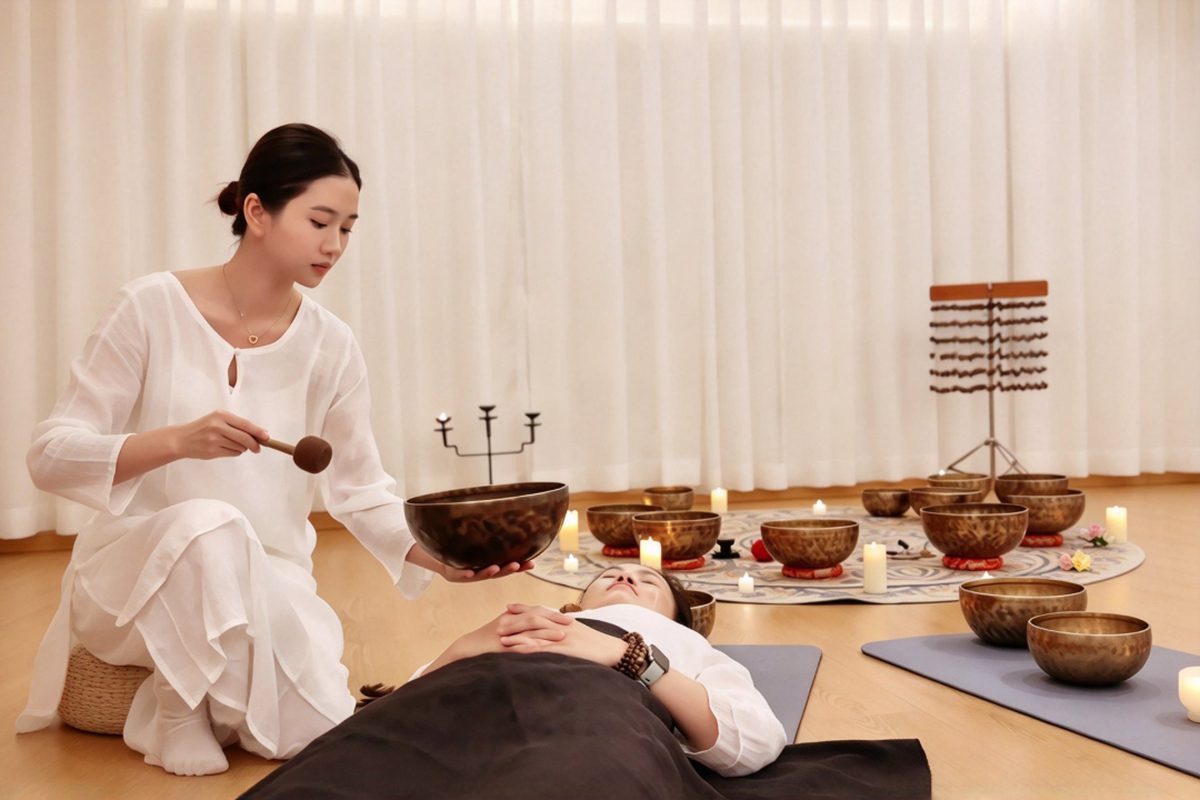
A singing bowl does not produce just one isolated note. When struck or played around the rim, it can create a complex sound with a prominent tone and softer accompanying frequencies. The sound may begin clearly, develop a layered quality, and gradually diminish.
This changing sound is an important part of the experience. There is no need to follow a melody, remember a sequence, or decide whether the music is being performed correctly. Attention can simply rest on the sound as it appears, changes, and disappears.
Some participants notice the difference between a bright, high tone and a deeper resonance. Others become more aware of the pauses between sounds, the acoustics of the room, or the rhythm of their own breathing. There is no single correct way to listen.
The instruments used, the room, the practitioner’s technique, and the distance between the bowls and the listener all influence the experience. A session in a quiet room may feel very different from one held in a large space with a longer natural reverberation.
The Science of Sound and Relaxation
You do not need to hold a particular spiritual belief to take part in a singing bowl session. Listening to sound is an ordinary human experience, and music and other auditory environments can influence mood, attention, and perceived relaxation.
A quiet session may offer several conditions that make rest easier: a break from screens and conversation, a comfortable place to lie down, fewer external demands, and a sustained focus on sound rather than everyday tasks. For people whose minds are usually occupied with planning and problem-solving, this change of attention can feel significant.
Attention, breathing, and mental activity
When attention follows a slow sequence of tones, some people find it easier to stop switching between thoughts. The sound provides a simple point of focus. If the mind wanders, participants can return to listening without judging themselves or trying to force the mind to become completely empty.
The quiet setting may also encourage slower, more comfortable breathing. Relaxation practices can help some people feel less tense, although individual responses vary. It is important to distinguish these possible effects from claims that a particular frequency automatically produces a specific brainwave pattern or physiological result.
What research can—and cannot—tell us
Research into sound-based relaxation and singing bowl interventions is still developing. Some small studies have reported improvements in self-rated tension, mood, or relaxation after sound-based sessions. However, study designs and methods vary, and the available evidence does not establish singing bowls as a treatment for medical or psychological conditions.
A sound bath should therefore be approached as a complementary wellbeing experience, not a cure. It does not replace medical care, prescribed medication, psychotherapy, or professional advice. A participant may feel deeply relaxed, mildly curious, sleepy, emotional, or simply unchanged. All of these responses are possible.
What Happens During a Session?
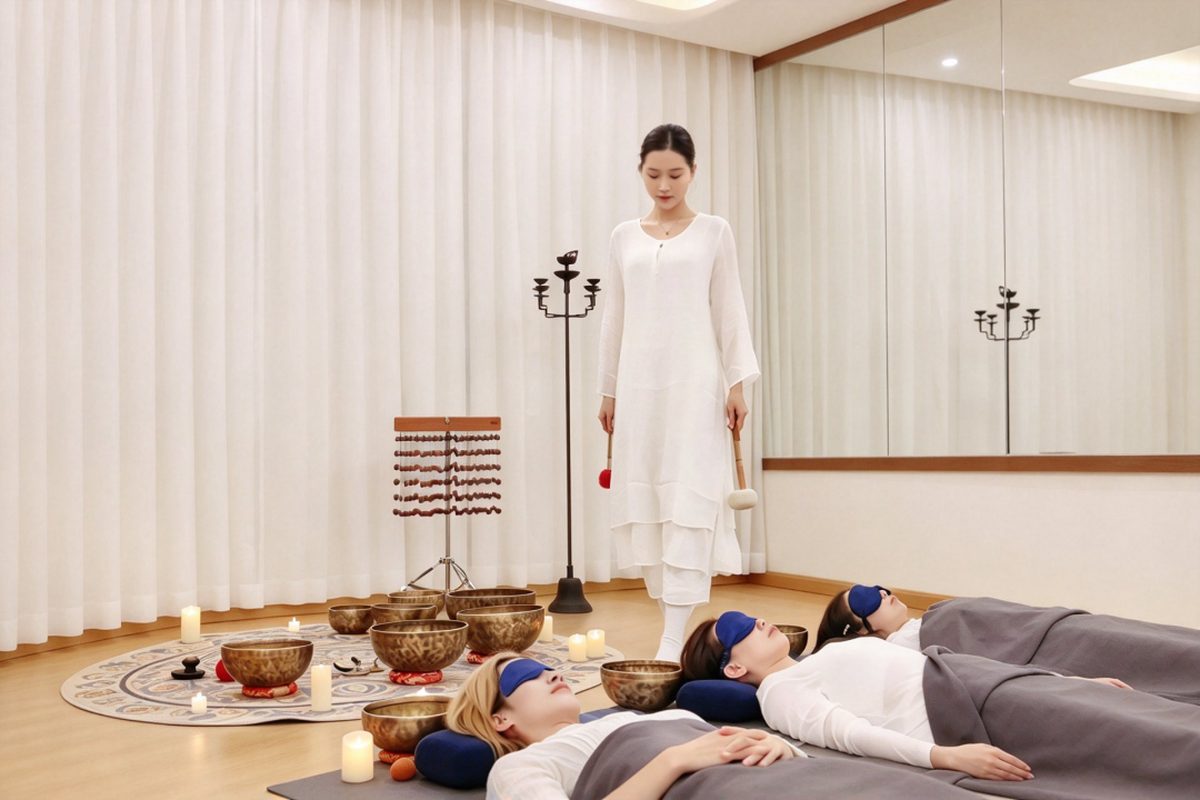
The exact format depends on the practitioner, venue, and programme. A session may last around 45–60 minutes, but this is a general example rather than a fixed promise for every Funzendo experience. If you are booking a particular activity, confirm its actual duration and format in advance.
Step 1: Arriving and getting comfortable
You begin by entering the practice space and finding a comfortable position. Depending on the venue, a mat, cushion, or blanket may be available. Participants are generally encouraged to silence their phones and minimise conversation so that everyone can settle into the same quiet environment.
You do not need special clothing. Comfortable layers are useful because body temperature can change when you remain still for an extended period. If lying on the floor is uncomfortable, ask whether a seated position or additional support is possible.
Step 2: Settling your attention
The practitioner may offer a short introduction or a few gentle breathing instructions. The purpose is not to achieve a perfect breathing rhythm. It is simply to make the transition from ordinary activity to attentive listening.
If you arrive with a busy mind, there is no need to wait until you feel calm before the session begins. You can bring the thoughts and concerns you already have into the room. The practice is an opportunity to pause, not a test of your ability to relax.
Step 3: Listening as the sounds emerge
The practitioner begins playing the bowls, often with a series of measured strikes or sustained tones. The sounds may overlap, creating layers of resonance, or appear individually with periods of silence between them.
You may notice changes in volume, pitch, rhythm, or the way a sound seems to move through the space. There is no requirement to interpret the sounds or attach a meaning to each one. Listening with curiosity is enough.
Step 4: Remaining still—or adjusting when needed
As the session continues, some people become drowsy or lose track of time. Others remain fully alert and notice small details in the sound. Some find their attention wandering repeatedly. None of these experiences means that the session has succeeded or failed.
If you feel uncomfortable, need to change position, or would prefer to sit up, do so as needed. You should not feel obliged to remain in a position that causes pain or distress. A considerate session allows participants to respond to their own comfort and boundaries.
Step 5: Letting the sound fade
Near the end, the practitioner gradually brings the sound to a close. A short period of silence may follow, giving participants time to notice the room again and return their attention to their surroundings.
It is helpful to sit up slowly, especially if you have been lying down with your eyes closed. Take a moment before standing or returning to a busy schedule. There is no need to describe your experience immediately unless you want to share it.
What Might You Feel Afterward?
People often approach a sound bath expecting a dramatic experience. In practice, responses can be subtle and highly individual. You might leave feeling rested, notice that your shoulders seem less tense, or find that your attention feels less scattered. You might also discover that you spent much of the session thinking about work, family, or your plans for the following day.
Some participants report feeling sleepy or finding it easier to settle down at bedtime. Others simply enjoy the sound and the opportunity to spend time without conversation or screens. These are personal reports rather than guaranteed outcomes.
There is no need to measure the session by how peaceful you feel afterward. If you found it difficult to relax, that is useful information too: you may prefer a shorter session, a seated format, a quieter room, or a different kind of contemplative activity.
If you wish to reflect on the experience, consider a few simple questions:
Which sounds did you notice most clearly?
Was it easier to focus on listening than on your thoughts or breathing?
Did you feel comfortable throughout the session?
Would you prefer a shorter, longer, seated, or lying-down experience next time?
These questions are not a scorecard. They help you identify what suits you personally, rather than comparing your experience with someone else's.
Is Singing Bowl Sound Healing Suitable for Beginners?
A sound bath can be accessible to people who have never attended a meditation class. There is usually no sequence to memorise and no need to maintain a particular posture for the entire session. The main task is to listen and find a comfortable way to rest.
It may appeal to travellers interested in Chinese temple culture, people curious about contemplative practices, or participants who find silent sitting challenging. It can also provide a quiet pause during a cultural retreat, where a day may include walking, learning, tea, incense, or visits to historical sites.
However, beginner-friendly does not mean that every format suits everyone. People who are sensitive to loud or high-pitched sounds may prefer a quieter session or a seat farther from the instruments. If you have tinnitus, sound sensitivity, a history of sound-triggered discomfort, or another relevant concern, consider speaking with a qualified healthcare professional and the practitioner before participating.
You should be able to ask about sound levels, instrument placement, whether bowls will be played close to your body, and whether you can leave or pause if needed. A well-run experience respects personal boundaries rather than asking participants to endure discomfort.
Is a Temple Sound Bath Religious?
The answer depends on the programme and setting. A session held in or connected with a Buddhist temple may take place within a broader atmosphere of Buddhist culture, ritual, and contemplative life. That context can be meaningful for visitors who want to learn about Chinese spiritual traditions.
At the same time, listening to singing bowls does not require participants to adopt a religious belief. A sound session may focus primarily on listening, stillness, and relaxation. If a particular programme includes chanting, a Buddhist ceremony, a teaching, or other ritual elements, those details should be explained before the activity begins.
It is also useful to distinguish modern sound-bath formats from traditional Buddhist practice. Singing bowls are used in a variety of contemporary wellbeing settings, and the instruments and methods used today do not all belong to one uniform historical tradition. Their presence in a session should not automatically be taken as proof of a specific ancient ritual lineage.
For international visitors, this distinction makes it easier to approach the experience with both curiosity and respect: enjoy the sound, learn about the surroundings, and ask questions when you want to understand more.
Singing Bowls Within a Wider Cultural Experience
A singing bowl session can be experienced on its own, but it can also form one part of a wider introduction to contemplative culture in China. In Luoyang, visitors can explore Buddhist heritage alongside traditional tea culture, incense practices, temple architecture, and the history of the Longmen area.
These activities offer different ways of paying attention. Tea culture emphasises the preparation and appreciation of tea; incense culture introduces the materials, aromas, and techniques associated with traditional fragrance practices; meditation invites participants to observe their attention and experience more directly. A sound session adds another dimension through listening.
The value of combining these activities is not that each one promises a particular health outcome. Rather, they provide opportunities to encounter different aspects of Chinese cultural life in a setting where the pace may be slower than in a conventional sightseeing itinerary.
For travellers who want to understand the relationship between sound, contemplative practice, and temple culture, Funzendo offers a starting point for exploring its meditation and contemplative experiences. Programme availability, session content, and booking arrangements should be checked before planning a visit.
You can also read more about the cultural context of singing bowls in a temple setting to explore the topic beyond the immediate experience of a sound bath.
How to Prepare for Your First Session
A little preparation can make the experience more comfortable without turning it into another task to complete. The aim is simply to arrive ready to listen.
Wear comfortable clothing. Choose clothes that allow you to sit or lie down without restriction. Bring an extra layer if you tend to feel cold while resting.
Avoid rushing in. If possible, leave enough time to arrive, put away your belongings, and settle before the session starts.
Share relevant needs. Tell the practitioner if you have difficulty lying on the floor, are sensitive to sound, or need to adjust your position.
Keep expectations flexible. You do not need to feel transformed, fall asleep, or stop thinking for the session to be worthwhile.
Check the session details. Ask about duration, the type and volume of instruments, participant numbers, and whether bowls will be played on or near the body.
Leave time afterward. If your schedule allows, take a few quiet minutes before returning to travel, work, or other activities.
If you are joining a retreat or temple stay, ask whether the sound session is included in the programme or booked separately. It is also worth confirming the language of any introduction, the accessibility of the practice space, and what facilities are available.
Frequently Asked Questions
Do I need meditation experience?
No previous experience is generally required for a basic sound bath. You can listen while sitting or lying down, depending on the session format. Follow the practitioner's instructions and choose a position that is comfortable for you.
Do I need to know how to use a singing bowl?
No. Participants normally listen while a practitioner plays the instruments. Learning to play a bowl is a separate skill-based activity and is not necessary for attending a sound bath.
Will the singing bowls be placed on my body?
Not necessarily. Many sessions use bowls that are played around the room or near participants. Direct contact or body placement depends on the specific method, so ask the organiser before booking if this is important to you.
Can singing bowl sound healing treat insomnia, anxiety, or pain?
It should not be presented as a treatment or cure for these conditions. Some people find sound-based relaxation helpful as a complement to their usual wellbeing routines, but responses vary and the evidence remains limited. Consult an appropriate healthcare professional about persistent symptoms and continue any recommended treatment.
What if I cannot stop thinking during the session?
That is normal. A sound bath does not require an empty mind. When you notice that your attention has moved elsewhere, you can return to the next sound without criticising yourself. If your thoughts continue throughout the session, you have still had the opportunity to pause and listen.
Is a temple sound bath suitable for visitors from different cultural backgrounds?
A contemplative sound session may welcome people from different backgrounds, but the format and any religious elements depend on the specific programme. Confirm these details with the organiser and follow any instructions about respectful conduct in the temple.
Experience Sound and Stillness at Funzendo
Singing bowl sound healing offers a simple invitation: pause, listen, and notice what happens when you give sound your attention. For some people, the session feels deeply restful. For others, it is an introduction to a new way of listening or an opportunity to experience a quieter side of Chinese temple culture.
There is no need to arrive with a particular expectation. You do not have to be an experienced meditator, understand Buddhist philosophy, or feel a dramatic change. Begin with curiosity, respect your own comfort, and allow the experience to be what it is.
If you are planning a visit to Luoyang, explore the meditation experiences at Funzendo and check the current programme for details about available sound-based activities. A session can be a stand-alone experience or one element of a broader cultural visit, depending on the options offered at the time of booking.