Sutra Copying in China: Discover Buddhist Calligraphy and Mindful Writing
In a traditional Chinese Buddhist temple, the sound of a brush moving slowly across paper can create a moment of unusual quiet. Each character is written with care, each line requires attention, and the process encourages the writer to slow down and become fully present.
Known as sutra copying, this traditional practice brings together Buddhist scripture, Chinese calligraphy, and contemplative discipline. It has been part of Buddhist cultural life for centuries, serving not only as a way to preserve sacred texts but also as an opportunity to study their meaning and cultivate concentration.
For international visitors discovering Chinese Buddhist culture, sutra copying offers an accessible introduction to a different side of temple life. You do not need to be an experienced calligrapher, understand every Chinese character, or have a background in Buddhism to appreciate the process.
Whether you are interested in traditional Chinese art, Buddhist heritage, or a quieter cultural activity during your travels, this guide explains the history, methods, materials, and practical details of Buddhist sutra transcription, including how beginners can approach the practice respectfully.
What Is Sutra Copying? Understanding an Ancient Buddhist Tradition
Sutra copying, sometimes called sutra transcription or scripture writing, is the practice of reproducing Buddhist teachings by hand. In Chinese, it is commonly known as Chao Jing (抄经) or Xie Jing (写经).
The tradition developed as Buddhist teachings were transmitted, studied, and preserved across Asia. Before printing became widespread, handwritten manuscripts played an important role in preserving religious and philosophical texts. Monks, scholars, and lay practitioners copied scriptures to create new manuscripts, support Buddhist learning, and pass teachings between communities.
As Buddhist culture developed in China, scripture copying became closely connected with traditional calligraphy. The act of writing was not regarded as a purely mechanical task. The selection of characters, control of the brush, arrangement of the page, and care taken with the text all reflected respect for the teachings being reproduced.
Several well-known Buddhist scriptures are frequently associated with this tradition:
The Heart Sutra: One of the best-known short Mahayana Buddhist scriptures, exploring wisdom, emptiness, and the nature of perception.
The Diamond Sutra: A foundational Mahayana text that examines attachment, perception, and the nature of wisdom.
The Lotus Sutra: An influential Buddhist scripture emphasizing the universal potential for awakening and the compassionate activity of the Buddha.
These texts have influenced Buddhist philosophy, Chinese literature, visual culture, and calligraphic traditions. Their handwritten versions also provide valuable insight into the relationship between religion and Chinese artistic history.
Today, sutra copying continues in Buddhist communities as a form of scripture study, devotional practice, and traditional cultural activity. Its significance depends on the participant's intention: for some it is a religious practice, while others approach it as an opportunity to learn about Buddhist heritage and traditional writing.
Why Is Sutra Copying Considered a Meditative Practice?
At first glance, copying a Buddhist scripture may appear similar to ordinary handwriting. However, the process requires a different kind of attention. Rather than writing quickly to communicate information, participants focus on the formation of individual characters and the relationship between each stroke.
Concentration Through Repetition
Chinese characters are formed through a combination of individual strokes arranged according to established structures. When copying a sutra, the writer pays attention to the order, direction, length, and balance of these strokes.
This repeated attention gives the mind a specific task. Instead of moving between unrelated thoughts, the participant returns to the next character, the movement of the brush, and the space on the paper.
It is a practical way to explore focused attention without requiring the participant to sit motionless for an extended period.
Learning to Slow Down
Modern daily life often involves constant movement between screens, messages, appointments, and competing demands. Sutra copying introduces a slower activity in which rushing makes the task more difficult.
Preparing the brush, positioning the paper, observing the example character, and writing each line all require patience. The process encourages a more deliberate relationship with time and movement.
Combining Hand Movement and Mental Awareness
Writing involves the coordination of visual attention, hand movement, posture, and breathing. When participants pay attention to these elements, they become more aware of the relationship between physical actions and mental concentration.
This is one reason why traditional Buddhist communities have regarded scripture copying as a meaningful practice rather than simply a handwriting exercise.
Connecting with Chinese Buddhist Heritage
Sutra copying also provides a direct connection with the cultural history of Chinese Buddhism. Instead of only reading about Buddhist scriptures in a museum or historical book, participants can experience one of the traditional ways in which these texts were studied and preserved.
For visitors from outside China, this offers an opportunity to understand the relationship between Buddhist philosophy, traditional Chinese writing, and the artistic development of calligraphy.
Sutra Copying vs Traditional Chinese Calligraphy: What Is the Difference?
Sutra copying and Chinese calligraphy share many materials and techniques, but they are not exactly the same practice. Understanding the distinction helps beginners appreciate the purpose of each activity.
| Aspect | Sutra Copying | Chinese Calligraphy |
|---|---|---|
| Main purpose | Transcribing Buddhist scriptures | Artistic expression through writing |
| Content | Buddhist texts and teachings | Poetry, classical literature, characters, and compositions |
| Writing style | Usually follows an established text or template | May involve different scripts and personal artistic styles |
| Emphasis | Accuracy, respect, and concentration | Structure, brush technique, composition, and expression |
| Learning approach | Copying a source text character by character | Studying strokes, scripts, and calligraphic techniques |
The distinction is primarily one of intention. A calligraphy student may focus on the artistic quality of a character, while someone copying a sutra gives particular attention to accurately reproducing a Buddhist text.
However, the two traditions have influenced one another throughout Chinese history. Many historical Buddhist manuscripts are also important examples of Chinese calligraphic art.
The Traditional Tools Used in Buddhist Sutra Copying
One of the most appealing aspects of sutra copying is that the materials are relatively simple. A traditional writing session usually requires only a few carefully prepared tools.
Chinese Writing Brush
The traditional Chinese brush is made with a flexible hair tip attached to a handle. Different brushes produce different line qualities depending on their size, shape, and material.
Beginners generally benefit from a manageable brush with a stable tip. The goal is not to create elaborate calligraphy but to learn how to control the movement of the brush and form clear characters.
Ink and Inkstone
Traditional Chinese ink may be prepared by grinding an ink stick against an inkstone with water. This preparation is itself an important part of traditional calligraphy culture.
In introductory sessions, ready-made liquid ink may also be used for convenience. Both approaches allow beginners to focus on the writing process.
Rice Paper and Practice Templates
Chinese calligraphy traditionally uses specialized paper, including Xuan paper, commonly known as rice paper. Its texture and absorbency influence how ink spreads across the surface.
For beginners, pre-printed templates with faint characters or writing grids can make the process easier. Participants can follow the example rather than worrying about remembering the structure of every character.
Paperweights and Writing Accessories
Paperweights help keep the paper in position, while an ink dish, brush rest, and clean cloth make the writing space more organized. These small details contribute to a comfortable and orderly practice environment.
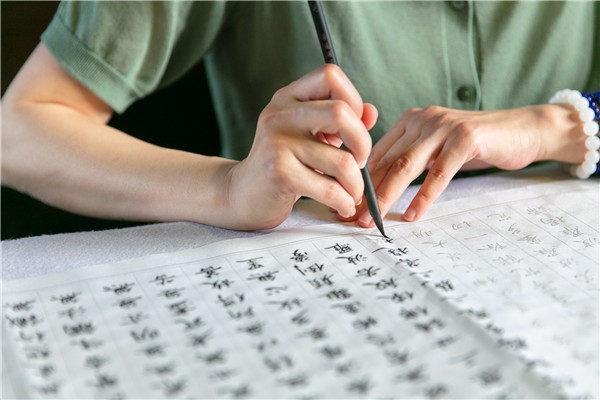
A traditional brush and ink are used to reproduce Buddhist scripture character by character. Illustrative reference image.
How to Practice Sutra Copying: A Beginner's Step-by-Step Guide
You do not need to master Chinese calligraphy before trying sutra copying. A simple introductory session can help you understand the materials, writing method, and respectful attitude associated with the practice.
Step 1: Prepare a Quiet Writing Space
Choose a clean table with enough space for your paper, brush, ink, and reference text. Avoid unnecessary objects that may interrupt the writing process.
If you are practicing in a Buddhist temple, follow the instructions of the host or teacher regarding where to sit and how to arrange the materials.
Step 2: Sit in a Comfortable Position
Keep your back naturally upright and your shoulders relaxed. Position the paper so that you can write without straining your neck or wrists.
You do not need to adopt a complicated meditation posture. Comfort and stability are more important than forcing your body into an unfamiliar position.
Step 3: Become Familiar with the Text
Before beginning, take a moment to look at the scripture you will copy. If the text is unfamiliar, ask for an explanation of its title and cultural background.
For international beginners, a bilingual introduction or an English translation can provide helpful context. Understanding every character is not necessary to begin, but knowing what kind of text you are reproducing makes the experience more meaningful.
Step 4: Learn How to Hold the Brush
Hold the brush steadily without gripping it too tightly. Allow the fingers and wrist to remain flexible. A teacher or experienced practitioner can demonstrate how to position the brush and maintain consistent contact with the paper.
Step 5: Copy One Character at a Time
Observe the reference character before writing. Pay attention to the arrangement of the strokes, the proportions, and the spaces between different parts of the character.
Write slowly and clearly. Beginners should focus on accuracy rather than speed or artistic perfection.
Step 6: Pause and Review Your Work
After completing a line or section, pause to review the characters. Check whether anything has been omitted or incorrectly reproduced. Follow the correction method recommended by the instructor rather than making arbitrary changes to the original text.
Step 7: Complete the Session Respectfully
When you finish, place the brush and other materials in their appropriate positions. Handle the completed page according to the temple's instructions.
Some sessions allow participants to keep their work, while others may have specific arrangements for storing or offering completed scriptures. Always check beforehand.
What Should Beginners Know Before Their First Session?
For international visitors, the unfamiliar writing system is often the first concern. However, several practical approaches make the experience much more accessible.
You Do Not Need to Speak or Read Chinese Fluently
Many introductory activities use reference sheets or pre-printed characters. Participants can follow the examples visually without having to memorize the Chinese language.
If English explanations are available, they can help you understand the meaning and historical background of the selected scripture.
Beautiful Handwriting Is Not the Objective
Traditional Chinese calligraphy requires years of study, but sutra copying does not require beginners to produce professional work.
A clear and careful transcription is more appropriate than attempting complicated brush techniques. Allow yourself time to become familiar with the materials.
Choose a Manageable Text
A short passage or introductory scripture is usually a better starting point than a lengthy Buddhist text. The Heart Sutra is frequently encountered in Buddhist communities, although the actual text used depends on the session and its tradition.
Respect the Religious Context
Sutra copying is not simply a decorative craft. Buddhist scriptures are treated with respect, and participants should follow the guidance of the temple or instructor.
Visitors who approach the activity as a cultural experience rather than a religious commitment are still expected to handle the texts and materials appropriately.

Group sutra transcription illustrates the shared discipline of traditional Buddhist writing. Illustrative reference image.
Sutra Copying as Part of a Chinese Temple Cultural Experience
One of the most interesting ways to understand traditional Chinese culture is to experience several related practices within the same cultural environment.
At a Buddhist temple, writing, tea, incense, meditation, and vegetarian food are not necessarily separate activities. Each reflects different aspects of traditional temple life and the relationship between daily habits and contemplative practice.
Combine Writing with Zen Meditation
For someone who finds it difficult to remain seated in silence for a long period, writing can provide a different starting point for focused attention.
A cultural session that combines introductory meditation with traditional writing offers an opportunity to explore two different approaches to concentration: observing the breath and working carefully with the brush.
Explore Funzendo's Zen and Traditional Cultural Activities to discover the experiences currently presented at Longmen Guanghua Temple.
Discover the Relationship Between Tea and Buddhist Culture
Chinese tea culture has a long relationship with Buddhist temple life. Preparing tea involves attention to water, temperature, utensils, and the timing of each step.
When experienced alongside traditional writing or meditation, a tea session provides another way to explore the connection between cultural craftsmanship and attentive daily activity.
Experience the Atmosphere of Temple Life
Longmen Guanghua Temple in Luoyang is closely connected with the history of Tang Dynasty Esoteric Buddhism. Its heritage, traditional architecture, and mountain setting make it an interesting destination for visitors seeking a deeper understanding of Chinese Buddhist culture.
Rather than viewing the temple only as a sightseeing destination, visitors can explore its history, architecture, cultural traditions, and available learning experiences.
For travelers who want to spend more time in this environment, a Chinese Buddhist Temple Stay at Guanghua Temple offers an opportunity to experience temple accommodation and discover the daily cultural atmosphere at a slower pace.
Frequently Asked Questions About Sutra Copying
Is Sutra Copying Suitable for Complete Beginners?
Yes. Beginners can start with a simple reference sheet and basic writing materials. Previous Chinese calligraphy experience is not required. The important thing is to follow the example carefully and approach the text respectfully.
Can Foreigners Practice Sutra Copying in China?
Yes. International visitors can participate in suitable introductory cultural activities when they are available. English explanations or bilingual materials can make the experience easier to understand. It is advisable to confirm language support before booking.
Do I Need to Understand Chinese Buddhist Scriptures?
No. You can learn about the background of a scripture through an English introduction or translation. However, understanding the general meaning of the text can make the activity more engaging.
Which Buddhist Sutra Is Best for Beginners?
The Heart Sutra is a common introductory choice because it is relatively short and widely recognized in Mahayana Buddhist communities. The most suitable text depends on the instructor, temple tradition, and available materials.
How Long Does a Sutra Copying Session Take?
The duration varies according to the selected text, writing method, and level of instruction. A short introductory session may take less time than copying an entire scripture. Beginners should allow enough time to become familiar with the brush and practice without rushing.
Can I Use a Regular Pen Instead of a Chinese Brush?
Some introductory formats allow pens or brush pens, while traditional Chinese scripture copying often uses a calligraphy brush. The appropriate tool depends on the activity and its cultural context.
Can I Take My Completed Sutra Home?
This depends on the temple or activity organizer. Some sessions allow participants to keep their completed pages, while others follow different arrangements. Ask about this before starting.
Is Sutra Copying a Religious Activity or a Cultural Experience?
It can be both. Within Buddhist communities, scripture copying may have devotional and educational significance. For international visitors, it can also provide a way to explore traditional Chinese writing, Buddhist literature, and temple culture. The appropriate approach depends on the setting and the participant's intention.
Discover Traditional Chinese Buddhist Culture at Funzendo
Understanding Chinese Buddhist culture involves more than reading historical accounts or visiting ancient monuments. Participating in traditional activities can provide a more personal understanding of how cultural knowledge is preserved and practiced.
At Longmen Guanghua Temple in Luoyang, Funzendo introduces international visitors to Chinese Zen culture, traditional temple life, meditation, and cultural learning within the setting of a historic Buddhist temple.
Depending on the program and availability, visitors can explore different aspects of traditional culture, including:
Zen meditation and mindful breathing.
Traditional Chinese tea culture and tea meditation.
Incense appreciation and traditional incense craftsmanship.
Buddhist temple culture and historical learning.
Traditional cultural activities and guided experiences.
Sutra copying can be discussed as a potential cultural activity when arranging a suitable visit. Please contact Funzendo in advance to confirm whether a guided session, appropriate materials, and language support can be arranged for your dates. It should not be assumed to be a standard daily activity or a guaranteed inclusion in every temple stay.
Explore the Chinese Buddhist Culture and Traditional Wisdom section to discover more about the history, philosophy, and cultural practices associated with Chinese temples.
Experience Chinese Temple Culture with Funzendo
Interested in exploring traditional Buddhist culture beyond ordinary sightseeing?
Whether you are planning a temple stay, looking for traditional Chinese cultural activities, or interested in learning more about Buddhist scripture and calligraphy, Funzendo can help you understand the available experiences at Longmen Guanghua Temple.
Tell us about your interests, travel dates, and preferred activities. We can help you check suitable programs and discuss possible cultural arrangements before your visit.
Funzendo · Longmen Guanghua Temple · Luoyang, Henan, China