The Buddhist Robe in China: From the Indian Kasaya to the Chinese Haiqing
When people visit a Chinese Buddhist temple, the clothing worn by monks is often one of the first details they notice. The robes may appear simple, with muted colors, broad sleeves, or layers of fabric arranged in a distinctive way. Yet these garments are not simply traditional clothing. They carry a long history of religious discipline, cultural exchange, and adaptation.
The Buddhist robe has changed considerably since Buddhism first developed in ancient India. As Buddhist teachings spread across Asia, monastic clothing adapted to different climates, materials, social customs, and ceremonial requirements. In China, this process produced distinctive forms of Buddhist attire, including the familiar haiqing, a wide-sleeved ceremonial robe associated with Chinese Buddhist monastic life.
Understanding the history of Buddhist robes offers a different way to explore Chinese Buddhism. A garment that may initially look like a simple religious uniform can reveal how a tradition preserves its principles while responding to a changing cultural environment.
The Origins of the Buddhist Kasaya
The Sanskrit term kāṣāya, commonly rendered in Chinese as jiasha or kasaya, refers to the characteristic robe of Buddhist monastics. In early Buddhist traditions, the robe was closely connected with renunciation, modesty, and the disciplined way of life adopted by monks and nuns.
Early Buddhist monastic regulations described a system of three principal robes. These garments served different practical purposes and were part of the clothing requirements established for ordained members of the monastic community.
The Three Traditional Monastic Robes
The traditional three-robe system is commonly described through three Sanskrit names:
Antarvasa: The inner or lower robe, worn as part of ordinary daily monastic clothing.
Uttarāsanga: The upper robe, used in assemblies and other formal or communal settings.
Saṅghāṭī: The outer robe, traditionally associated with more formal occasions and situations requiring an additional layer of clothing.
These garments were not simply interchangeable pieces of fabric. Their arrangement and use were connected with monastic discipline and the practical requirements of religious life. The system also demonstrates that Buddhist clothing developed within an established set of religious regulations rather than through fashion preferences alone.
The three robes became an important part of the visual identity of Buddhist monastics. Their forms and methods of wearing could vary according to the occasion, the monastic tradition, and the rules followed by a particular community.

Why Traditional Buddhist Robes Were Made from Patches
One of the most recognizable features of the traditional kasaya is its patchwork appearance. Rather than being made as a single uninterrupted piece of decorative fabric, the robe was traditionally assembled from smaller sections of cloth.
Early Buddhist monastic traditions placed importance on simplicity and reducing attachment to material possessions. The practice of using discarded or unwanted fabric was associated with this ideal. Cloth that had little value in ordinary society could be cleaned, repaired, dyed, and made into a garment suitable for monastic use.
This approach reflected more than an economical way of making clothing. It expressed a broader religious attitude toward possessions. A monk's robe was not intended to demonstrate wealth, social prestige, or personal luxury. Its purpose was to support a disciplined life.
The Meaning of the Rice-Field Pattern
The arrangement of the patches creates a pattern that resembles the divisions of agricultural fields. In Buddhist terminology, the robe is sometimes associated with the idea of a field of merit, or punyakṣetra.
The comparison is meaningful. Just as a cultivated field can produce nourishment, Buddhist teaching and practice are traditionally understood as conditions through which wisdom and wholesome qualities may develop. The robe's field-like pattern therefore became a visual reminder of the responsibilities associated with monastic life.
This symbolism also explains why the patchwork design remained important even as the materials and construction of Buddhist robes changed across different regions.
The pattern should not be understood as merely decorative stitching. It connects the physical garment with ideas of modesty, discipline, and religious commitment.
How Buddhist Robes Changed After Buddhism Reached China
When Buddhism spread from India into China, monastic clothing encountered a different cultural and environmental setting. Chinese clothing traditions had their own established forms, fabrics, tailoring techniques, and expectations concerning appearance.
The Indian robe system could not simply be transferred without adjustment. Climate, local textile production, everyday activities, and Chinese social customs all influenced the development of Buddhist attire.
Over time, Chinese Buddhist communities developed ways of wearing and constructing robes that preserved important elements of the earlier tradition while responding to local needs. This was part of a much wider process through which Buddhism became established in Chinese society.
The history of monastic clothing is therefore one small but revealing part of the broader story of the development of Buddhism in China. Religious ideas traveled across geographical boundaries, but the institutions and material culture through which people practiced those ideas continued to evolve.
What Is the Haiqing in Chinese Buddhism?
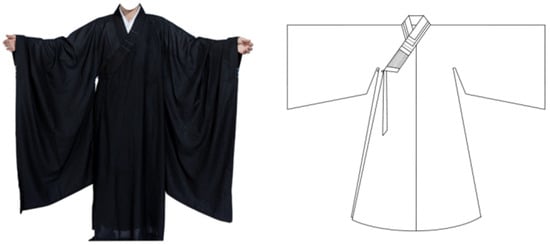
One of the distinctive garments associated with Chinese Buddhist monastic life is the haiqing. It is a broad ceremonial robe traditionally characterized by a rounded collar, wide sleeves, and a loose, flowing shape.
Its appearance differs from the simpler rectangular construction associated with the traditional Indian kasaya. The wide-sleeved form reflects the influence of Chinese clothing traditions and the adaptation of Buddhist ceremonial dress to the local cultural environment.
The haiqing is commonly associated with formal Buddhist settings, including worship, scripture recitation, and religious assemblies. Its shape gives the garment a distinctive visual presence while allowing it to function as part of ceremonial attire.
The development of the haiqing illustrates an important feature of Chinese Buddhism: cultural adaptation does not necessarily mean abandoning an earlier religious tradition. Instead, established forms may be reinterpreted and expressed through local materials, craftsmanship, and aesthetic conventions.
Why the Colors of Buddhist Robes Are Not Always the Same
Visitors sometimes expect Buddhist monks to wear robes of one standard color. In reality, the history of Buddhist clothing reveals a much more varied picture.
Early Buddhist monastic regulations emphasized subdued or altered colors rather than expensive, brightly decorated fabrics. The purpose was to avoid clothing that encouraged vanity or attachment to luxury. The Sanskrit word kāṣāya itself became associated with the characteristic color of the monastic robe.
As Buddhism developed in China, however, the colors of monastic clothing changed in different historical periods and regions. Local textile traditions, court regulations, ceremonial requirements, and the development of monastic institutions all influenced these choices.
During certain periods, robe colors also became associated with official recognition and religious status. For example, the historical practice of granting purple or other distinguished robes to eminent monks reflected the relationship between Buddhist institutions and imperial authority.
These historical developments should not be simplified into a universal color code. A particular color does not necessarily identify a monk's Buddhist school, level of realization, or personal spiritual attainment. The meaning of a garment depends on its historical and institutional context.
Monastic Clothing and Buddhist Identity
Religious clothing communicates identity in ways that ordinary clothing does not. A Buddhist robe identifies its wearer as a member of a religious community and reflects a commitment to a particular form of life.
For ordained monks and nuns, clothing is connected with religious discipline, communal identity, and the responsibilities of monastic practice. It distinguishes the monastic way of life from ordinary lay life, although specific clothing requirements differ across Buddhist traditions and levels of ordination.
It is important not to assume that every Buddhist garment has the same meaning. A kasaya, a haiqing, an everyday monastic robe, and the clothing worn by a lay Buddhist participant are not necessarily equivalent. Their functions depend on the tradition, the occasion, and the person wearing them.
This distinction is useful when learning about Chinese Buddhist temple culture. Visitors may see monks wearing different garments during daily activities and formal ceremonies. Rather than treating every robe as a costume or a uniform, it is more accurate to understand it as part of a wider religious and cultural system.
What Buddhist Robes Reveal About Cultural Exchange
The transformation from the Indian kasaya to Chinese forms of monastic clothing provides a clear example of cultural exchange. Buddhist robes traveled with religious teachings, but their appearance changed as communities adapted them to new environments.
This process involved more than differences in fabric or tailoring. It reflected the interaction between religious regulations, local aesthetics, social structures, and historical circumstances.
The study of Buddhist clothing therefore contributes to a wider understanding of how Buddhism developed in China. Alongside scriptures, sculptures, architecture, and inscriptions, garments provide material evidence of how religious traditions were transmitted and localized.
For visitors interested in the cultural setting of Chinese Buddhism, Funzendo's Chinese Buddhist culture resources offer further background on the traditions and historical influences that shaped Buddhist life in China.
Observing Buddhist Robes During a Temple Visit
A visit to a Buddhist temple provides an opportunity to observe how religious clothing forms part of everyday temple life. A monk's attire may look different during ordinary work, meditation, scripture recitation, or a formal ceremony.
These differences are best understood through the context of the activity rather than appearance alone. Visitors should also remember that religious garments are not museum costumes. They are part of the living practice of the people who wear them.
When visiting a temple, it is appropriate to observe respectfully, avoid touching religious garments or ceremonial objects, and ask permission before taking photographs of monks or religious activities.
At Longmen Guanghua Temple in Luoyang, the temple environment offers an opportunity to learn about the traditions and daily rhythms of Chinese Buddhism. Visitors interested in this living context can explore Temple Life in China: A Day with Buddhist Monks and discover how religious practice is connected with ordinary activities.
The Funzendo Photo Gallery also offers a visual introduction to Guanghua Temple, its surroundings, and the cultural environment in which these traditions continue to be encountered.
Conclusion: A Garment That Carries a Living Tradition
The Buddhist robe is much more than a recognizable symbol of monastic identity. Its history reflects the development of Buddhist discipline, the practical needs of monastic communities, and the cultural exchanges that accompanied Buddhism's movement across Asia.
From the patchwork kasaya of early Buddhist traditions to the wide-sleeved haiqing of Chinese Buddhism, each stage of this development reveals how religious clothing can preserve an established tradition while adapting to a new cultural environment.
The next time you see a Buddhist monk wearing a traditional robe, consider the history behind its shape, fabric, and arrangement. What appears to be a simple garment may carry centuries of religious practice, cultural adaptation, and historical memory.
At Funzendo, within the cultural setting of Longmen Guanghua Temple, exploring Chinese Buddhist heritage means looking beyond the visible architecture and familiar symbols. It also means discovering the material traditions, daily practices, and historical ideas that have helped shape Buddhist life in China.