The Mogao Caves of Dunhuang: How the Silk Road Shaped Buddhist Art in China
On the edge of the Gobi Desert in northwestern China, a series of ancient caves preserves one of the world's most remarkable records of cultural exchange. The Mogao Caves of Dunhuang are celebrated for their Buddhist murals and painted sculptures, but their importance extends far beyond religious art. Within these caves, visitors can discover evidence of ancient trade, international travel, artistic innovation, political change and the movement of ideas across Asia.
For more than a thousand years, Dunhuang stood at a significant crossroads along the historic Silk Road network. Merchants passed through its surrounding oasis, monks traveled between religious centers, translators worked across languages, and artists transformed visual traditions into new forms. The result was a cultural landscape in which Chinese traditions encountered influences from Central Asia, India and other regions connected by long-distance travel.
Today, the Mogao Caves offer an opportunity to look beyond the familiar image of camel caravans crossing the desert. Their murals preserve details of clothing, architecture, music, ceremonies and everyday activities. Their sculptures reveal changing approaches to representing sacred figures, while manuscripts provide evidence of the languages, beliefs and intellectual life of communities along the Silk Road.
Understanding Dunhuang means exploring how a place at the edge of a desert became a center of artistic achievement and cultural interaction. It also means recognizing that Chinese Buddhist heritage developed through centuries of contact between different peoples, rather than in isolation from the wider world.
Dunhuang: The Oasis That Connected Different Worlds
To understand why the Mogao Caves developed in Dunhuang, it is necessary to begin with the geography of the Silk Road. The term describes a broad network of land and maritime routes that connected communities across Asia and beyond. These routes changed over time according to political conditions, commercial opportunities, environmental challenges and the availability of safe passages. They were never simply one road running directly between China and Europe.
Dunhuang occupied an important position near the western end of the Hexi Corridor, a route through which travelers could move between the Chinese heartland and regions farther west. Beyond the corridor lay desert landscapes, mountain ranges and oasis settlements that formed part of the wider Central Asian trading world. For people traveling across these demanding environments, settlements with access to water and supplies were essential.
The oasis supported communities that depended on agriculture, trade and the movement of travelers. Merchants transported silk, textiles, precious materials, spices, ceramics and other goods. Yet the importance of these routes cannot be measured only by the value of the merchandise that passed through them. Travelers also carried religious texts, artistic techniques, stories, languages and practical knowledge.
Dunhuang's position made it a natural setting for these encounters. The caves at Mogao were not created in a cultural vacuum. Their development reflected the needs, beliefs and artistic ambitions of communities that participated in a much larger world of exchange.
The earliest Mogao caves are traditionally associated with 366 CE. Over the centuries that followed, additional caves were excavated and decorated, supported by different patrons and religious communities. The site eventually became one of the most important surviving repositories of Buddhist art in China.
The scale of the surviving complex is remarkable. The Mogao Caves preserve hundreds of caves, extensive murals and more than two thousand painted sculptures. Together, these works represent an artistic tradition that developed over roughly a millennium, from the fourth century into the fourteenth century.
Why Were Buddhist Caves Created in a Desert Landscape?
At first glance, a remote cliff overlooking an arid landscape may seem an unlikely place for a major center of religious art. Yet the location of the Mogao Caves reflects the interaction between geography, religious practice and the cultural traditions of Buddhist communities.
Rock-cut religious sites were developed in several parts of Asia. In some regions, caves offered spaces for worship, religious instruction, contemplation and the commemoration of patrons. Over time, these spaces could be expanded and decorated, creating environments that combined architecture, sculpture and painting.
At Mogao, the natural cliff provided the setting for successive generations of cave construction. The caves were not identical. Their dimensions, internal arrangements, decorative programs and sculptural features varied, reflecting different purposes and periods of artistic development.
Patronage was an important part of this history. The creation and decoration of a cave required resources, skilled labor and sustained organization. Patrons could include local officials, wealthy families, religious communities and individuals seeking to express devotion or commemorate particular events. Their contributions helped shape the physical and artistic landscape of the site.
The caves also reveal that religious art was produced within social relationships. Artists did not work independently of the communities around them. Their subjects, compositions and decorative choices were influenced by religious teachings, available materials, established artistic conventions and the preferences of those who supported the work.
This combination of religious purpose and social history makes Mogao especially valuable. The caves preserve sacred images, but they also provide evidence of the communities that created and maintained them. Studying the site allows historians to examine how religious belief, artistic labor and social organization intersected over time.
The Murals: A Visual Record of Ancient Life
The murals of the Mogao Caves are famous for their religious imagery, including Buddhas, bodhisattvas, celestial beings and scenes illustrating Buddhist teachings. Yet one of the most rewarding ways to approach these paintings is to look beyond their central religious figures and examine the smaller details surrounding them.
Clothing can reveal differences in social position, regional style and historical fashion. Architectural backgrounds provide clues about the buildings and spaces familiar to the artists and their audiences. Musical instruments, ceremonial objects and decorative patterns can help researchers investigate connections between artistic traditions across different regions.
Some murals include scenes associated with commerce, travel, agriculture and public life. These images remind us that the people who commissioned and viewed the paintings inhabited a world of practical concerns as well as religious beliefs. Their lives involved work, family relationships, political authority, social customs and contact with people from distant places.
One example appears in Cave 302, which dates to the Sui Dynasty. A mural there depicts a camel pulling a cart, offering a visual connection between the religious world of the caves and the commercial networks that helped sustain Dunhuang.
Such details are valuable because historical paintings can preserve information that written records do not always provide. A garment depicted on a wall may help researchers compare styles across regions. A musical instrument may invite investigation into performance traditions and cultural exchange. A representation of a building can raise questions about architectural practices and the visual imagination of its time.
However, murals must be interpreted carefully. An image is not a photograph of everyday life, and religious paintings often follow symbolic conventions. Researchers compare visual evidence with manuscripts, archaeological findings and other historical sources before drawing conclusions. The strongest interpretations emerge when different forms of evidence support one another.
For visitors, this approach makes the experience more engaging. Instead of viewing a mural simply as a beautiful surface, one can ask why particular figures occupy certain positions, how the composition directs the eye, what objects appear in the background and which details might reflect historical circumstances.
These questions turn looking into a form of historical investigation. They also reveal why the Mogao Caves continue to attract scholars from disciplines including art history, archaeology, religious studies and the history of material culture.
How Artistic Styles Traveled Along the Silk Road
The Mogao Caves preserve more than one artistic style. Because the site developed over many centuries, its paintings and sculptures document changing approaches to representing sacred figures, organizing compositions and decorating religious spaces.
Buddhist art reached China through complex networks of cultural contact. As Buddhism moved across regions, artists and religious communities encountered visual traditions that had developed in South Asia and Central Asia. These traditions offered different ways of representing the Buddha, bodhisattvas, celestial beings, narrative scenes and sacred environments.
When such ideas reached China, they were not simply copied without change. Artists worked within local traditions and adapted imported forms to the expectations of their audiences. Over time, the resulting works reflected both international connections and distinctly Chinese artistic developments.
This process can be understood as cultural translation. A visual convention may travel from one region to another, but its meaning and appearance can change as it is adopted in a new setting. Artists may modify proportions, clothing, gestures, colors or decorative details. They may also combine unfamiliar elements with established local techniques.
The history of Dunhuang demonstrates that cultural exchange is rarely a straightforward movement from one center to another. Different traditions can overlap, coexist and influence one another in ways that are not always immediately visible. A single cave may preserve evidence of several artistic decisions made at different moments in history.
The Tang Dynasty, which lasted from 618 to 907 CE, was an especially important period in the history of Chinese Buddhist art. Tang China maintained extensive connections with regions across Asia, and its cultural life was shaped by the movement of people, goods and ideas. Dunhuang participated in this wider environment while developing its own artistic character.
Later periods brought additional changes. The political circumstances of the region shifted, patronage patterns evolved, and artistic conventions were adapted to new needs. Some subjects and styles continued across generations, while others changed significantly. The surviving caves therefore provide a record of artistic continuity as well as transformation.
It is this long sequence of development that makes Mogao so significant. Rather than offering a single snapshot of Buddhist art, the site allows researchers to compare works from different centuries and investigate how artists responded to changing religious, cultural and historical conditions.
Flying Apsaras, Color and the Movement of the Eye
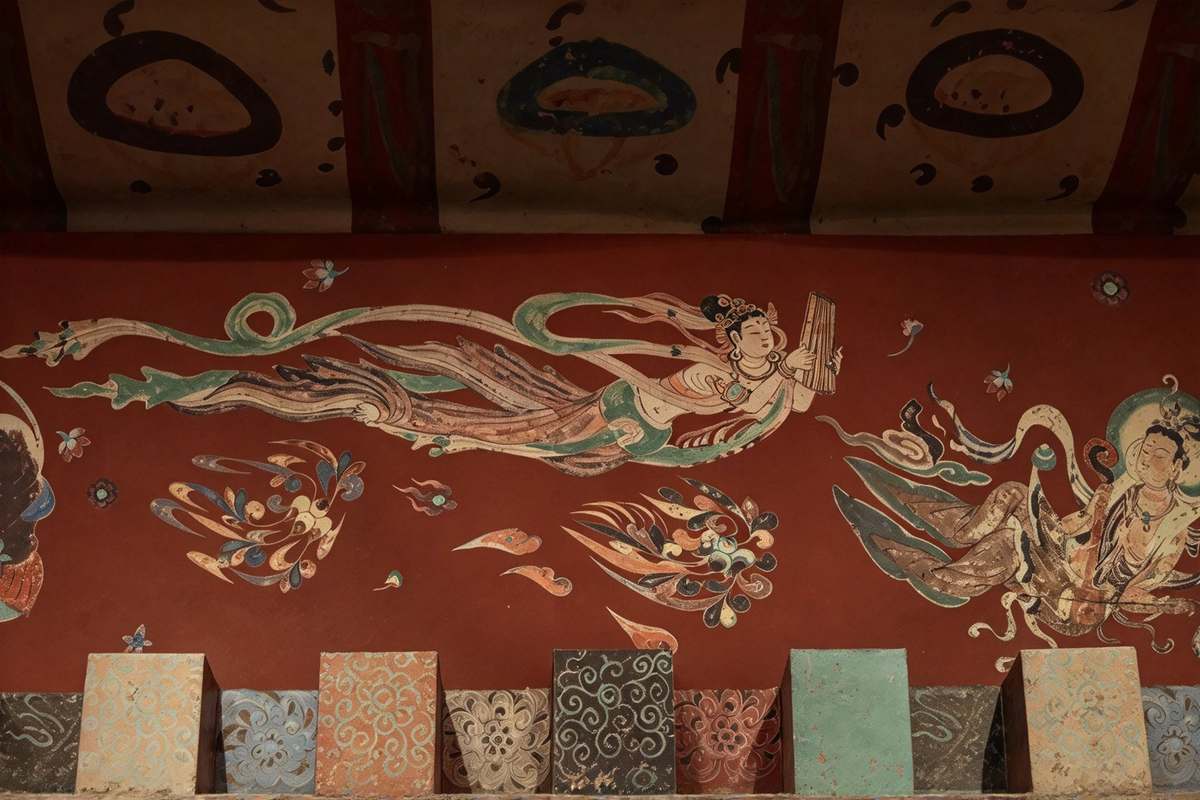
Among the most recognizable images associated with Dunhuang are the flying celestial figures commonly known as apsaras. Their flowing garments, extended ribbons and dynamic poses create a sense of movement across the painted surfaces. They appear to move through an imagined celestial space, connecting the architectural structure of a cave with the religious world represented on its walls and ceiling.
These figures are compelling not only because of their graceful appearance but also because of the technical decisions involved in their depiction. Artists used lines, overlapping forms, color contrasts and carefully arranged gestures to guide the viewer's attention. A ribbon may curve across a composition, while the direction of a figure's body carries the eye toward another part of the scene.
Such details show that the murals were carefully designed visual environments. Their effect depended on the relationship between individual figures and the overall composition. A small change in the direction of a gesture or the placement of a decorative element could influence how a scene was experienced.
Color is another essential part of the artistic language. Different pigments and painting techniques created contrasts between figures, garments, backgrounds and ornamental patterns. The surviving colors also reflect the materials and methods available to artists in different periods, as well as the challenges of preserving painted surfaces over centuries.
The flying figures offer an accessible starting point for understanding the sophistication of Dunhuang art. Their apparent lightness contrasts with the solid rock surrounding the paintings. They also demonstrate how artists used movement and ornament to create a visual experience that extends beyond the representation of individual bodies.
Looking closely at these details can reveal the relationship between artistic skill and religious meaning. The paintings were created for sacred settings, but their visual power also reflects the observation, imagination and technical knowledge of the artists who produced them.
Painted Sculptures and the Architecture of Sacred Space
Although murals receive much attention, the painted sculptures of Mogao are equally important to the site's artistic history. The caves contain sculptural figures that interact with the surrounding walls, painted backgrounds and architectural arrangements. Their placement contributes to the experience of entering and viewing each space.
These sculptures were not designed as isolated museum objects. They belonged to carefully organized religious environments in which sculpture, painting and architecture worked together. A central figure could establish the visual focus of a cave, while surrounding images and decorative elements created a larger symbolic setting.
The relationship between three-dimensional forms and painted surfaces is especially significant. A sculpted figure occupies physical space, while a mural can extend the imagined environment around it. Color and line can connect the sculpture to surrounding figures or narrative scenes, allowing the entire cave to function as an integrated composition.
Differences between sculptures can also reveal historical change. Artists worked with varying proportions, expressions, garments and decorative techniques. Comparing these features across caves helps researchers examine how visual conventions evolved and how artists balanced established religious forms with changing artistic preferences.
Architecture itself played a central role. The arrangement of a cave affected how visitors encountered its images, where their attention was directed and how the artworks related to one another. The site therefore demonstrates that the history of religious art cannot be separated from the spaces in which it was created and experienced.
For modern visitors, it is worth taking time to understand the cave as a whole. The most famous sculpture may attract immediate attention, but the surrounding paintings, ceiling patterns, wall arrangements and relationships between figures often reveal equally important information about the artistic design.
The Library Cave: Manuscripts That Changed the Study of Dunhuang
In 1900, a discovery at Mogao brought a new dimension to the world's understanding of Dunhuang. A chamber now commonly known as the Library Cave, or Cave 17, contained a large collection of manuscripts and other written materials. These documents provided an extraordinary source of evidence for studying religion, language, administration, literature and daily life across different historical periods.
The manuscripts were not limited to a single subject or tradition. Buddhist texts formed an important part of the collection, but the wider documentary record reflects the diversity of the communities connected with Dunhuang. Written materials in different languages and scripts reveal that the region participated in a world of intellectual and cultural exchange extending beyond any single religious community.
One of the most famous objects associated with Dunhuang is a printed copy of the Diamond Sutra dated 868 CE. It is widely recognized as an exceptionally early example of a dated, complete printed book. Its survival provides important evidence for the history of printing and the circulation of Buddhist texts in medieval China.
The significance of the Library Cave lies partly in the relationship between written and visual evidence. Murals can show how religious stories were represented, while manuscripts can preserve the wording of texts, records of their transmission and evidence of how they were used. When studied together, these sources can illuminate different aspects of the same cultural environment.
Documents may also reveal ordinary concerns that are less visible in monumental art. Administrative records, contracts, letters and other materials can offer insight into economic relationships, local institutions and the practical organization of life. Such evidence helps historians move beyond the most famous monuments and consider the people who lived around them.
The modern history of the manuscripts is also complicated. After the chamber became known, a portion of its contents was removed from Dunhuang by foreign explorers and collectors, and materials were dispersed among institutions in different countries. Their movement has shaped scholarly research as well as ongoing discussions about cultural heritage, provenance and access.
Today, the study of Dunhuang manuscripts involves collaboration across institutions and disciplines, supported in part by cataloguing, conservation and digital research. Digitization can help researchers examine materials remotely, compare texts and images, and make parts of the collection more accessible without requiring every original document to be handled repeatedly.
The Library Cave therefore tells two connected stories. One concerns the intellectual life of medieval Dunhuang; the other concerns the modern responsibilities involved in protecting and studying cultural heritage. Both are essential to understanding why the Mogao Caves matter far beyond their physical location.
What the Mogao Caves Tell Us About Life on the Silk Road
The popular image of the Silk Road often focuses on camel caravans crossing vast deserts. Although caravans were an important part of long-distance trade, the historical network was much more complex. It consisted of interconnected routes, towns, oasis settlements, mountain passages and maritime connections that changed over time.
Travelers rarely moved every item from its point of origin to its final destination. Goods could pass through many hands, while merchants traveled particular sections of a route and exchanged cargo along the way. Settlements along these routes became places where languages, customs and commercial practices met.
The circulation of religious ideas followed similarly complex patterns. Monks and pilgrims traveled for different reasons, texts were copied and translated, and artistic traditions developed through contact between communities. The spread of Buddhism was therefore not a single event but a long process involving many people, languages and institutions.
The Mogao Caves preserve material evidence of this interconnected world. Their paintings show scenes associated with travel and commerce; their artistic styles reveal changing cultural relationships; and their manuscripts document intellectual and religious activity. Together, these sources demonstrate that Dunhuang's importance came from its participation in a network rather than from geographic isolation.
This perspective also challenges the idea that cultural influence always moved in one direction. Traditions from different regions were adapted and reinterpreted as they traveled. Chinese artistic practices shaped works at Dunhuang, while contacts with Central Asian and South Asian traditions contributed to the development of Buddhist art in China.
The Silk Road should therefore be understood as a history of interaction. Its legacy lies not only in the objects that moved across great distances but also in the changes that occurred when people encountered unfamiliar ideas, materials and artistic forms.
Dunhuang and Longmen: Two Different Chapters of Chinese Buddhist Art
To understand the wider history of Buddhist art in China, it is useful to compare the Mogao Caves with another major heritage site: the Longmen Zen Heritage Journey destination near Luoyang in Henan Province. Both sites preserve important evidence of Buddhist art, yet their settings and surviving works reveal different aspects of the tradition.
Dunhuang developed in an oasis landscape connected to the Silk Road. Its painted caves preserve an extensive record of murals, sculptures and written materials associated with centuries of cultural exchange. The visual richness of the site reflects the role of a frontier region where Chinese traditions encountered artistic influences arriving through Central Asia and other parts of Asia.
Longmen, by contrast, is particularly celebrated for its rock-cut Buddhist sculptures. Located near Luoyang, a city that served as a capital during several periods of Chinese history, the grottoes developed within a different political and cultural environment. Their inscriptions and sculptural programs provide important evidence for the relationship between Buddhism, patronage and society in central China.
The two sites should not be treated as interchangeable examples of the same artistic style. Their differences are precisely what make comparison valuable. Dunhuang helps visitors understand the relationship between cave painting, sculpture and long-distance exchange, while Longmen offers an exceptional opportunity to examine Buddhist sculpture and its historical setting within central China.
Comparing them also encourages a broader view of Chinese civilization. Artistic traditions did not develop in one place alone, and no single monument can represent the full range of historical experience. Different regions contributed their own techniques, patrons, visual languages and religious practices to the development of Buddhist heritage.
For travelers, this comparison creates a meaningful way to connect destinations. Rather than visiting famous sites as isolated attractions, visitors can explore how each location contributes a different chapter to the history of Buddhism, art and cultural exchange in China.
Luoyang provides a useful starting point for this wider exploration. Its historical significance, proximity to the Longmen Grottoes and connections with Buddhist heritage make it a valuable destination for travelers interested in understanding the relationship between place and history.
How to Visit the Mogao Caves Responsibly
A visit to the Mogao Caves is most rewarding when it combines careful observation with an understanding of the site's conservation needs. The murals and sculptures are fragile historical works, and the environment inside the caves can be sensitive to changes caused by human presence. Visitor management and conservation measures are therefore essential to protecting the site for future generations.
Before traveling, visitors should consult official visitor information for current opening arrangements, ticket requirements, access procedures and any restrictions that may apply. The availability of particular caves can change, and not every cave or artwork is necessarily accessible on every visit.
Photography rules should also be checked in advance. Restrictions may apply inside the caves, and visitors should follow the instructions of site staff. Flash photography, touching painted surfaces or disregarding barriers can place vulnerable heritage at risk.
It is also useful to approach the visit with a few specific questions. What details in a mural suggest the movement of people or goods? How does the arrangement of a cave guide the viewer's attention? What differences can be observed between painted and sculpted figures? How do written sources help researchers interpret the images?
These questions encourage a more thoughtful experience than simply trying to see as many famous images as possible. They also help visitors appreciate the work of historians, archaeologists, conservators and researchers whose efforts make the site's significance better understood.
For those interested in the wider region, Dunhuang can serve as a starting point for learning about the geography of the Silk Road, the history of oasis settlements and the movement of religious traditions across Asia. Understanding the surrounding landscape adds context to the caves and explains why this location became such an important center of cultural exchange.
Why Dunhuang Still Matters Today
The Mogao Caves remain relevant because they preserve more than an artistic legacy. They demonstrate how cultural traditions develop through contact, adaptation and the work of successive generations. Their murals, sculptures and manuscripts record a world in which religion, commerce, artistic creativity and everyday life were closely connected.
At a time when cultural heritage is often reduced to a photograph or a short visit, Dunhuang reminds us that historical places reward deeper attention. A painted figure can open questions about artistic technique; a manuscript can reveal a network of language and learning; and a cave's architecture can show how sacred space was designed and experienced.
The caves also offer a broader lesson about the relationship between local identity and international exchange. Dunhuang became distinctive not because it was cut off from the world, but because it participated in a network of encounters that brought different ideas and artistic traditions together. Its cultural identity emerged through both continuity and change.
Preserving this heritage requires more than maintaining the physical structures. It also involves research, responsible tourism, public education and respect for the historical context of the works. When visitors learn how the caves were created, used and studied, they gain a deeper appreciation of why the site deserves protection.
For anyone interested in Chinese history, Buddhist art or the Silk Road, Dunhuang provides a powerful reminder that the past is not a collection of isolated monuments. It is a connected story of people, places, beliefs and creative achievements that crossed regional boundaries.
Explore China's Buddhist Heritage with Funzendo
The story of the Mogao Caves offers an entry point into the wider cultural history of Buddhism in China. From the painted cave sanctuaries of Dunhuang to the monumental stone carvings of Longmen, different heritage sites preserve distinct evidence of how Buddhist art and religious traditions developed across regions and centuries.
Located within Longmen Guanghua Temple in Luoyang, Funzendo provides a starting point for international visitors interested in Chinese Buddhist culture and heritage. Luoyang's historical landscape offers its own important connections to the development of Buddhism in China, while the nearby Longmen Grottoes reveal an extraordinary tradition of stone sculpture and religious patronage.
For travelers who want to explore beyond a single destination, Funzendo's Silk Road Zen Pilgrimage from Longmen to Dunhuang is the most relevant place to explore the site's cultural connection with a broader journey. Review the itinerary and program details to confirm which destinations and activities are included.
A cultural pilgrimage can connect places through their history rather than simply through distance. The most meaningful itinerary is one that allows time to understand the differences between sites, the stories behind their monuments and the historical relationships that link them.
Whether your interest lies in Buddhist art, ancient manuscripts, historic architecture or the cultural exchanges of the Silk Road, the Mogao Caves provide a compelling starting point for discovering the depth of China's heritage.
Continue exploring China's historic Buddhist destinations with Funzendo. Discover the cultural and pilgrimage programs to learn more about journeys connecting significant historical places in China.
Historical reference: The Mogao Caves were inscribed on the UNESCO World Heritage List in 1987. This article draws on UNESCO's published description of the site's history, artistic significance and role in cultural exchange along the Silk Road. Check official sources for current visitor arrangements before planning a visit.