Who Is Guanyin? The Buddhist Goddess of Mercy Explained
Walk into almost any traditional Chinese Buddhist temple and you may encounter a serene figure dressed in white, holding a vase of pure water or a willow branch, or seated peacefully upon a lotus. Visitors pause before her image, offer incense, join their palms in prayer, or simply stand quietly for a moment. This is Guanyin (觀音), one of the most widely revered figures in Chinese Buddhism, known in English as the Goddess of Mercy.
For many international visitors, Guanyin is one of the first Buddhist figures they recognize when exploring Chinese temples. Yet her identity, history, and symbolism are often misunderstood. Is she a goddess, a Buddha, or a bodhisattva? Why is she usually represented as a woman in China? And what do the vase, willow branch, and lotus flower mean?
Understanding Guanyin offers more than an introduction to a familiar temple statue. Her story reveals how Buddhist teachings travelled from India to China, how religious imagery developed across different cultures, and why compassion became such a powerful part of Chinese Buddhist devotion.
By Master Lin
1. Who Is Guanyin?
Guanyin is the Chinese name for Avalokiteshvara, a bodhisattva associated above all with compassion. The Sanskrit name is traditionally understood in relation to perceiving or hearing the cries of the world. In Chinese, Guanyin is written as 觀音, commonly interpreted as "the one who perceives the sounds" or "the one who hears the cries" of those in need.
In Mahayana Buddhism, a bodhisattva is a being dedicated to awakening for the benefit of all sentient beings. Rather than focusing solely on personal liberation, the bodhisattva path places great importance on wisdom, compassion, and helping others overcome suffering.
Guanyin embodies this compassionate ideal. Her defining quality is the ability to hear the suffering of the world and respond with kindness. For this reason, people turn to her in moments of fear, uncertainty, grief, and difficulty. Her image is often associated with protection, reassurance, and the hope that compassion can be present even in challenging circumstances.
In everyday English, Guanyin is frequently called the "Goddess of Mercy." This is a familiar and understandable translation, but it needs a little explanation. In Buddhist teaching, Guanyin is not a creator god or a goddess in the sense used in some other religious traditions. She is a bodhisattva, and her significance comes from the Buddhist ideals of compassion and wisdom.
2. From India to China: How Avalokiteshvara Became Guanyin
The story of Guanyin begins with Avalokiteshvara in Indian Buddhism. As Mahayana Buddhist teachings spread across Asia, the bodhisattva's image and devotional traditions travelled with them. When Buddhism entered China and developed within Chinese society, Avalokiteshvara gradually acquired forms and meanings that reflected local culture, religious imagination, and artistic traditions.
Indian origins
In early Indian Buddhist art and literature, Avalokiteshvara was generally represented in a male or sometimes less distinctly gendered form. The bodhisattva was associated with compassion and the ability to respond to the needs of living beings. These qualities became central to the figure's identity as the tradition spread.
The development of Guanyin in China
In China, Avalokiteshvara became known as Guanyin. Over many centuries, Chinese artistic representations gradually developed a softer and increasingly feminine appearance. This transformation was not the result of a single event. It reflected the interaction of Buddhist beliefs with Chinese ideas about compassion, family care, maternal protection, and the ideal of a merciful figure who responds to ordinary people's needs.
By the Song dynasty and later periods, the female image of Guanyin had become increasingly familiar and influential in Chinese religious art and popular devotion. The white-robed Guanyin, in particular, became one of the most recognizable representations of the bodhisattva.
From Buddhist teaching to everyday devotion
As Guanyin devotion developed, people increasingly turned to the bodhisattva in connection with the concerns of everyday life. Sailors and travellers prayed for safety, families sought blessings and protection, and parents asked for the well-being of their children.
These devotional traditions helped make Guanyin one of the most beloved figures in Chinese Buddhism. Her appeal extends beyond formal religious study because the compassion she represents speaks to experiences shared by people across different backgrounds and generations.
3. What Does Guanyin Represent?
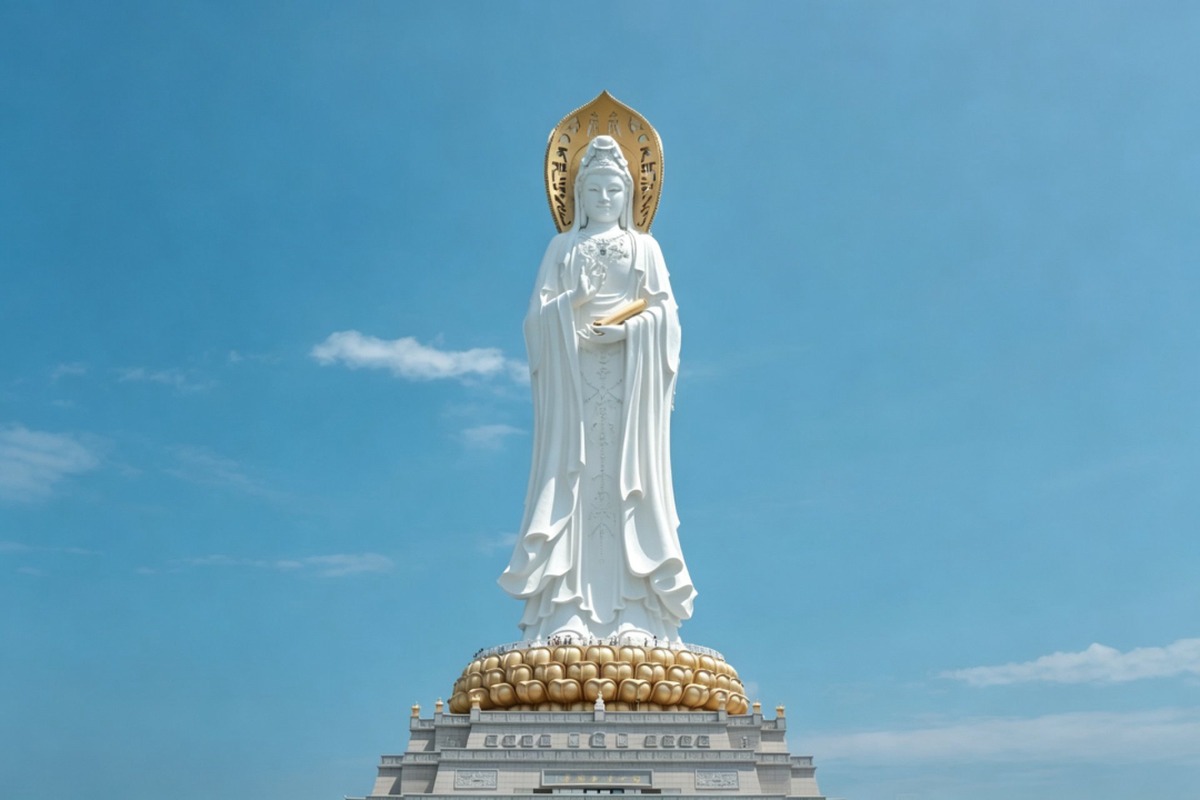
Guanyin's image carries several layers of meaning. Although individual traditions and local customs may emphasize different aspects, compassion remains the central theme. Understanding these associations can help visitors look beyond the appearance of a statue and appreciate the Buddhist ideas it represents.
| Theme | Meaning |
|---|---|
| Compassion | The central quality of Guanyin: hearing the suffering of living beings and responding with understanding and care. |
| Mercy | Kindness, forgiveness, and the wish to relieve fear and suffering without judgment. |
| Protection | A devotional association with safety and reassurance, particularly for travellers and people facing danger or uncertainty. |
| Fertility and family | In some Chinese devotional traditions, Guanyin is associated with children's well-being, motherhood, and the hopes of families. |
These meanings are closely connected. Compassion is not simply an emotion or a kind thought. In the bodhisattva ideal, it involves recognizing suffering and cultivating the wisdom and willingness to respond. Guanyin therefore represents both the comfort people seek and the compassionate qualities they are encouraged to develop themselves.
4. Common Forms of Guanyin and the Meaning of Her Symbols
Guanyin appears in many forms throughout Chinese Buddhist temples, paintings, sculptures, and household devotional spaces. Her appearance may differ according to the historical period, artistic style, regional tradition, or religious context. Several forms are particularly familiar to visitors.
White-Robed Guanyin
White-Robed Guanyin, or Baiyi Guanyin (白衣觀音), is among the best-known representations in Chinese Buddhist art. She is usually depicted wearing flowing white robes, with a peaceful expression and a gentle posture.
White is often associated with purity, clarity, and freedom from defilement. The image therefore suggests a compassionate presence that remains calm and clear amid the difficulties of the world. For many visitors, this is the image that comes to mind when they hear the name Guanyin.
The vase and willow branch
In many representations, Guanyin holds a small vase, sometimes described as a vase containing pure water or the nectar of compassion. The water symbolizes the ability to relieve suffering and bring spiritual refreshment.
A willow branch may appear alongside the vase. In Chinese Buddhist imagery, it is associated with the sprinkling of pure water and the expression of compassionate blessings. Together, the vase and willow branch create one of Guanyin's most recognizable visual combinations.
Guanyin seated on a lotus
The lotus is one of the most important symbols in Buddhist art. It grows from muddy water yet produces a beautiful flower above the surface. This makes it a symbol of purity, wisdom, and the possibility of awakening amid the difficulties of ordinary life.
When Guanyin is shown seated or standing on a lotus, the image connects her compassion with the broader Buddhist path of spiritual awakening.
Songzi Guanyin: Guanyin with a child
Songzi Guanyin (送子觀音), often translated as Child-Giving Guanyin, is a form associated with family hopes and the wish for children. In this representation, Guanyin may be shown holding or accompanied by a child.
This form reflects the development of Guanyin devotion within Chinese society, where the bodhisattva became closely associated with family well-being and maternal compassion. It is a particularly meaningful example of how Buddhist imagery interacted with local cultural concerns.
5. Guanyin in Chinese Buddhist Temples
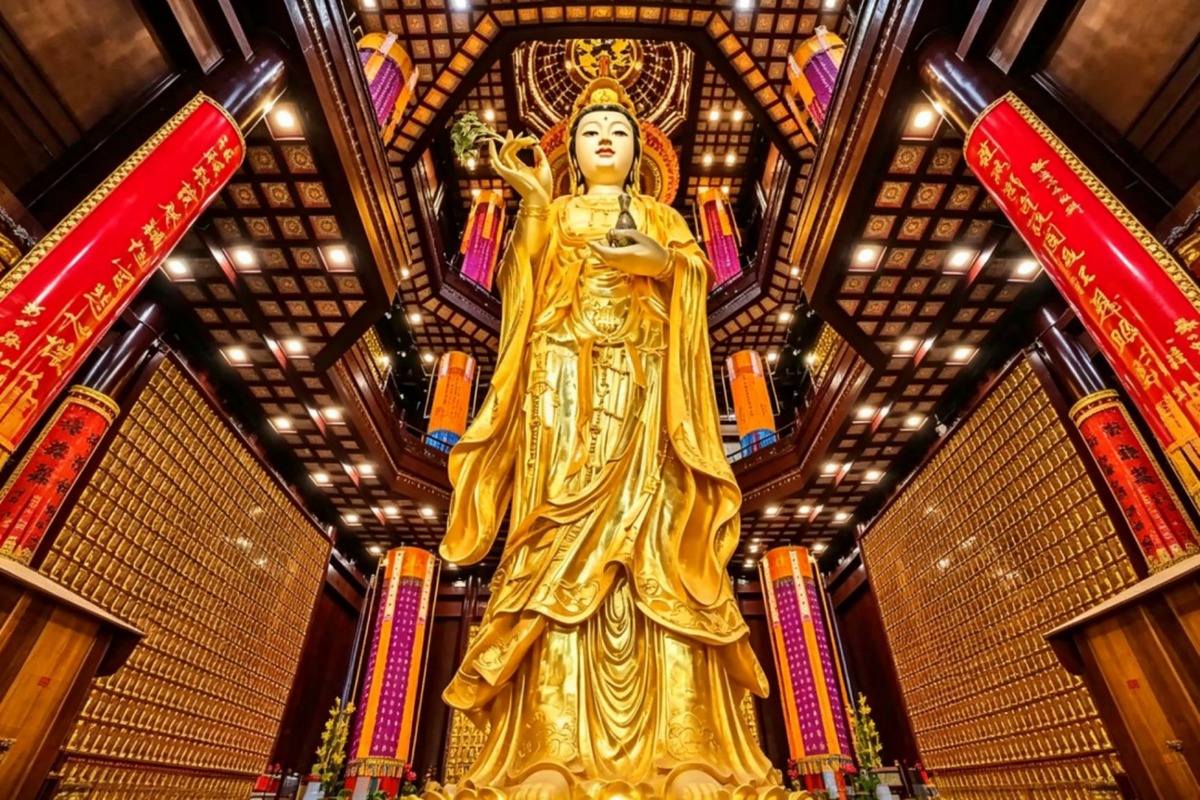
Guanyin is an important presence in Chinese Buddhist temple life. Her image may be found in a dedicated Guanyin Hall, within a main worship hall, in a courtyard, or in another sacred space. The arrangement varies from temple to temple, reflecting its history, architectural layout, and religious traditions.
For visitors, a Guanyin statue can be an accessible starting point for understanding Buddhist devotion. Even without knowing the full history of the bodhisattva, people can recognize the themes of compassion, care, and protection expressed through her image.
In many temples, devotion to Guanyin is expressed through chanting, bowing, offerings, and quiet personal prayer. Some visitors come with a specific concern, while others simply wish to express gratitude or spend a moment in reflection.
It is important to understand that these practices are part of a wider Buddhist religious context. A statue is not merely a decorative object, and the rituals performed before it have meanings shaped by Buddhist teachings and temple traditions.
6. Why Guanyin Matters at Longmen Guanghua Temple
Longmen Guanghua Temple in Luoyang, Henan Province, offers visitors an opportunity to encounter Chinese Buddhist culture within a setting connected with the history of Tangmi, or Chinese Esoteric Buddhism. Located near the Longmen Grottoes, the temple is part of the wider Buddhist heritage of the Longmen area.
Guanyin's significance within Chinese Buddhism provides an important context for understanding the devotional life of temples such as Guanghua. Her compassionate ideal is relevant across different Buddhist traditions, while the ways in which she is represented and worshipped may reflect the particular history and practices of each temple.
When visiting Guanghua Temple, take time to observe the religious spaces and the way visitors approach them. You may see people pause before a Buddhist image, join their palms, bow, or make a quiet personal prayer. These gestures are expressions of respect and devotion rather than performances for visitors.
Guanyin is also a useful starting point for learning about the wider history of Chinese Buddhism. Her story connects Indian Buddhist origins, the development of Mahayana teachings, Chinese religious art, and the everyday devotional traditions that remain important to many people today.
7. How to Show Respect When Visiting a Guanyin Hall
You do not need to be Buddhist to visit a Chinese Buddhist temple or learn about Guanyin. Visitors from different religious and cultural backgrounds are welcome to observe, provided they respect the space and the people who use it for religious practice.
A few simple guidelines can help make your visit more comfortable and respectful:
Observe before participating. Take a moment to see how other visitors behave and follow any instructions displayed by the temple.
Join your palms if you wish. Placing your palms together in front of your chest is a familiar gesture of respect in Buddhist settings. A simple bow may also be appropriate.
Be considerate when taking photographs. Look for photography notices and avoid photographing people during prayer or ceremonies without permission.
Keep your voice low. Speak quietly, particularly in worship halls and during religious activities.
Follow incense and offering guidance. If you wish to offer incense, ask about the temple's arrangements rather than assuming that every hall follows the same practice.
Respect the religious atmosphere. Avoid touching statues, altar objects, or ritual items unless you are specifically invited to do so.
There is no need to imitate rituals you do not understand. Quiet observation is a perfectly respectful way to begin learning about Guanyin and Chinese Buddhist culture.
8. Experience Chinese Buddhist Culture Beyond the Guanyin Statue
Learning about Guanyin can be the beginning of a wider exploration of Chinese Buddhist culture. A temple is not only a place where visitors encounter statues and religious architecture. It is also an environment shaped by daily routines, ceremonies, traditional teachings, and the relationship between spiritual practice and ordinary life.
For visitors interested in experiencing this culture more deeply, a temple stay offers a different perspective from a short sightseeing visit. Time spent in the temple environment can provide opportunities to understand its daily rhythm, learn about Buddhist customs, and observe how religious traditions continue in contemporary China.
At Funzendo, visitors can explore opportunities for a Buddhist temple stay at Longmen Guanghua Temple. This is an opportunity to learn about temple life and the cultural setting of the Longmen area, subject to the arrangements and programme confirmed before booking.
Those who would like to understand the atmosphere of the temple before planning a visit can also read A Day at Guanghua Temple: Discover Traditional Chinese Temple Life.
For visitors interested in guided practice as well as cultural learning, Funzendo also introduces its meditation and healing experiences. Each programme has its own focus, so it is helpful to review the details before choosing an experience.
9. Frequently Asked Questions About Guanyin
Is Guanyin a god or a goddess?
In popular English, Guanyin is often called the Goddess of Mercy. In Buddhist teaching, however, she is a bodhisattva associated with compassion, not a creator god. The title "Goddess of Mercy" is a familiar cultural translation rather than a precise description of her Buddhist status.
Why is Guanyin usually shown as female in China?
Avalokiteshvara was generally represented in male or less distinctly gendered forms in early Indian Buddhist art. After Buddhism spread to China, the image gradually developed a feminine appearance over many centuries. This transformation was influenced by Chinese artistic traditions and cultural ideas about mercy, care, and maternal compassion.
What does Guanyin represent?
Guanyin represents compassion above all: hearing the suffering of living beings and responding with mercy and understanding. Her image is also associated with protection, reassurance, and family well-being in Chinese devotional traditions.
What does the vase in Guanyin's hand symbolize?
The vase is commonly associated with pure water or the nectar of compassion. It symbolizes the relief of suffering and the refreshing or purifying qualities of compassion. When shown with a willow branch, the two objects form a familiar symbol in Chinese Guanyin imagery.
Why does Guanyin sit on a lotus flower?
The lotus symbolizes purity and spiritual awakening. It grows from muddy water while rising above the surface to bloom, making it a powerful Buddhist image of wisdom and the possibility of awakening amid worldly difficulties.
Can visitors pray to Guanyin if they are not Buddhist?
Visitors from different backgrounds can respectfully observe Guanyin devotion. If you wish to participate, you may follow the temple's guidance for a simple bow or incense offering. There is no requirement to identify as Buddhist, and quiet observation is also welcome.
Where can I see Guanyin in China?
Guanyin images can be found in Buddhist temples throughout China, including dedicated Guanyin halls and main worship spaces. Longmen Guanghua Temple in Luoyang is one place where visitors can explore Chinese Buddhist culture and the wider Tangmi heritage of the Longmen area.
Can I learn more about Chinese Buddhism during a temple stay?
A temple stay can provide a closer introduction to the cultural environment and daily rhythm of a Buddhist temple. The activities and learning opportunities vary by programme, so visitors should check the current details of the Funzendo temple stay before booking.
10. Meet Guanyin Through a Visit to Longmen Guanghua Temple
Photographs can show the gentle expression of Guanyin, the folds of her white robes, and the symbolic objects she holds. But understanding her place in Chinese Buddhism involves more than recognizing a statue. It means learning about the ideas of compassion, the history of Buddhist culture, and the devotional traditions that have developed over many centuries.
For international visitors, Guanyin offers a welcoming introduction to Chinese Buddhist culture. Her story connects India and China, Buddhist philosophy and popular devotion, religious art and the concerns of everyday life.
If you would like to explore these traditions in person, consider visiting Longmen Guanghua Temple in Luoyang. You can learn more about the Funzendo Temple Stay or discover the atmosphere of the temple through A Day at Guanghua Temple.
Explore the wisdom of Chinese Buddhism, discover the meaning of compassion, and experience the cultural heritage of Longmen at your own pace.