Wudang Tai Chi: History, Daoist Philosophy and the Art of Movement
Wudang Mountain is one of the most recognizable places in China for anyone interested in Daoist culture and traditional martial arts. Located in Hubei Province, this mountain landscape is known for its ancient temples, dramatic peaks and long association with Daoist religious traditions. It is also closely connected with the cultural identity of Wudang martial arts, particularly the practice of Tai Chi.
For many international visitors, Wudang Tai Chi is introduced through a familiar story: a Daoist master named Zhang Sanfeng observed nature, understood the relationship between softness and strength, and created a martial art based on these principles. The story is memorable, but the history is more complex. The development of Taijiquan, the religious heritage of Wudang Mountain and the later traditions associated with Zhang Sanfeng are related subjects, but they should not be treated as one documented historical event.
Understanding these distinctions makes Wudang Tai Chi more interesting. It can be explored as a martial art, a movement tradition and a cultural expression shaped by China's philosophical and religious history.
Wudang Mountain: A Center of Daoist Heritage
Wudang Mountain's reputation begins with its religious and architectural history. Its temples and palaces developed over many centuries, and the mountain became an important center of Daoist activity. The surviving architectural complex reflects several historical periods, particularly the Yuan, Ming and Qing dynasties.
During the Ming Dynasty, imperial patronage helped transform Wudang into an extensive religious and architectural complex. The mountain's temples were closely associated with the worship of Zhenwu, a major figure in Daoist religious tradition. This connection helped establish Wudang's position in Chinese religious history.
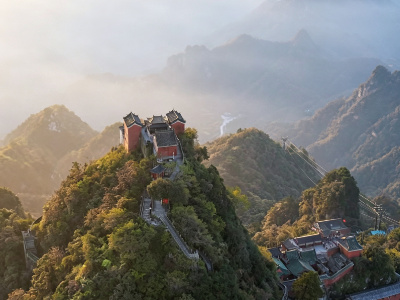
The UNESCO World Heritage property, officially named the Ancient Building Complex in the Wudang Mountains, includes palaces, temples and other historic structures. UNESCO notes that some Daoist buildings can be traced to the seventh century, while the surviving complex represents architectural and artistic achievements across nearly a thousand years.
This heritage provides the historical setting in which Wudang martial culture is understood today. However, the existence of a long-standing Daoist center does not by itself prove that every martial art associated with the mountain originated there. Religious history and martial arts history need to be examined through their own sources.
The Legend of Zhang Sanfeng
Zhang Sanfeng is one of the most famous figures in the traditional stories surrounding Wudang martial arts. He is portrayed in popular accounts as a Daoist master whose understanding of nature, movement and internal cultivation led to the creation of Tai Chi.
One widely circulated version of the story describes Zhang Sanfeng observing a bird and a snake. Their movements are said to have inspired his understanding of flexibility, timing and the ability to respond rather than resist. The details differ between retellings, but the central idea is consistent: effective movement does not always depend on meeting force with force.
The story has considerable cultural significance. It expresses a philosophy of adaptability and has helped shape the way Wudang martial arts are presented to later generations. It also connects the image of the Daoist practitioner with the natural world.
Nevertheless, the Zhang Sanfeng origin story should be understood as a traditional attribution rather than a conclusively established account of the invention of modern Taijiquan. Historical discussions of Tai Chi involve different texts, martial lineages and periods of development. The available evidence does not establish that one individual created the complete art in the form practised today.
Recognizing this distinction does not diminish the legend. It allows readers to appreciate its place in Chinese cultural memory without confusing folklore, religious tradition and documented martial history.
How Did Taijiquan Develop?
Taijiquan, commonly known in English as Tai Chi, developed through Chinese martial arts traditions that became identifiable in historical records during the seventeenth century. UNESCO's description of the art connects its emergence with the mid-seventeenth century in Wenxian County, Henan Province.
Chen-style Taijiquan is central to many accounts of the art's early documented development. Over subsequent generations, different schools and family traditions became established. Among the best-known styles are Chen, Yang, Wu, Wu-Hao and Sun. Each has its own movement characteristics, training methods and historical lineage.
These schools share certain principles, including coordinated movement, changes in weight, controlled posture and the relationship between softness and strength. Yet they are not identical. The pace, structure, technical emphasis and appearance of a routine can differ considerably between styles.
In 2020, Taijiquan was inscribed on UNESCO's Representative List of the Intangible Cultural Heritage of Humanity. The inscription recognizes the art as a traditional practice involving physical techniques, cultural knowledge and transmission between generations. Readers can explore the background in UNESCO's Taijiquan heritage entry.
What Makes Wudang Tai Chi Distinctive?
The term Wudang Tai Chi is often used to describe Tai Chi traditions associated with Wudang Mountain and its martial culture. In contemporary cultural presentations, it is frequently connected with Daoist philosophy, internal cultivation and the relationship between movement and stillness.
It is useful to distinguish this cultural association from the broader history of Taijiquan. Tai Chi has several major styles and transmission lineages, while Wudang martial arts encompass a wider range of practices. The two fields overlap in popular understanding, but they are not interchangeable.
Wudang's distinctive appeal comes partly from the setting in which its martial traditions are presented. The mountain's temples, natural environment and religious history create a context in which physical training is often discussed alongside philosophical ideas about balance, restraint and harmony.
Five Movement Principles Behind Tai Chi
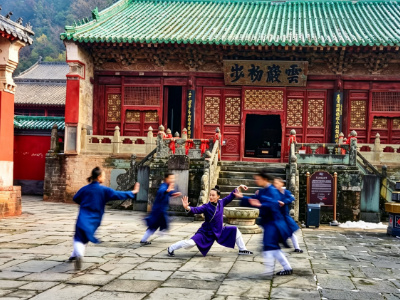
Tai Chi is sometimes described simply as slow-motion exercise. Although its movements are often performed at a measured pace, this description misses much of the skill involved. The practice requires attention to body structure, balance, direction and the relationship between successive movements.
1. Weight Transfer and Rootedness
Weight transfer is one of the foundations of Tai Chi. Practitioners learn to shift their weight between the legs while maintaining a stable and organized posture. The supporting leg provides a base, while the other leg becomes available for stepping or changing direction.
This process involves coordination between the feet, knees, hips and upper body. A controlled transfer of weight helps prevent unnecessary movement and allows transitions to remain connected.
2. Continuous Movement
In many Tai Chi routines, one posture flows into the next rather than stopping abruptly. The hands, arms, torso and legs work in coordination, creating a sequence of connected movements.
Continuity does not mean moving without structure. Each movement has a direction and purpose, and the transitions between postures are an important part of the practice.
3. Relaxation Without Losing Structure
Relaxation is an important principle in Tai Chi, but it should not be confused with collapsing the body or allowing the joints to become uncontrolled. Practitioners aim to reduce unnecessary muscular tension while maintaining an organized posture.
This balance between relaxation and structure is one reason why apparently simple movements can require considerable practice. The aim is not to force the body into a shape, but to coordinate it with greater efficiency and awareness.
4. Coordination of Upper and Lower Body
Tai Chi movements involve more than the arms. Changes in direction and posture are coordinated through the feet, legs, waist and upper body. The hands follow the movement of the body rather than acting independently.
This whole-body coordination gives Tai Chi its distinctive flowing appearance. It also explains why learning a movement involves understanding its structure, not simply copying the position of the hands.
5. The Relationship Between Stillness and Movement
Stillness in Tai Chi is not necessarily the absence of movement. It can also refer to a stable and attentive quality within movement. Practitioners learn to avoid unnecessary tension and rushed transitions, allowing each change of direction to remain controlled.
This relationship between stillness and movement is also a recurring theme in Chinese philosophical traditions. It provides a useful cultural framework for understanding the art, although the technical principles of Tai Chi should also be studied through martial arts instruction and practice.
Daoist Philosophy: Yin, Yang and Wu Wei
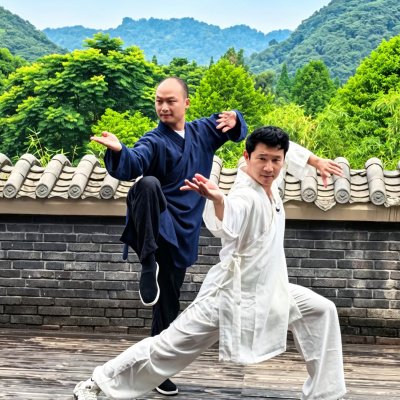
Wudang's association with Daoism has influenced how its martial traditions are interpreted. Several philosophical ideas are frequently used to explain the qualities of internal martial arts, particularly the relationship between opposites and the value of responding appropriately to changing circumstances.
Yin and Yang: Understanding Change
Yin and yang describe complementary aspects of change in Chinese thought. They are not fixed categories in which one side is always better than the other. Instead, they help explain relationships such as stillness and movement, softness and firmness, opening and closing, or fullness and emptiness.
In Tai Chi, these relationships can be observed through the alternation of weight, the direction of movement and the transition between postures. A movement is understood in relation to what comes before and after it.
Wu Wei: The Principle of Non-Forcing
Wu wei is commonly translated as non-action, effortless action or non-forcing. In Daoist philosophy, it does not simply mean doing nothing. It describes an approach to action that avoids unnecessary interference and responds to circumstances with appropriate timing.
When discussed in relation to Tai Chi, wu wei offers a way to understand why practitioners value adaptability over excessive force. A movement should respond to its situation rather than rely on stiffness or tension. This is a philosophical interpretation of the practice, not a claim that every Tai Chi technique directly originated from a particular Daoist text.
Following Nature Without Romanticizing It
Traditional Chinese thought often uses natural images to explain change and balance. Water, wind, trees and seasonal cycles appear in philosophical discussions because they offer ways to observe how things adapt to their surroundings.
Wudang's mountain environment makes these ideas especially visible to visitors. The relationship between architecture, landscape and religious practice provides a cultural setting in which the language of harmony with nature can be explored.
Wudang Martial Arts Beyond Empty-Hand Tai Chi
Wudang martial culture is not limited to empty-hand routines. It is also associated with traditional weapons practice, including sword techniques, as well as other forms of martial training.
Wudang sword traditions are especially prominent in the public image of the mountain. Sword practice requires coordination between the body and the weapon, together with an understanding of direction, distance, timing and controlled movement.
These traditions should be understood within the broader history of Chinese martial arts. The fact that a particular practice is associated with Wudang does not mean that all Wudang schools use identical techniques or follow one uniform system. Martial traditions can vary between teachers, lineages and training communities.
Learning Tai Chi: Beyond Memorizing a Routine
For a beginner, learning Tai Chi often starts with observing and remembering a sequence of movements. This is a useful first step, but memorizing the external shape of a routine is not the same as understanding the practice.
As learning develops, attention turns to the details that connect each posture: where the weight is placed, how the body changes direction, whether the joints remain comfortable and how the movement flows from one position to another.
It is also important to distinguish between Tai Chi as a personal movement practice and Tai Chi as a martial art. Many people learn forms for cultural interest, gentle physical activity or personal development. Martial training may also include applications, partner exercises, sensitivity, distance and timing.
Neither approach should be reduced to the other. Understanding the purpose of a particular class or tradition helps learners choose an appropriate way to study.
Explore Wudang Tai Chi and Daoist Culture with Funzendo
Wudang Mountain offers an opportunity to explore the relationship between Chinese martial arts and Daoist heritage in a setting closely associated with both traditions. Its significance extends beyond the story of Zhang Sanfeng: the mountain's historic buildings, religious culture and martial arts identity provide a wider context for understanding Chinese internal arts.
Funzendo's Wudang Tai Chi and Daoist Wellness Retreat in China connects Tai Chi practice with the cultural environment of Wudang Mountain and other destinations associated with traditional Chinese culture. The program brings together martial arts practice, Daoist heritage, mountain landscapes and cultural experiences.
Visitors interested in other heritage journeys can also explore the Funzendo Zen Pilgrimage programs, which introduce different destinations and traditions across China.
Understanding Wudang Tai Chi Through History and Practice
Wudang Tai Chi is best understood through several connected perspectives. The mountain's Daoist heritage provides an important cultural setting; the Zhang Sanfeng story expresses a powerful traditional interpretation of the relationship between nature and martial practice; and the historical development of Taijiquan reveals a wider process involving martial communities, teachers and different schools.
For international learners, separating documented history from cultural legend makes the subject clearer rather than less meaningful. Tai Chi can be appreciated as a martial art and a movement tradition, while Wudang Mountain can be explored as one of China's most important centers of Daoist architectural and religious heritage.
By approaching both with curiosity and historical awareness, visitors can gain a richer understanding of the traditions that have made Wudang an enduring symbol of Chinese culture.