How Does Buddhist Philosophy Explain the Self?
A core question in contemplative practice is "What am I?" The answer provided by Buddhist philosophy is both direct and profoundly different from many Western perspectives. Instead of identifying a permanent, unchanging soul or ego, it deconstructs our experience of "self" into a collection of interacting, impermanent processes. Understanding this concept, known as anattā or "no-self," is not an abstract intellectual exercise; it is a practical foundation for developing greater mindfulness, emotional balance, and resilience.
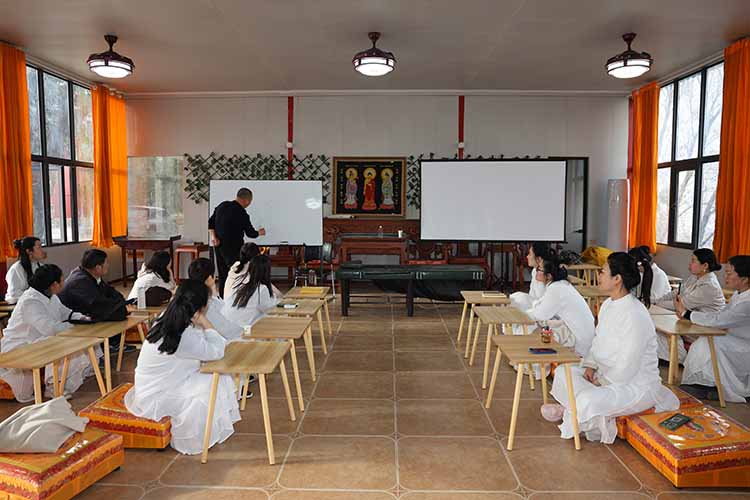
This framework is central to the contemplative traditions we explore at Funzendo. Through practices like meditation and mindful living, one can directly observe the components of the self in action. Our programs, hosted in the authentic setting of Longmen Guanghua Temple, provide an immersive environment for international guests to engage with these foundational ideas of Chinese contemplative traditions.
Deconstructing Experience: The Five Aggregates (Skandhas)
Rather than starting with a conclusion about a fixed self, Buddhist analysis begins by examining the raw data of our experience. It categorizes every moment of consciousness into five distinct groups, known as the five aggregates or skandhas. The "self" we perceive is simply the temporary coming-together of these five dynamic elements. There is no separate, independent "I" standing behind them; the collection *is* the experience of selfhood. Understanding these components is the first step in seeing through the illusion of a solid identity.
This analytical approach is a key part of what participants explore during a temple stay, where the structured environment helps quiet the mind enough to notice these subtle internal processes.
- Form (Rūpa): This includes the physical body and all material phenomena—sights, sounds, smells, tastes, and tangible objects. It is the aggregate of matter.
- Sensation (Vedanā): This refers to the feelings that arise from contact between our sense organs and external objects. These are categorized as pleasant, unpleasant, or neutral. It is the raw feeling, before judgment or story is applied.
- Perception (Saññā): This is the faculty of recognition and labeling. When you see a color and recognize it as "blue," or hear a sound and identify it as "a bell," that is perception at work. It organizes the raw data from our senses.
- Mental Formations (Saṅkhāra): This is a broad category that includes all volitional activities, such as thoughts, intentions, biases, habits, and desires. It is the momentum of the mind, shaping our reactions and future actions.
- Consciousness (Viññāna): This is the fundamental awareness that cognizes the other four aggregates. It is the knowing faculty that arises when a sense organ, a sense object, and the other mental factors are present. It does not exist independently but is always consciousness *of* something.
The Doctrine of No-Self (Anattā) vs. Common Misconceptions
The doctrine of no-self is perhaps the most frequently misunderstood concept in Buddhist philosophy. It does not mean that you do not exist, nor is it a call for nihilism or the annihilation of the person. Instead, it is a precise description of *how* you exist—not as a static noun, but as a dynamic verb. The "self" is a process, not a thing. This distinction has significant implications for personal development, leadership, and wellness. Misinterpreting it can lead to confusion and incorrect practice. The following table clarifies these critical differences.
| Concept | Core Idea | Practical Implication |
|---|---|---|
| No-Self (Anattā) | The "self" is a conventional label for the interdependent, impermanent flow of the five aggregates. There is no fixed, independent, or unchanging essence. | Reduces clinging and attachment to outcomes, identity, and opinions. Fosters empathy and adaptability by showing that "self" and "other" are not rigid categories. This is the goal of mindfulness. |
| Permanent Soul (Ātman) | There is an eternal, unchanging essence or soul that constitutes a person's true identity. This soul persists beyond the physical body and mental states. | Encourages identification with this permanent essence, often leading to attachment to personal identity and a view of the self as separate from the world. |
| Nihilism | Nothing truly exists; there is no meaning, no moral law, and no consequence for actions. The self is a complete illusion, and therefore, nothing matters. | Leads to apathy, despair, and an abdication of ethical responsibility. This view is explicitly rejected in Buddhist teachings. The doctrine of karma directly refutes this. |
| Everyday Personal Identity | The conventional self we navigate the world with—our name, history, personality, and roles. This is our functional, social identity. | Buddhism acknowledges this conventional self as necessary for daily life. The "no-self" doctrine does not deny this functional identity but explains its ultimate nature as a fluid process, not a solid entity. |
Practical Applications in Wellness and Professional Development
Understanding the fluid nature of the self has direct, tangible benefits in both personal wellness and professional contexts. For corporate teams and leaders, this perspective offers powerful tools for managing stress, improving communication, and fostering a more resilient organizational culture. When we stop defending a rigid, fixed idea of "who we are," we become more open, adaptable, and effective. This is why our Zen Meditation & Mindfulness programs are designed to be accessible for beginners, providing practical breathing and awareness techniques to observe these principles firsthand.
At Funzendo, we integrate these philosophical underpinnings into our experiences. For instance, our Unique Sound, Tea & Zen Integration combines multiple modalities to facilitate this insight. A guided singing bowl sound healing session encourages mindful listening and inner calm, creating a state where the constant flow of thoughts (mental formations) can be observed without judgment. Similarly, our Authentic Chinese Tea Ceremony, built on over 10 years of practice, blends traditional culture with Zen philosophy, transforming a simple act into a mindful ritual of presence and attention. These immersive experiences introduce guests to chinese traditional culture training not as history, but as a living practice for modern challenges.
Common Pitfalls in Applying the Concept of No-Self
While the concept of no-self is liberating, beginners on the path often fall into predictable traps. These misunderstandings can hinder progress and lead to a skewed application of the philosophy. For organizations or individuals incorporating these ideas into wellness programs, being aware of these pitfalls is essential for effective guidance.
- Mistake 1: Intellectualizing Instead of Experiencing. Simply reading about and agreeing with the doctrine of no-self has little impact. The transformation comes from directly observing the impermanent, interdependent nature of the five aggregates through sustained mindfulness and deep Zen meditation retreat practices. The concept is a map; it is not the territory.
- Mistake 2: Using No-Self to Justify Apathy. A common error is to conclude, "If there is no self, then my actions don't matter." This is a slide into nihilism. Buddhist philosophy strongly emphasizes causality and ethical responsibility (karma). The point is not to deny agency but to purify intention from ego-driven clinging.
- Mistake 3: Aiming for a State of "Blankness." The goal of observing no-self is not to obliterate thoughts, feelings, or personality. It is to see them for what they are: transient phenomena. The aim is clarity and non-attachment, not a state of void. This allows for more authentic and compassionate engagement with the world.
- Mistake 4: Confusing No-Self with Low Self-Esteem. The doctrine is not a judgment on one's worth. It is a neutral, objective description of reality. In fact, letting go of a fixed, needy ego often leads to a more stable and genuine sense of well-being, free from the constant need for validation.
Avoiding these errors requires guidance and a proper environment for practice. This is why structured programs, from a 3 day meditation retreat China for beginners to longer residencies, are so valuable.
The Buddhist explanation of the self is not a denial of life but an invitation to experience it more fully and freely. By deconstructing the illusion of a fixed, separate self, we open ourselves to a more connected, compassionate, and resilient way of being.
To explore how these principles can be integrated into a customized wellness program or cultural journey for your organization, please contact us for a detailed consultation.