Buddhist Philosophy Traces the Causes of Suffering Through Dependent Origination
Buddhist Philosophy asks a specific causal question that most Western frameworks skip over: not just "why do I suffer" but "what exact sequence of conditions produced this particular moment of suffering." The answer, laid out across early Buddhist texts, is dependent origination — in Sanskrit, pratityasamutpada. This is not a vague statement about everything being connected. It is a twelve-step causal chain, and each step does something specific. Understanding where each link sits, and what happens when a practitioner misreads it, is the difference between intellectual appreciation and a framework you can actually apply to a reactive thought as it happens.
What Is Dependent Origination in Buddhist Philosophy?
Dependent origination is the teaching that no experience arises on its own. Every mental state, every craving, every moment of aversion depends on prior conditions, and those conditions depend on conditions before them. Buddhist philosophy uses this chain to explain Buddhist causes of suffering without resorting to a first cause or a fixed self generating the experience. At Longmen Guanghua Temple, where the Tang dynasty master Subhakarasimha was once laid to rest, this causal reasoning sits underneath much of the esoteric transmission still taught there. Teachers trained in that lineage treat dependent origination less as doctrine to memorize and more as a diagnostic tool — a way to trace a specific feeling of frustration or craving back to its actual conditions, rather than to a story about who caused it.
The Twelve Links Buddhism Maps Across the Causal Chain
The twelve links Buddhism identifies are sequential, though in practice they loop rather than run in a straight line. They are: ignorance, formations, consciousness, name-and-form, the six sense bases, contact, feeling, craving, clinging, becoming, birth, and aging-and-death. Each link conditions the next. Ignorance shapes the formations we carry into experience. Those formations shape how consciousness lands on an object. Name-and-form shapes the sense bases, which generate contact, which generates feeling. From feeling onward, the chain shifts from passive conditioning into active reactivity — this is where most practical intervention happens, and where Buddhist philosophy puts the bulk of its instruction.
How Does Dependent Origination Work Link by Link in Practice?
This is the part most introductions skip, and it is the part that actually matters for practice. Each link is not just a definition — it is a function. Get the function wrong, and the practitioner either over-blames external triggers or tries to suppress a link that was never the actual problem. The table below maps what each link does, how it reinforces a reactive habit if left unexamined, and where a practitioner can realistically interrupt the cycle.
| Link | What It Describes | How It Reinforces Reactive Habits | Where the Cycle Can Be Interrupted |
|---|---|---|---|
| Ignorance | Not seeing experience as conditioned | Sets the baseline assumption that reactions are justified and permanent | Study and reflection; rarely interrupted mid-reaction |
| Formations | Habitual mental and physical patterns | Pre-loads a response before the situation even arrives | Long-term meditation practice, not single sessions |
| Consciousness | Bare awareness landing on an object | Carries the imprint of past formations into the new moment | Difficult to isolate; shows up as "automatic" attention |
| Name-and-form | Mental and physical components of experience | Frames the object before any judgment is applied | Not a practical intervention point for beginners |
| Six sense bases | Eye, ear, nose, tongue, body, mind as contact points | Determines which stimuli even register | Sense-restraint practices; limited daily control |
| Contact | Sense meeting object meeting consciousness | Triggers the first spark of an experience | Noticing contact itself, before reaction forms |
| Feeling | Pleasant, unpleasant, or neutral tone | Supplies the emotional pull that drives the next step | First realistic intervention point — pausing here is the core instruction in most beginner meditation training |
| Craving | Wanting more of pleasant, less of unpleasant | Converts a neutral feeling into a demand | Second intervention point — recognizing craving before it hardens into clinging |
| Clinging | Grasping at craving as identity or necessity | Locks the reaction into "I need this" rather than "this arose" | Harder to interrupt once established; requires sustained practice |
| Becoming | Momentum toward a future action or identity | Builds the sense of a self that must act on the craving | Rarely interrupted directly; prevented upstream |
| Birth | The arising of a new state, action, or identity | Manifests the reaction as speech, action, or self-concept | Consequence stage, not an intervention point |
| Aging and death | The decay of that arisen state | Feeds back into ignorance for the next cycle | Reflection after the fact, seeding future awareness |
The practical mistake most beginners make is trying to intervene at "ignorance" or "clinging" — the two links that sound most important philosophically but are the hardest to work with directly. Feeling and craving are where actual leverage exists, because they are brief, repeatable, and noticeable in ordinary experience. This is also why most structured meditation instruction, including the breathing and awareness drills used in a traditional Chan meditation retreat, spends so much time on noticing feeling-tone before reaction, rather than trying to argue a practitioner out of ignorance directly.
Common Mistakes When Reading Buddhist Causes of Suffering
- Treating the chain as strictly linear: the twelve links loop and overlap; a single day can cycle through feeling to craving to clinging several times over one unresolved email.
- Confusing dependent origination with fatalism: conditions produce effects, but conditions can be changed — that is the entire point of practice, not a statement that suffering is fixed.
- Skipping the craving-clinging distinction: craving is a pull; clinging is identifying with that pull. Missing this distinction makes the whole framework feel abstract instead of actionable.
- Assuming ignorance means stupidity: in Buddhist philosophy, ignorance (avidya) refers specifically to not perceiving conditionality — it is a perceptual gap, not an intelligence gap.
A Worked Scenario Showing the Chain in Daily Life
Consider a procurement manager who receives a delayed shipment notice. Contact happens the moment the eyes meet the email. Feeling arises almost instantly — unpleasant, because the notice threatens a deadline. Craving follows within seconds: a pull toward resolving the discomfort, usually by blaming someone. Clinging shows up if the manager identifies with the frustration — "this is ruining my week" — rather than noting it as a passing reaction. Becoming is the mental rehearsal of an angry reply. Birth is sending that reply. Aging and death is the regret an hour later, which seeds the next reactive cycle. The entire sequence, from contact to birth, often takes under thirty seconds. The only realistic place to interrupt it is at feeling or craving — which is exactly why breathing-based pause techniques, rather than willpower, are what gets taught in a structured retreat setting.

Where Practitioners Study This Framework Experientially
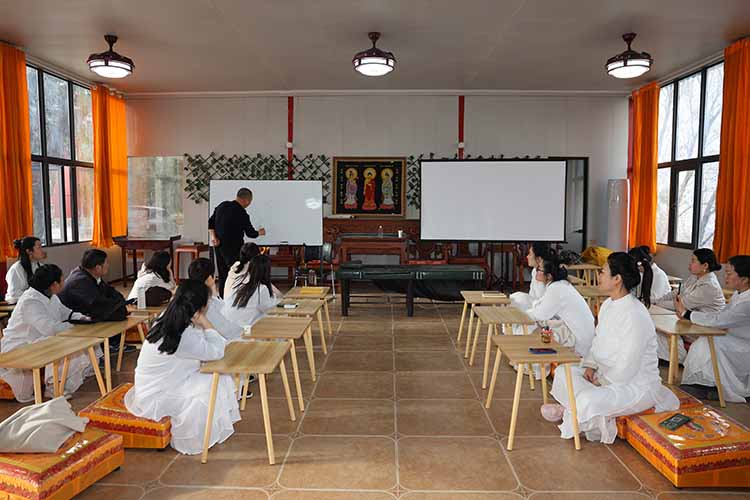
Reading about dependent origination rarely changes a reaction pattern on its own. Most learners need repeated, guided exposure to notice feeling and craving as they arise, rather than after the fact. This is the gap that structured temple programs are built to close. A Zen temple stay in China places participants inside a daily schedule where sitting meditation, walking practice, and silence reduce the number of competing stimuli, making the feeling-to-craving gap easier to observe. Corporate wellness groups often choose a 7 day Zen retreat China format specifically because a single afternoon session is rarely enough for the pattern to become visible — it tends to take several consecutive days before participants notice the gap between contact and reaction on their own. For groups wanting deeper historical grounding alongside the practice, a Longmen Zen pilgrimage tour pairs the causal teaching with the actual site where it was transmitted through the Tang dynasty Esoteric lineage.
A Learner's Checklist Before Choosing a Retreat or Program
- Confirm whether the teaching includes the twelve links explicitly, or only a general meditation overview — ask for the daily schedule in advance.
- Check group size: smaller cohorts allow more individual feedback on where a participant's reactive pattern is forming.
- Ask whether the program separates sitting instruction from applied scenario work — both matter, and one without the other limits transfer to daily life.
- Clarify duration. A single-day session teaches the concept; multi-day formats, such as a Buddhist fasting retreat, are built for the pattern itself to surface repeatedly.
- Verify the teaching lineage. Programs connected to an established temple setting, rather than a generic wellness venue, tend to anchor the philosophy in its original context rather than a simplified summary.
Teams designing a cultural itinerary around this material should also consider pairing it with a Chinese tea meditation practice, since the slow, procedural nature of a tea ceremony offers a low-stakes setting to practice noticing feeling before reaction — the same mechanism described in the twelve links, applied to a cup of tea rather than an email.
FAQ About Dependent Origination and Buddhist Philosophy
Is dependent origination the same as karma? They are related but not identical. Karma refers to intentional action and its consequences; dependent origination is the broader causal structure explaining how any phenomenon, including a karmic result, arises from conditions. Buddhist philosophy treats karma as one application of the larger causal principle, not a separate system.
Can the twelve links be studied without a teacher? Reading the sequence is straightforward. Noticing it in real time, particularly the feeling-craving gap, is harder without guided feedback. Most learners benefit from sitting practice under instruction, such as what is offered through a deeper Buddhist meditation practice, before attempting to apply the framework independently.
How is this different from general mindfulness training? General mindfulness often stops at noticing a feeling. Dependent origination asks what produced that feeling and what the feeling will produce next, which gives practitioners a specific point in the chain to work with rather than a general instruction to "be present."
If your organization is planning a retreat, pilgrimage, or corporate wellness program built around this material, contact our program team for guidance on which format and duration fits your group's goals.