How to Start Qigong Safely With Standing or Seated Practice
Qigong raises one practical question for almost every wellness planner before a session is even scheduled: should participants stand, sit, or move between both? The answer determines who can safely join, how long a session should run, and what equipment a room needs. This article answers that question directly, with a format comparison, a step-by-step beginner routine, and the planning details a wellness operator or retreat coordinator needs before booking a class.
What Is Qigong?
Qigong is a Chinese practice combining slow, deliberate movement, controlled breathing, and focused attention, rooted in Traditional Chinese Medicine concepts of circulating internal energy, or qi. Unlike high-intensity fitness formats, it relies on posture, breath pacing, and gentle repetition rather than strength or flexibility thresholds. This is why it suits mixed-ability groups better than most movement disciplines. At Funzendo's programs based at Longmen Guanghua Temple, breathing and movement work of this kind is taught alongside Taoist wellness and TCM wellness training, giving participants a grounded, low-barrier entry point into Chinese contemplative practice before they move into deeper meditation or temple-based study.
Standing Qigong vs Seated Qigong Which Fits Different Mobility Levels
This is the single decision that determines inclusivity for a group session. Standing qigong builds more postural engagement and is the traditional default, but it assumes a participant can hold weight on both legs for 15 to 20 minutes with brief rest breaks. Seated qigong removes that requirement almost entirely, making it workable for older adults, participants recovering from injury, or anyone in a chair-based office environment. Neither format is "better" in absolute terms — the right choice depends entirely on the group in front of you.
| Factor | Standing Qigong | Seated Qigong |
|---|---|---|
| Mobility requirement | Able to stand unsupported for extended periods | Minimal — works from a chair or stool |
| Balance demand | Moderate to high, especially in weight-shifting forms | Very low, spine and arm movement only |
| Best suited for | Active adults, retreat groups, outdoor sessions | Office wellness breaks, elderly groups, post-injury participants |
| Typical session length | 20 to 30 minutes including rest intervals | 10 to 20 minutes, easy to repeat throughout a workday |
| Main limitation | Excludes participants with balance or joint restrictions | Limits full-body circulation movements like weight shifting |
A practical rule for operators: if more than a third of a group has limited standing tolerance, default to seated qigong or offer both formats within the same session and let participants choose their position. This single adjustment resolves most accessibility complaints before they happen.
Core Elements of a Gentle Movement Practice
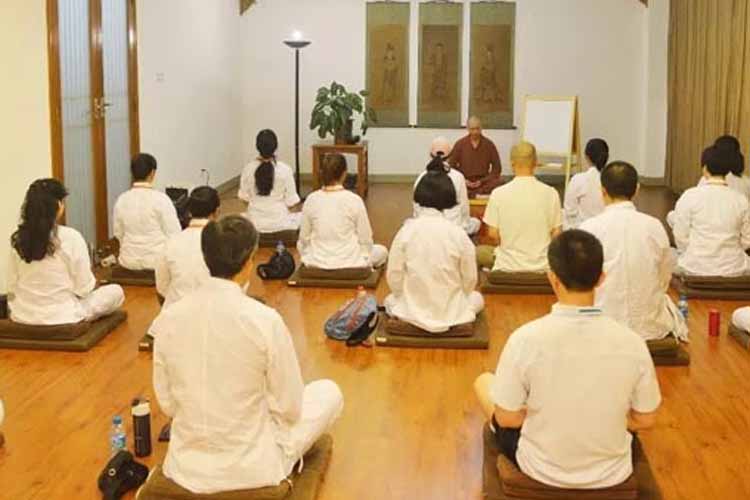
Every qigong session, standing or seated, rests on three elements: breath pacing, slow repetition, and relaxed attention rather than strict alignment. Breath is usually paced to the movement — inhaling on an opening gesture, exhaling on a closing one — rather than counted in seconds, which keeps the practice approachable for first-time participants. Movements repeat in short cycles, typically six to eight repetitions per form, so beginners can learn by following rather than memorizing. This is also where qigong connects naturally to other mindfulness formats; many wellness programs pair a short qigong warm-up with seated breathing work before guests explore a deeper Buddhist meditation practice. The gentle movement practice format works precisely because it does not demand prior training, flexibility, or athletic background.
How to Build a Beginner Qigong Routine
A workable beginner qigong routine follows a fixed sequence rather than an open-ended flow. The steps below are a standard structure used across most introductory formats.
Settle and breathe (2 minutes). Participants find their stance or seated position and take five slow breaths. Common failure: starting movement before breathing has settled, which carries over tension from before the session.
Warm the joints (3 to 5 minutes). Shoulder rolls, gentle neck turns, and wrist circles. Common failure: skipping this step for time, which increases discomfort in the next phase for participants with stiff joints.
Core movement set (10 to 15 minutes). Two or three repeating forms, led slowly with verbal cues matched to breath. Common failure: instructors moving faster than the group's breath pace, which turns the practice into exercise rather than mindful movement.
Stillness and closing (3 to 5 minutes). A short period of standing or seated stillness to let the nervous system settle. Common failure: ending abruptly without this transition, which participants often report as the least satisfying part of a rushed session.
This structure also transfers directly into multi-day formats. Guests who begin with a short routine like this often continue into a full 3 day meditation retreat China once the basic breath and posture habits are established.
Where Qigong Fits Into a Wellness Program
For wellness operators and corporate program designers, qigong usually serves as a bridge activity — something low-risk enough to open a session, yet substantial enough to stand on its own as a scheduled module. Three scenarios cover most bookings: a corporate wellness break where employees rotate through a 15-minute seated routine at their desks; a retreat morning block combining standing qigong with breathing instruction before a full meditation sitting; and a temple-based immersion where guests experience daily Buddhist temple life alongside movement and tea practice. Before booking a format, run through this checklist:
What is the average mobility range of the group — mixed, mostly active, or mostly limited?
Is the session a standalone activity or a lead-in to deeper training, such as experience Taoist wellness and breathing practices?
Is there floor space for standing forms, or only seating/desk arrangements?
Does the group need repeat sessions (weekly corporate break) or a single immersive block (retreat day)?
Answering these four questions before scheduling prevents the most common planning mistake: booking a standing-only format for a group that cannot comfortably sustain it.
Planning Considerations and Cost Factors for Group Sessions
Cost for a qigong session or series is driven less by the practice itself and more by the surrounding program design. The main variables operators should budget around are:
Session length and frequency — a single 20-minute session costs less to arrange than a recurring weekly series, but recurring series build habit and retention for corporate wellness clients.
Group size and instructor ratio — seated qigong in an office setting can run with a single instructor for larger groups, since movement correction needs are lower than standing forms.
Venue requirements — standing sessions need clear floor space and non-slip flooring; seated sessions can run in existing meeting rooms with no setup changes.
Integration with other modules — bundling qigong into a larger program, such as explore mindful movement and standing meditation, typically costs less per session than booking it as an isolated add-on.
Operators planning multi-day itineraries should request a breakdown that separates instructor time, venue, and any bundled cultural modules like tea or incense practice, rather than a single flat figure — this makes it easier to adjust group size or duration without renegotiating the whole package.
Qigong Program Guidance From Funzendo
Funzendo structures its movement and breathing instruction within the Taoist wellness and TCM wellness training offered at Longmen Guanghua Temple, where guests can combine short gentle movement sessions with Chan meditation, tea practice, and temple residency. This setting lets operators scale a program from a single introductory session to a full multi-day format, including a 7 day Zen retreat China that layers qigong, breathing work, and seated meditation across a structured schedule. Group bookings and individual reservations are both available, with scheduling dependent on the specific training course or retreat itinerary selected. If you are looking for a reliable Qigong program partner for a retreat, corporate wellness series, or temple-based cultural module, please contact us anytime to get the latest availability and quote.
FAQ of Qigong
Can beginners switch between standing and seated qigong within the same session? Yes. Many groups start standing for the warm-up and shift to seated positions for the stillness phase, particularly when the group includes participants with mixed mobility. This blended approach is common in corporate wellness settings and does not require separate instructors.
Is prior meditation experience needed before starting a beginner qigong routine? No. Qigong's breath-paced, repetitive movement structure is designed as an entry point, often used before guests attempt longer seated meditation blocks or a full Zen retreat format.
How many participants can one instructor manage in a seated qigong session? Seated formats generally scale to larger groups than standing ones, since balance correction is not required — though exact ratios depend on room layout and the specific training course booked.